womb in purgatory – ingrid calderon

fullsizeoutput_1ff7 (1).jpeg

(a spin-off of Eggs in Purgatory)

Ingredients

1 tablespoon of extra-virgin sacrosanct
½ medium ego, chopped
1 cup of depression
1 clove of laughter, minced
¼ teaspoon of anger
1 teaspoon suicide
½ teaspoon freshly ground prayers
¼ cup fresh cemetery dirt, finely chopped
4 large wombs
¼ cup grated afterlife

Instructions

Drizzle sacrosanct into skillet set over medium heat.

Once it begins to shimmer, add in the ego and cook until tender, about 3 minutes.

Stir in the anger, minced laughter, and depression.

Sprinkle the teaspoon of suicidal ideation and allow the mixture to thicken, about 5 minutes.

Break a womb into a small bowl and using a large spoon, make an indention in the angry mixture. Repeat with the remaining wombs.

Top with grated afterlife and prayers.

Cover skillet and cook until the wombs set and are cooked to the desired level of doneness.

Remove skillet from the heat.

Sprinkle with remaining cemetery dirt and serve.

cropped-dead-bird-clip-art.jpg

Ingrid is a Salvadoran poet & refugee residing in Los Angeles. She’s published in OCCULUM, Electric Cereal, Dryland, Seafom Mag, Memoirmixtapes, Punch Drunk Press, Moonchild Magazine, Anti-Heroin Chic, Bad Pony Mag, L’Éphémère Review amongst others etc… Guilty of four full-length poetry books entitled ‘Things Outside’, ‘Wayward’ ‘Zenith’ & ‘Ablution.’ She invites you to stalk her on Twitter at @BrujaLamatepec and to read her rants at notesofadirtyyoungwoman.com

Photo: “Tidy notes led me astray”, also by Ingrid Calderon

three poems – john dorsey

wind

Where the Prom Queen Ends Up or Poem for Kristen

there is nobody waiting outside
the cowboy cafe & truck stop
to bring you flowers
or even offer you their coat
on a rainy afternoon
in lyman wyoming

most mornings you are
the first thing the sun sees
no matter when you punch in
& time stands still just long enough
for you to remember
how you ended up here

how this was just supposed to be a summer job
how calendars can bend the will of any ambition
how your thighs were once a temple of worship

stray dogs still sniff your ass
for that last scent of beauty
for that last slice of cherry pie
made holy by your touch

at least once a day
you are still
the most beautiful woman in the world
depending on who you ask

& if the wind kicks up just right
in any direction
you are still magic.


The Ballad of Pegleg & Double Stamp

as we drop him off at the greyhound
crazy mark says that the whole country is on fire

just outside the station
a legless vietnam vet asks a young girl
where she got her tattoos done

& i think maybe she’s a prostitute
or maybe she just looks like his daughter

or the high school sweetheart
he left on prom night
to wander into a jungle
of regret

that’s the thing about flames
you can move in any direction
& still end up
in places you never
intended to go.


Free as a Bird
for eric roetter

the image i have
in my heart
is you flying
through city streets
on your bicycle

before daylight
before heroin

the birdman of broad street

i’ll tell ya brother
you were already pure.

cropped-dead-bird-clip-art.jpg

John Dorsey lived for several years in Toledo, Ohio. He is the author of several collections of poetry, including Teaching the Dead to Sing: The Outlaw’s Prayer (Rose of Sharon Press, 2006), Sodomy is a City in New Jersey (American Mettle Books, 2010), Tombstone Factory, (Epic Rites Press, 2013), Appalachian Frankenstein (GTK Press, 2015) Being the Fire (Tangerine Press, 2016) and Shoot the Messenger (Red Flag Press, 2017). He is the former Poet Laureate of Belle, MO and Co-Editor, with Jason Ryberg, of the Gasconade Review. His work has been nominated for the Pushcart Prize. He may be reached at archerevans@yahoo.com.

Photo: Abigail Lynn

art – mikhail s.k.

Artist’s Statement:

e t h o s

As I grow older, I begin to understand that core mechanics of all things – from business, to politics, religion, even interpersonal relationships – all boil down to psychology, and the strange nature of the mind. Human consciousness is a bizarre and fascinating place. Fragile as it is, it can be a powerful force. It creates and imposes meaning from nothing but conjured-up thoughts, and distorts our perception of the world and ourselves. I believe, these ‘distortions’ produced by the mind are reflections of its own state – a subconscious cry. I redirect my own curiosity via something between glitch art, and surrealism, flirting with themes of the subconscious.

This slideshow requires JavaScript.

cropped-dead-bird-clip-art.jpg

Mikhail SK is an industrial designer, who has been an illustration artist since childhood. His work often revolves around humanism, and expressed via psychological surrealism. Being a multi-media artist, Mikhail draws a lot of inspiration from the various methods and techniques of his craft, and then translates them into visceral experimentation in his art. As he delved into his studies in architecture and work as a carpenter, his way of thinking gradually shifted to a calculated, pragmatic, approach which although is design-oriented, still seeps into his art. www.msk.design

RATTY or the errands end – meredith counts

counts

An homage to Edward Gorey.

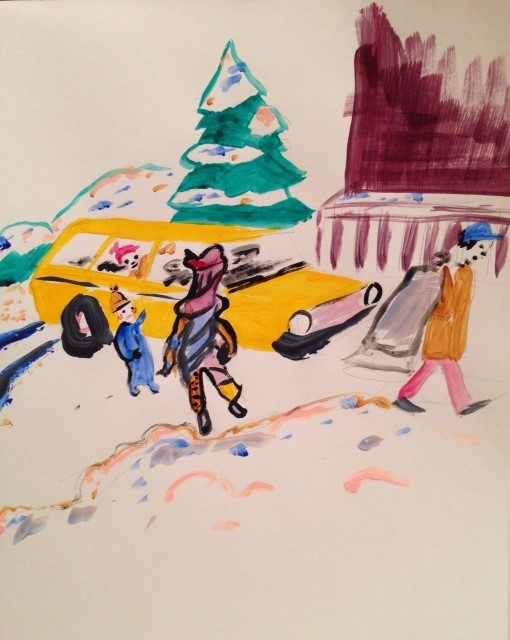
Their dad was running errands in town and insisted that the kids come along. They had been to the dry cleaner to drop off Wraddey’s dragon suit to see what could be done about the ink stains. They’d been to the butcher for sausage, the hardware for tacks, and the place that sold glow-in-the-dark soda. It wasn’t that their dad wanted their company, Wraddey thought, so much as that he remembered what a mess they’d made last time they’d stayed home unattended. Weeks later their father complained he still found marshmallow in crevices about the house, and he wasn’t happy that Wraddey had pasted over every reachable inch of her room with the funnies.

In the backseat of the station wagon, Wraddey felt so bored that she might disappear into the seat, that’s how sick of things she was. Her big brother Egor elbowed her to get her attention. As she reeled back to sock him for touching her she saw the stranger wading through the high piles of snow. Wraddey liked to fight her brother, but it had been a long and relentlessly dull winter. Both children were so hungry for something out of the ordinary to happen that the fight melted away.

“Do you see…?” Wraddey started to say.

“But who…?” Egor asked.

Wraddey shushed him.

Teetering through the dirty snow on the side of the road, whoever-it-was wasn’t wearing a coat or boots, but was cocooned in yards and yards of fabric. Every bit of the person was wrapped up, and except for a purplish brown velvet, most of the wrappings were clashing patterns. No nose or wrist or eyeball, no feature to be seen. As the car passed, the kids turned to keep looking.

“Huh,” Egor said.

“Wow,” Wraddey said.

“Huh?” said their father from the driver’s seat.

The person grew smaller through their wide rear window. Then they turned into a parking lot and the strange person was out of sight.

Their dad ran in to check on a watch he was having fixed. The kids waited in the car, admiring the neon line drawings of jewels in the window of the tiny shop, and listened to the radio. From her seat in the back, Wraddey put her feet up on the center console. Egor kicked Wraddey’s boot and started to scold her.

“Dad wouldn’t let you–“

“Shut up. Look!.”

“I’ll tell him you’re putting your – “

“Shut up and look, Eeg. Who is that?”

The stiff figure crossed the jeweler’s parking lot. Wraddey wondered out loud if they were walking backwards, the way she did when it was windy at the bus stop. Maybe that’s why they were going so slowly, why their knees didn’t bend.

She waved but the figure didn’t respond. It wasn’t possible for Wraddey to tell if she was unseen or being ignored. But you know how being ignored can stoke your interest.
Their dad returned, satisfied and whistling. He was old-fashioned even as far as fathers went – he wore a watch, their car didn’t drive itself, he whistled to an actual FM radio station. Then he whistled a song that wasn’t the song on the radio, then he whistled through the people asking for donations to the radio station. At one point Egor started whistling, then Wraddey tried too though she’d never quite got the knack of whistling (she was only eight) and their father told them to cut out all that racket.

They passed the strange person up ahead one last time. Even from a distance, the scraps and scarves and sheets covering the covered up person didn’t look homeless. From elsewhere, maybe, but not weathered.

Then their always steady, never-impulsive father was in such a good mood that he impulsively swerved over to the side of the road, rolled down the window, and offered that fascinating bundled-up person a lift.

The person was tall, and bent sideways to peer into the open window. The head, scarves on top and scarves on bottom sandwiching huge blue blocker sunglasses in between, seemed to nod. Their father leaned across the passenger seat, opening the door from the inside so the person could climb in.

They lived near a prison and never picked up hitchhikers, let alone wobbly mysterious persons wrapped up like fragile treasure with no single centimeter of skin to be seen.
The figure sat tall in the passenger seat, head skimming the roof, looking forward. Winter air flooded the car, for the person hadn’t closed the door after climbing in. Dad stared at the person. The person stared ahead, making no moves toward the door or otherwise.

“Um, allow me, I guess,” their father said, exiting and going around to close the door.
Wraddey giggled. Her brother belted her for it, but their father’s guest didn’t seem to notice.

The car filled up with the smell of an apple orchard past its season and also of mothballs like at their aunts’ house and wet wool and something like cheap warm cheese.
Dad asked “So where can we drop you off?” but the person only looked forward, so Dad filled the car with chit chat.

“Cold enough for ya?”

“Been a hell of a winter.”

It was a chattering sort of aimless talk, their dad was filling silence and gaining no answers. The children kept a very close eye on the stranger, but they offered no response. Not a word.

“Yes, sir-ee.”

“Where’d you say you’re headed?”

Nothing.

Their father was unsettled. He couldn’t tell if the person was stupid or deaf or dangerous, or scariest of all – silently judging him to be not worth a response.

“Are we, uh, headed in the right direction for ya?”

From the backseat, Wraddey thought she heard a faint scratching sound.

“Well, uh, say, we’re close to home. We can drop you off there, or, uh…” He paused for a moment, then finally said “Would you like to come in and warm up?”

The person’s head fell violently downward. The one harsh nod sent a puff of that rotten apple smell into the cold air of the backseat.

Impressive! Wraddey thought. By ignoring their father, the stranger had bullied him into an invitation inside. They hardly ever had a visitor. If someone did come over, it was in sensible parkas and those visitors had faces.

In the driveway the person sat stone still again, so that father told Egor to go around and open the passenger side door and let “their friend” out.

“I can do it!” Wraddey yelled.

She was closest, but moreover she wanted to be the one to do it.

While father went ahead with the dry cleaning bags to unlock the door, Wraddey opened the passenger side door to let the stranger out. Both feet swung out together like the tines of a tuning fork, then they found purchase on the snowy drive and the whole body lurched up and out. Wraddey said “follow them,” pointing to the guys, followed, watching closely. Wraddey followed the tiny footprints in the snow that looked more like a deer’s than a person’s.

In the house, the stranger clomped over to the davenport and sat, imperiously, down.

“Make yourself at home,” father said with some sarcasm.

The stranger didn’t even look at him.

“Maybe I’ll, uh, put a snack together then?”

The figure nodded that violent nod.

Feeling he was being had, the children’s father disappeared into the kitchen, searching for some unstale crackers for their silent guest. Wraddey thought that she was going to try the stranger’s approach the next time she wanted something.

Egor stood shuffling by the door in his thick winter socks.

Wraddey sat down on the couch next to their guest.

“Hello,” she said, in her soft voice.

It was only when she reached out and laid a hand on its leg that the figure jerked around and pointed its head at her. When it raised its arm, Egor knew it was going to pull his sister’s brain out through her nose, but the arm stopped short. It didn’t strike Wraddey but hung in front of her, inviting a shake.

She accepted, taking the end of the arm in her own hand. Around where a wrist should be, she felt a tassel. She felt it between her thumb and forefinger. She couldn’t help it. She pulled.

It was the end of a scarf, which came off the stranger’s arm in a great spiral, like the curly paper wrapper of a China marker. Under the scarf was a folded blanket, which Wraddey unfolded, the stranger oddly kicking one leg out but not moving the rest of its body at all as its arm was revealed to be not an arm really but two thumb-thick sticks stabbed into a withered apple where an elbow would be. When Wraddey peeled off another layer, leading to the abdomen, the smell of rotten apple grew stronger.
Then when she pulled a hank of Pendleton plaid from under the collarbones, two shocking things happened. First, the head, still pointed at her, tipped clean off and landed on the floor with a thump. At the neck was a pair of broken sticks, and when she wrenched one out it uncovered the chest.

There sat a large rat, in a wicker sort of ribcage, concentrating hard and pulling at the levers of its failing body with all four feet and tail.

“Oh!” Egor yelled in disgust, for he was becoming adult enough to be wary of rats.

“Oh!” Wraddey repeated, in a different way, because she was a lover of animals and it wasn’t the ugliest rat ever, not really, and it was so clever.

“Oh?” Their father said, coming from the kitchen with a platter of finger foods. Then he bellowed, and dropped his cargo, dehydrated apricots and wheels of sliced summer sausage bouncing on the heirloom carpet.

“Tssss!” Shrieked the rat, pointing his ratty face this way and that.

Then it leaped out of its seat in the rib cage, neatly landing on its hind legs.
Another ancient apple fell out of the body, landing with a muffled plop in the piles of shed fabrics.

The rat looked directly into Wraddey’s eyes. It cocked its pointy head toward the door, and Wraddey nodded.

Wraddey took the rat by the paw, helping it out of its wrecked body. She slipped her feet into her boots, grabbed her coat, opened the door and vanished with him out into the cold bright day.

Her family watched from the big picture window, the girl and the large rat, running through the high snow, past the station wagon, down the driveway, down the road, never to return. Over their years together Wraddey and the Rat travelled and saw amazing things. They rebuilt it’s human body better than ever, using common kitchen implements Wraddey was able to produce a more convincing gait and her fingers could tie much sturdier knots that an animal could. What the rat lacked in terms of getting its protegee into college it made up for with adventure. With it’s keen sense of smell the two never went hungry, and after a year of trust building the rat would give up its wrappings on cold nights so that Wraddey could use the fabric as blankets and the rat would cozy up into her chest, it’s fast rodent heart beating twice for every single beat of hers.

cropped-dead-bird-clip-art.jpg

Meredith Counts has an MFA from the Fiction Writing Department at Columbia College Chicago. Now she’s studying archives at the University of Michigan. She’s had work in Traverse, Portage Magazine and Quail Bell Magazine. Her story on poet Jim Gustafson and Detroit Tigers baseball, originally published in the Detroit Metro Times, was named notable by Best American Sports Writing 2018. She’s always loved Edward Gorey.

Artwork: also by Meredith Counts

more than one way to be a gravedigger – divya

gravedigger

i bet your hands taste like honey. put a finger in my mouth
….& let me dream it. i watch you roll cigarettes –
i know you memorized my number when we were in eighth grade
i know you think of me when you can’t sleep at night

the ghost of me lingers these corridors in your house,
counts your pennies, fucks with your linen. oh baby,
you listen to songs to kill time, you dance in empty houses
and i think of the last boy i loved
& how he set fire to everything

me too, i think. i’ll have that fag, thanks. i am a fag, thanks.
i blow smoke out like a fairy godmother. who am i
if not this broken glass bundle of queer? i have always been
pretty face, ugly existence. the fire alarm, the dynamo.
the girl of your dreams, the girl with tree-branch fingers
typing out obituaries in the cold dampness of 3AM thursdays.

cropped-dead-bird-clip-art.jpg

Divya is a writer and dreamer whose hobbies include reading poetry, drawing pictures of flowers in their sociology study notes, romanticizing make-believe worlds and occasionally ignoring the rules of grammar in the name of art. They have posted their work on various online platforms since 2016. They believe in the healing powers of nature, art, music, sunsets and in the overall goodness and resilience of people. They currently live in the southern half of the Indian subcontinent, but can be found online in various places, most notably @divwhine on twitter and @cyanidesunflowers on WordPress.  Their work has been previously published in The Brown Orient and Rose Quartz Magazine.

the monk’s succulents – j. miller

monkulents

What kills you doesn’t make you stronger, as if every reason happens for a thing. I spent weeks trying to figure out how to keep the succulents alive. Patiently listening to classical music, and sufferingly waiting to hear back from my botanist-friend. Gregor Mendel waits as the plumule and cotyledons spread to the sunshine, to live without shame and to massage the ground as a 马杀鸡, accept the shame and stains of the ascetic life. A horticulturist who loves their houseplants will lose them; A horticulturist who hates their houseplants will need to water them even after death.

The matter of the fact is death creeps towards the houseplants. Now I remember if time passes by me, the magnolias will outlive me. Now I remember these sheets of time. Each layer found in a newspaper or magazine. The monk as a botanist advises that sunlight accelerates growth.

Growth. A bush beats around the dead houseplants. 上a Chinese word for up, pronounced shàng shàng shàng shàng shàng shàngshàngshàngshàng shàng shàng shàng shàng shàng shàng shàngshàngshàng. Can the shrub withdrawal into the moonlight, and still watch the birds fly from their holes in the sky? Those aren’t birds.

You were a bird in a previous life, said my monk-friend, as we walked towards the delicatessen on 84th. A previous life, a forgotten sheet, sediment un-dredged, left to fall through the hole in the sky and rain that creates holes in the smoke, and holes in the sea, and sea in the holes. I am a houseguest here. Resultant from the monk’s prediction, all the houseplants died on 84th street. Or it could have resulted from an ancient Chinese proverb.

All gardens know better than their gardeners. My houseplant smirks at me. The houseplants know that I am its houseguest. Bonsai sprouts legs and waters me in my sleep, my pillow stained with sweat. All sheets uncanny, my potted plant and I use the same bathroom.

cropped-dead-bird-clip-art.jpg

J. Miller is a writer currently living in Central China. He teaches literature to a city that is often referred to as a furnace, and in winter he lives shrouded in a white curtain. Instagram @yawn_sea

Photo: Viktor Talashuk

miscarriage in train car #4 – lauren napier

letoh

The salt of embryo and ocean
The grounding of the shoreline and rubber tread
Here is where true nature is seen
Here is where fleshly goodbyes are said

Parallel lines in a hotel room
A parallel universe unfolding within a surreal frame
Enfolded in two familiar arms
Embracing again for the first time
Renewal – the act of letting go

cropped-dead-bird-clip-art.jpg

Inspired by all forms of energy and art, lauren.napier takes comfort in the written word and in creative performance. She lives within a lush realm of bittersweet melodies and phrases alongside her black feline, her guitar, and typewriter. Wherever lauren might be, her work may be found online at punkrockdoll.com or followed upon instagram.

Photo: Jonathan Pielmayer

two poems – sandra santos

santos

have you ever asked a butterfly
if flying once transformed is hard
and how much weight is lost meanwhile
the wasteful creaking of the world’s skin
the copious slash on a piece of blow
pushing your smile through the night
— you belated hour end a cycle
music is the dawn
you trace in my way of surrendering to sleep
the remembrance that fills my heart with a sudden longing
to have you here someday
lightly
unveiling the beauty
of our flight
that heads to silence.

nunca perguntaste a uma borboleta
se lhe custa voar quando transformada
qual o peso largado no voo
e é custoso o ranger de pele do mundo
o corte copioso sobre um pedaço de sopro
movendo o teu sorriso pela noite
— ó hora tardia que findas um ciclo
a música é a aurora
que traças no modo de me abrir ao sono
a lembrança que traz ao peito um súbito desejo
de te ter aqui um dia
já leve
desvendando a beleza
do nosso voo
rumo ao silêncio.

if I were a dagger
I would drop
the blade
every day
on the wet grass
until it came back
in blossom.

se eu fosse um punhal
deixaria cair
a lâmina
todos os dias
na erva molhada
até ela regressar
em flor.

cropped-dead-bird-clip-art.jpg

Sandra Santos is a poet, teacher, writer, and translator from Portugal born in 1994. She holds a B.A. in Languages and International Relations from University of Porto and got her Master’s degree in Editorial Studies at the University of Aveiro. As a translator, she has published her work in Portugal, Spain, and Latin America, working back and forth in Portuguese, Spanish, and English. Her own poetic work can be found online at: http://sandrasantos-ss.blogspot.pt/.

Prepared and translated by Nicolás Barbosa López

Photo: Claire Brear


two of pentacles – robert beveridge

two of pentacles

The table sits in the corner. It
is brown. The fixture over
the table holds four lights. One
is burnt out. One is missing.
The other two are low watt
bulbs. The walls on two sides
of the table are beige. Chairs,
mismatched, face the table
on the other two sides.

The table is empty save a single
sheet of paper. It bends upwards
at the edges as if it had been
folded into thirds, placed
in an envelope. If there was
an envelope, it is not there.
It has been moved from the table.

A thread dangles from between
the two expansion leaves. It is
attached to the body of a spider.
The spider catches every draft,
drifts in the wind on the end
of the silk. The spider cannot
read, does not know what
the paper says. The Russian
Blue who lives in the house
jumps up, bats at the paper,
knocks it from the table.

cropped-dead-bird-clip-art.jpg

November 2018 marked Robert Beveridge’s thirtieth anniversary as a publishing poet. When not writing, he makes noise (xterminal.bandcamp.com) in Akron, OH. Recent/upcoming appearances in Pink Litter, Triadæ, and Welter, among others. 

NEVERS – angelo colavita

nevers

never as cold as alone
never as grievance as cowering
never as erstwhile as while away
never as milk as apology
never as pointed as silent
never as sentient as salient
never as cause as roundabout
never as hiccup as dying
never as frogs-hop as toad-croak
never as ordinary as chemical burn
never as prescribed as diaries
never as ocean as beginning
never as lost as ocean
never as poem as breathing
never as cost as cat’s pajamas
never as love as never
never as sometimes
never as nevermind
never as fact as daydream
never as bird as poem
never as whole as posturing
never as skinny minnie as loosie-goosie
never as punk as monks and monkeys
never as goth as a grandmother
never as metal as hedge nettle
never as entropy as dystrophy
never as end as cluster
never stars

cropped-dead-bird-clip-art.jpg

Angelo Colavita is a nihilist and experimental poet living in Philadelphia, where he serves as Founding Editor of Empty Set Press and Associate Editor at Occulum Journal. He is the author of two chapbooks, Flowersonnets (2018) and Heroines (2017), with work forthcoming or appearing in Pigeon Anthology 2, Dream Pop Journal, Prolit Magazine, Breadcrumbs, Luna Luna Magazine, Yes Poetry, Be About It Zine, and elsewhere online and in print. Follow him on Twitter @angeloremipsum and on Instagram @angelocolavita   

Photo: Samuel Zeller