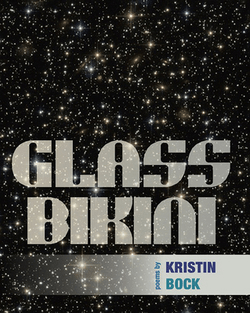
Book Review | Glass Bikini by Kristin Bock

Reviewed by South Broadway Press Editor, Brice Maiurro

In Glass Bikini, I want to say that Kristin Bock throws us smack dab in the center of an endless-seeming funhouse. Funhouse feels incomplete though. Riddled with everything from angels to monsters, robots to ghosts, Bock has strewn together many worlds, funhouses, haunted houses, universes, and open fields alike.

Bock has a knack for quick, weirdo storytelling the likes of James Tate, but Bock separates from Tate when her words turn down darker roads, often leaving the reader with a profound feeling that something substantial has just occurred. I found myself reflecting on the absurdity of my own experience. In the lawless land of a universe where snowmen cry tears of fire, I was given permission as the reader to reside in whatever strange corner of the ether that called to me.

Monsters are probably the most common image of the collection, stomping around at the intersection of childlike whimsy and our collective trauma. This is aided by a selection of quotes throughout by Mary Wollstonecraft Shelley, author of Frankenstein. In her second poem, “Creation Myth”, the poet herself creates a monster. “The ideal monster is 8 hands tall,” says Bock establishing her authority on the creation of these terrible creatures. The poem continues on to place together the ornate details of this monster before ending with “Then, find the ribbon within the figure, the gesture at its center and pull.” She seems to advise us how to make a monster, just to show us then how to dismantle one. “Sometimes monsters are so big you can’t see them,” Bock reminds us in “The President’s Dream.”

This theme continues throughout the collection. A matter-of-fact building of a surreal world, if only to figure out how to escape it. A looking-in-the-eye of the ugly and scary, then blown away as soon as Bock decides to send in the hurricane.

At times the world-building is devastatingly quick. In “How Rabbits Finally Took Over the World”, Bock says, “Sometime after the extinction of whales,” as if it were just a throwaway line. I want to stop, and grieve this loss, but in what feels like a mirroring of our own modern world, I’m left with the deep feeling that there is simply no time. There is too much to do and say, and my longing to process all this change will have to be placed on the backburner, possibly to never be revisited. 

Where so many poems in existence might feel like a warm hug, or floating down a river, with Bock’s poems, I often felt I had found myself in a bear trap, or perhaps a wormhole between universes. She wonderfully works with dark matter, as if she is acting as the great organizer of the animalistic floats and mannequin musicians in a parade of the shadow self.

One of the turns I found astounding in Glass Bikini was the occasional page turn to something romantic and incredibly present. In “Barn Burning” the poet comes home to a barn on fire, and in an undoubtedly spiritual moment shares with us,

“Out of the smoke / a mare walked up to me / slowly, as if she knew me— / as if we weren’t on fire.”

Moments like this were the highlight of the collection for me. In the middle of so much frenetic chaos, an undoubtable and slow encounter with beauty held so much weight to me as the reader.

Bock is well-aware of that reader, and the relationship that she is engaging them in. Her poems in the second person had a strong “you” to them, as if Bock were reaching her hand out directly to us to belong here, come hell or high water. With the same insistence as John Lennon’s famous “picture yourself on a boat on a river,” Bock presents the reader with less of a request to come along, and more of a sudden and total immersion.

I’d have to say my favorite poem in the collection was “Pluto”, where Bock casts a spell on a laundry list of all of the bigots, abusers, racists, and misogynists of the world, sending them to the cold recesses of space. “[T]here’s a place for you here,” says Bock, “ inside my vacuous core of ice and ash.” Bock firmly draws a hard line in the sand against these all-too-real monsters and monstrous ideologies that persist on the main stage of society.

Bock’s poetry is a magic I want to see more of. In Glass Bikini, she is resolute to fall as deep as she can into the rabbit hole, prepared to make and unmake the cruelest of monsters and reform herself in the shade of whatever strange color she can. This is what I want of poetry, the humility and power of a collection like Glass Bikini. One section of the book is introduced with an Emily Dickinson quote “’Tis so appalling—it exhilarates—“. This appalling exhilaration finds home in the words of Bock to remind us that these fever dreams are a masterful mimicry of our sober reality.

Glass Bikini was published by Tupelo Press and is available for purchase here.

HOMESICK | M. Palowski Moore

HOMESICK

I am dreaming of
An Alabama night-
Crickets chirping; echoing
Of sentiment, breaking
The song of the loon
Diving, strutting
Through phrases, phases
Of a honeysuckle
Milk glass moon
Whose distant sway
Ripples, pools, pulls
Pebbled ponds, precious pearls
Where locals gather
To swim, fish, skip stones
Across reflections of sky and stars.

I am. falling, failing-
Form fleeing a cold city
An asp escaping
This fruitless orchard
A moth chained by the
Candlelight of a distant beacon.

I close my eyes
See the pines, skies
White wings, fluttering
Glittering patchwork
Transforming. I am again
A small-town boy
Taking the back road,
Wooded path winding
To the Jackson-Slaughter bridge;
Racing in the pecan grove,
Chasing shadows, fireflies;
Laughing, dreaming, laying
Staring, believing- feeling
The force; the iron vein
Of a vanishing home-
Remembering more from
Windows that never close
A place I no longer belong.

M. Palowski Moore is a poet, writer and storyteller.  He has five volumes of poetry, including the Lambda Award nominee BURNING BLUE. His compositions reflect diverse themes and interpretations of prejudice, racism, socioeconomic inequality, homophobia and systemic oppression.  He is a contributing poet to the Civil Rights Memorial Center (SPLC) community poem A CIVIL COMMUNITY, a new exhibit that will be featured inside the final gallery of The Civil Rights Memorial Center. 


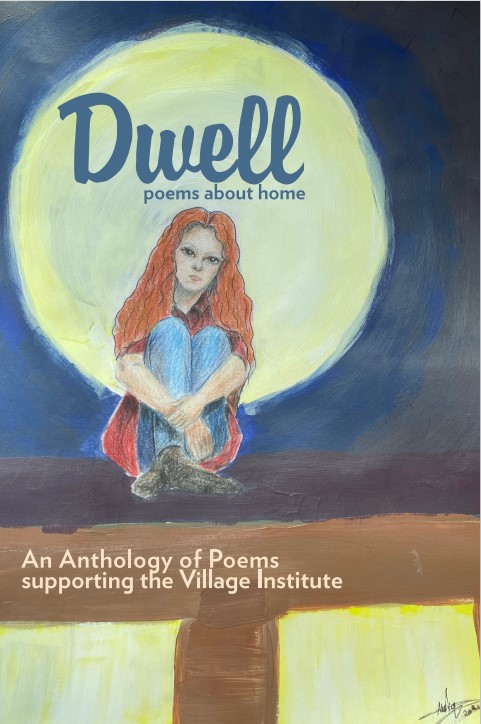
This poem is from South Broadway Press’ new anthology, Dwell: Poems About Home. Purchase here.

Rooms | Liza Sparks

Image: Guillaume Lorain

Rooms 

“I dwell in Possibility—”
-Emily Dickinson

Every
body has a right
 to shelter in a home.
To be safe from cold, the heat,
the storm.

///

We want a house built by the people / we want walls of justice / 
we want liberation / we want windows and doors of possibility / 
look outside / in a world where everyone has a home / 
anything is possible / how do we transform / 

///

“Home is where the heart is.” The heart is the size of your fist. 
Some things are worth fighting for.

///

Homelessness is not a choice. 

Criminalizing survival is unconstitutional.[1]

///

The body—
my body is made of rooms of memory—
The body—
my body is made of hallways—
The body—
my body does not remember—
The body—
my body remembers everything

///

Here is my skin. Imagine all of the things I have touched.
Here are my bones. 

///

I do not remember leaving the dwelling of my mother’s body.
I do not remember being born.

///

What does it mean to care for another? 


[1] Denverhomelessoutloud.org

Liza Sparks (she/her) is an intersectional feminist, writer, poet, and creative. She is a brown-multiracial-queer-woman living and working in Colorado. Her work has appeared with Ghost City Review, Bozalta Collective, Cosmonauts Avenue, and many others; and is forthcoming with Honey Literary, Split This Rock’s social justice database—The Quarry, and will be included in Nonwhite and Woman Anthology published by Woodhall Press in 2022. Liza was a semifinalist for Button Poetry’s Chapbook contest in 2018 and was a finalist for Denver Lighthouse Writers Workshop Emerging Writer Fellowship in Poetry in 2020 and 2019. She is a poetry reader for The Chestnut Review. You can read more of Liza’s work at lizasparks.com, IG @sparksliza534, or TW @lizathepoet

This poem is from South Broadway Press’ new anthology, Dwell: Poems About Home. Purchase here.

Apartment | Wheeler Light

Image: Nathan Dumlao

You open the apartment door and it is just wood. Wood behind the door. You need to enter your apartment. To sleep. To work. To clean. You burrow into the wood with a small drill bore. You carve a desk inside the wood. You leave legs of the wood in each corner of the room so the wood roof doesn’t collapse on you, crushed by mahogany in the night. You wake one day and it is raining paper. A hole has split in the wood from all the paper where it was leaking from the bathtub upstairs. The paper is covered in all your upstairs neighbor’s poetry. Your upstairs neighbor is always so loud, crying for whole weeks at a time. Your neighbor is so loud the sound bleeds through the mahogany. The mahogany is now spilling into your bed, your bed you carved yourself out of the desk, the desk which appeared behind the door, the apartment which was drowned in poetry. The future that is always words.

Wheeler Light is an MFA candidate at the University of Virginia. His work has appeared or is forthcoming in Hobart, Pretty Owl Poetry, The Penn Review, and Broadsided Press, among others. His work can be found at www.wheelerlight.net


This poem is from South Broadway Press’ new anthology, Dwell: Poems About Home. Purchase here.

Tell It Slant | Cortney Collins

Image: Chris Bair

My family grew corn in the heartland, but I’ve never seen it quite like this:

Angelic, husk-winged, guarding every shard of bone hidden in the soil. 

How is it that I didn’t know I had thousands of angels? They were with me all the time. 

I remember going out into the fields with my grandpa, crossing into the humid network, stalks sending out messages to each other across droplets of August air. 

I could hear their choir, their low and incandescent hum, the sway of bass clef notes rocking me to sleep in the farmhouse.

Emily Dickenson advised us all to tell the truth slant, and I remember this is what hailstorms taught the fields. The slant truth seemed tragic, in a way, as if nothing stays upright or rooted for long. Not even cornstalks.

Not even families. 

Not even farmhouses, burned to the ground long after they’ve become vacant, when the small town fire department needs a fire to practice on.

Something is always missing.

Maybe it’s just a three-hundred-sixty degree view, the ability to see that everything is overflowing, 

all the time.


Cortney Collins lives on the Front Range of Colorado with her two beloved feline companions, Pablo (after Neruda) and Lida Rose (after a barbershop quartet song in The Music Man). She is the founder of the pandemic-era virtual poetry open mic, Zoem. Zoem produced an anthology of its poets’ work, Magpies: A Zoem Anthology, of which she is co-editor. Her work has been published by South Broadway Press, 24hr Neon Mag, Amethyst Magazine, Sheila-na-Gig, Back Patio Press, and others. Cortney considers herself a poet secondarily; her first calling is encouraging others’ beautiful words in community. 


This poem is from South Broadway Press’ new anthology, Dwell: Poems About Home. Dwell will be available to purchase August 1st, 2022.

Carrying stones | Jane-Rebecca Cannarella

Image: Tom van Hoogstraten

Erin told me her face was falling. We sat on a motel bed in downtown Anaheim, each of us with stones inside our bodies where organs used to be. Hand to her face she placed her fingers at her jaw and said, it’s sagging. Like a landslide.

Our foundations were made from the gulfs created in the void of saltwater and sun; we were grown from the melting glaciers. Skeletons shaped from every piece of rock we had once picked up from the tongue of the shore because we thought it was pretty, replacing the bone until we were both ambling monuments.

In the motel in downtown Anaheim, we cracked geodes against one another with enough force to break them open to see if our guts were quartz. The same sort of rock scientists on playgrounds smashing stones to see if there were hidden crystals, only we were older, and our shared insides didn’t carry crystals…as we found out. Sharp fragments splintered and dented the cold bedcovers, rock people applying pressure as a kind of embrace.

And her face was falling like how Venice is sinking, and the world is impermanent, so we split our skin open to find anything secreted from the soft outsides. The shells of our exteriors thawed like those candles whose wax peels away to reveal tiny gems, but really, it’s just a trinket more like trash than treasure.


Structures like bones crease into putty like how memorials fall and become their own grave markers, and on a floral smoke-smelling comforter in a strip mall in Anaheim, I ease into the rock rain of my own face and the spring that found itself seeping out of the remains of my body. Our mingled landslide faces and surfaces liquified with only the memory of boulder bodies and gritted organs left in our wake.

Tomorrow we’d go back to carrying our stones.


Jane-Rebecca Cannarella (she/her) is a writer and editor living in Philadelphia. She is the editor of HOOT Review and Meow Meow Pow Pow Lit, and a former genre editor at Lunch Ticket. She’s the author of Better Bones and Marrow, both published by Thirty West Publishing House, The Guessing Game published by BA Press, and Thirst and Frost forthcoming from Vegetarian Alcoholic Press. 

The Artist’s Prerogative // Gracie Nordgren

Image: Sergio Rodriguez

The Artist’s Prerogative

BY GRACIE NORDGREN

His name was Pietro Ludivicci, and he was in love with symmetry.

            Those statues of his were carved with a delicate accuracy, angels and saints poised to bless or condemn, their pale faces set in expressions of aloof piety. That marble virgin of his was housed inside the chapel, the object of awe among the townspeople. For the sculptor had rendered the stone folds of her clothing as soft-looking as fabric.

            The flawless beauty of Ludivicci’s creations was rivaled only by the appearance of the sculptor himself. With his tight curls, regal nose, cherubic lips, and mahogany eyes, it was as if he were the personification of the suppleness of youth. How lovely, this Pietro!

            Of course, the young women of the town were hopelessly taken with him. Why, even the mayor’s wife fondly referred to him as her first love! A cacophony of tokens, flowers, letters, and gifts took up permanent residence outside his door. In the marketplace, women would tarry and stare, and those bold enough to proposition him always received the same answer: a curl of the lip, and a flat “I’d rather not”. You see, Ludivicci was a paramour of human beauty- and perfection his muse. How could he settle for anything else in a lover?

            These harsh rejections were hard on the ladies of the town. Many would weep, and some would pull at their hair. Young Viola, who cleaned the sculptor’s apartment, witnessed countless of these spurnings. In the smoky bars, her father, the innkeeper, and the older townsmen would snidely remark that Ludivicci may as well wed one of his statues.

            There came a day, as the harvest-season came round, that the sculptor unexpectedly stopped accepting commissions. For seventeen days on end, he vanished from the eyes of the community. Circulating whispers suggested illness, or even his death. Viola of course knew that the artist was not dead at all. He had thrown himself into his newest project.

Ludivicci the recluse remained shut up in his apartment, his door opening only to receive the bread and wine he paid Viola to purchase for him. During these visits, the girl caught glimpses of a form standing in the center of his room- a new statue, perhaps? Alas, she could never get a good enough look, as the sculptor would pay her what was owed and then slam the door with a force that made the frame creak.

The longer Pietro Ludivicci was in isolation, the more fanciful the rumors about him became. He had certainly lost his sanity, most agreed. Signora Columbo swore she had spotted him at the temple, worshipping the pagan gods! How could he have fallen so far? Poor Pietro! A red-cheeked and mortified Viola confessed to her sister as they lay in bed one night that she had caught the sculptor cradling what seemed to be the face of his passion project and kissing its lips!

Months passed before Ludivicci was spotted in public again. He looked certainly worse for wear, with dark shadows underneath his eyes, an unkempt beard, and his shoulder-length hair hanging in an unruly tangle.

His sculpting seemed to be abandoned as a thing of the past, as he had emerged from his isolation with nothing to show for it. If one would catch him walking about in town or marketplace and inquire about his work, he would stare back with haunted, glassy eyes and mutter something about having more important matters to pursue.

No one quite knew where the woman had come from. The way the innkeeper told it, she had knocked upon the inn’s door late one night (the night before Ludivicci returned to society) and requested residence. Said her name was Giana Aldi. She had paid him handsomely for room and board from a fine leather coin purse that hung from her waist. She was a painter, this woman, who wished to work undisturbed within the rooms. Why is it that this town is the place of so many fussy artists? The innkeeper bemoaned to his wife and daughters as they, dazed and recently roused from sleep, stumbled to prepare a room.

Soon enough, the town forgot their fascination with Ludivicci in favor of the mysterious Giana Aldi. It was if she had been carved from marble, as such flawlessness seemed unnatural. Smooth dark locks flowed down her back to her waist, and large black eyes were framed by heavy lashes. They seemed to see into one’s heart, and one couldn’t help but feel naked and exposed under her gaze.

She was stern and dedicated to her art with a borderline religious fervour. Her neighbors took notice, with news of her traveling within hours. Who was she? Perhaps she and Ludivicci would be the perfect match for one another. Two kindred spirits, parallel in looks and practice.

Evidently, Ludivicci was enthralled by her as well. Every evening, he would stand at her balcony, wildly waving bouquets of flowers, imploring her to come down and speak to him. No one ever saw Giana Aldi do so much as open her window. Late into the night, the sculptor would cry, shout, and even sing love poetry! Poor Ludivicci was in such a state of ruin by the seventh night, yet he persisted. Having enough of this, the innkeeper accosted him on the street, ordering him to give it up at once! Ludivicci, likely emboldened by the wine running through his body, declared that he would never stop his pursuit until he heard word from the lady herself.

It is said, and there have been several witnesses to this, that Giana Aldi appeared on the balcony then. Leaning over its edge, raven hair spilling over her shoulders, her disdainful shout could be heard by all:

“I’d rather not!”


Gracie Nordgren is a Creative Writing student at the University of Colorado Boulder. She enjoys daydreaming and pomegranates, and would very much like to travel to Venus. Her work has appeared in Kalopsia Literary Journal, The University of Colorado Boulder Honors Journal, and Cathartic Youth Literary Magazine, among others. 

Outrageous as Flowers | Amy Wray Irish

Image: Ida Andersen Lang

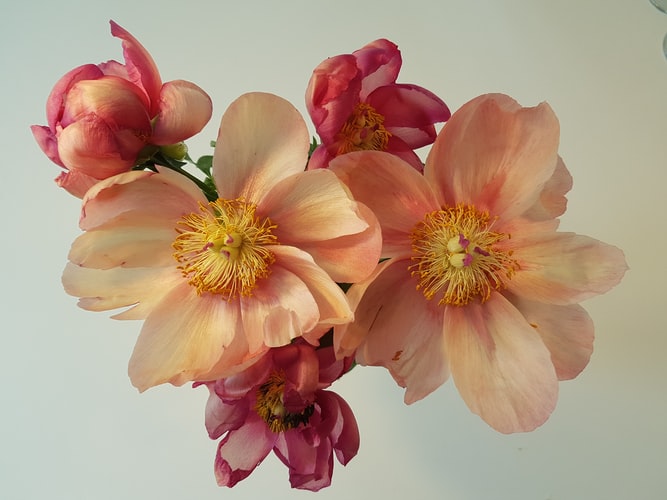
Oh poets and their peonies!
“As big as human heads”
Jane Kenyon exalts, her pen
heavy with extravagant
language, enormous
metaphors as big as life.

The perfume of such heady
description smothers me,
face-first in the reproduction
of perfumed pistol and stamen.
Yet it keeps the real makings
of this craft at a distance.

Amongst poets, there’s a secret
censorship of creation
surrounding their beloved peonies—
afraid too close they’ll catch
the inner workings of such art.

Aware they’ll see, let’s be honest,
the ants. Mary Oliver admits
they exist. That something dark
and alien spiders
across this beauty.

She knows that a necessity for budding
is this cutting, this eating.
Knows that the cataract
of leaves covering the bud
must feed the hungry
just enough. Must just
hold back the swarm
to unlock the flower’s form.

These thousand tiny bites
release a poem as well.
The flowering depends on it
yet can also kill.
So we unleash the ants
but prevent such furtive legs
from going too far within.
Allow the justice of devouring
so that the exquisite sweetness
opens.

Inside any creation
is a little taste
of destruction.
To pretend
otherwise would be
outrageous.


Amy Wray Irish (she/her/hers) grew up near Chicago, received her MFA from the University of Notre Dame, then fled the Midwest for Colorado sunshine.  She has been published in Spit Poet Zine and Thought for Food; she has work upcoming in Progenitor and Chiaroscuro.  Her third chapbook, Breathing Fire, won the 2020 Fledge Competition and is now available from MiddleCreek Publishing.  For more information go to amywrayirish.com.

Dingle Bay, Summer 2012 | Sean Woodard

Image: Xulong Liu

Along the cliffs of Ceann Sibéal
herds of sheep graze, weighed
down by crimped fleece.

Rough-hewn Celtic crosses,
slathered in dust and moss,
peek out from brittle underbrush.

A boat slices through still bay waters,
inboard motor stirring up foam
as the throttle is revved.

A gray dorsal fin approaches the vessel.
With a barrel roll and flick of his flukes,
Fungie the bottlenose dolphin launches

into the air, slips back under the surface,
and reemerges to nuzzle starboard
and port sides with his rostrum.

The Ring of Kerry is bathed in gold
as Dingle’s red and white lighthouse guides
Fungie back to the bosom of the Atlantic Ocean.


Sean Woodard (he/him) is a doctoral student at the University of Texas at Arlington. He also serves as the film editor for Drunk Monkeys. His creative works has appeared in NonBinary ReviewThe Cost of Paper Vol. 4, and Found Polaroids, among other publications. You may follow him at http://seanwoodard.com, Twitter @seanwoodard7326 and Instagram @swoodard7326.

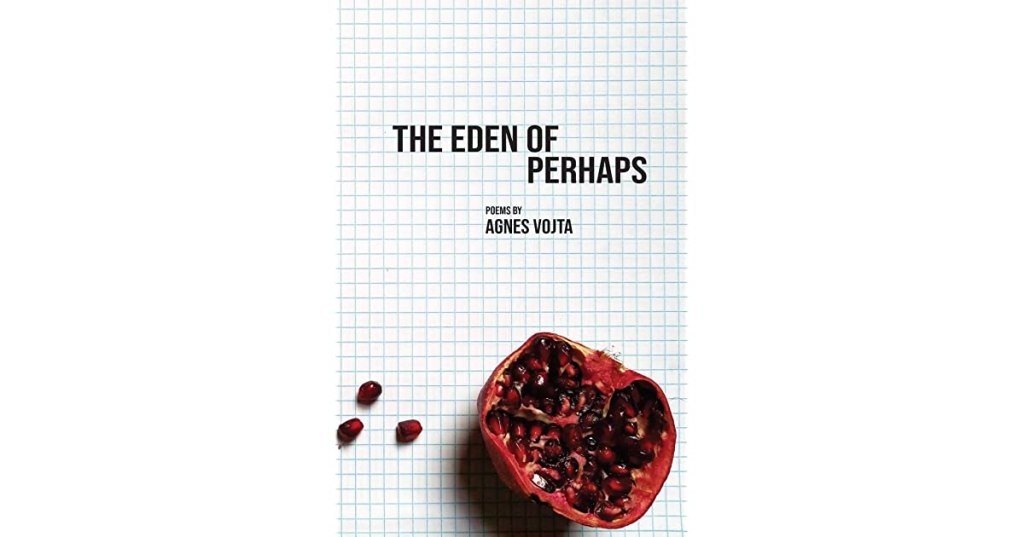
Book Review | The Eden of Perhaps by Agnes Vojta

Reviewed by South Broadway Press Editor, Brice Maiurro

Agnes Vojta’s full-length poetry collection, The Eden of Perhaps, finds itself welcomed into a lineage of poets existing in liminal spaces. In an early poem in the collection, What If, Vojta asks the reader “what if the answer is not here/there, either/or, but both, between, and?” In our society, plagued by othering, perfectionism, and divisiveness, Vojta’s poems continue to ask the right questions all throughout the collection.

I believe it is often the work of a poet to consider grey space. This may feel contrary to what someone thinks of when they think of a poet, self-assured and convicted, preaching their gospel or anti-sermon to an enraptured audience, but there is often more truth when a poet brings along a healthy sense of humility. Poets like John Brehm speak to and curate collections on impermanence. In a 2020 episode of the podcast Between the Covers, Pulitzer Prize recipient Natalie Diaz encourages the acknowledgement of not understanding, or even misunderstanding. Ocean Vuong, in his poem Someday I’ll Love Ocean Vuong shares with the reader “the most beautiful part of your body/ is where it is headed.” Many great poets have learned to walk the tight rope of transition, to balance on the line of maybe.

I was particularly stricken by Vojta’s poem, Atonement:

Sometimes I wish I belonged
to a religion that practices confession.

I can walk in the forest and confess to the trees,
kneel by the river and whisper to the water,
stand in the field and shout to the sky –
but who will pronounce me shriven?

I have to prescribe my own penance,
whip my body to exhaustion to drown out
the mind’s self-flagellation,

and wait for the unpromised peace.

Being raised Catholic, I am no stranger to this attitude of religious penance that Vojta brings forth in the four short stanzas of Atonement, but though she mentions at times she longs for this space of confession, she ultimately settles, or unsettles, in the uneasy space of waiting “for the unpromised peace.” Vojta’s style at times reminds me of the beloved American poet Mary Oliver. An iceberg—in the sense that often below the surface of the deceptively simple words is ten secret tons of depth. Vojta is something of an iceberg herself. In Atonement, she seems to remind us that religion may present us some feeling of closure, but where a truth lies is in understanding that no peace is promised. These are the words that could shake a world free of the imprisonment of ignorance and return us to a shared experience of unknowing.

The book is brimming with bop after bop. In Seeds of No Return, Vojta, in a kind of magic, bans “the word never” from her mind. In Accomplished Hamster, Vojta manages to turn the cute allegory of a hamster on its wheel into a dark social commentary on hopelessness. Vojta’s poems are no stranger to humor, but they wield it like a knife. In Greeting Cards They Don’t Make, Vojta stands on her soapbox to announce the world’s lack of a greeting card that appropriately states inside “I hope the bastard rots in jail.”

It seems to me that Vojta must live her life as a student to poetry, often passing through the world with dreamer’s eyes. Finding compassion in the dying words of the Mars rover, Vojta creates a beautiful eulogy for a robot in My Battery is Low and It’s Getting Dark. Vojta hoists a feminist fist of dissent that RBG would applaud throughout the collection, including a disruptive reworking of such classic, albeit dated, fairy tales as Rapunzel and Sleeping Beauty.

 What’s refreshing about Vojta’s Eden of Perhaps is that it is, in fact, a collection. The poems are in conversation with each other, coming together like a multitude of seeds in the juiciest most pungent pomegranate you’ve ever eaten, unapologetically dripping all over the blueprint of a broken society.

Having read Vojta’s poems, I find myself more willing to say “I don’t know” as I move through my daily life, and while this may sound like some kind of defeat to some, for me it’s a nice walk through the garden in an imperfect Eden that feels more real than anything that they are trying to sell us.

              The Eden of Perhaps was published by Spartan Press and is available for purchase here.