
BOOK REVIEW:
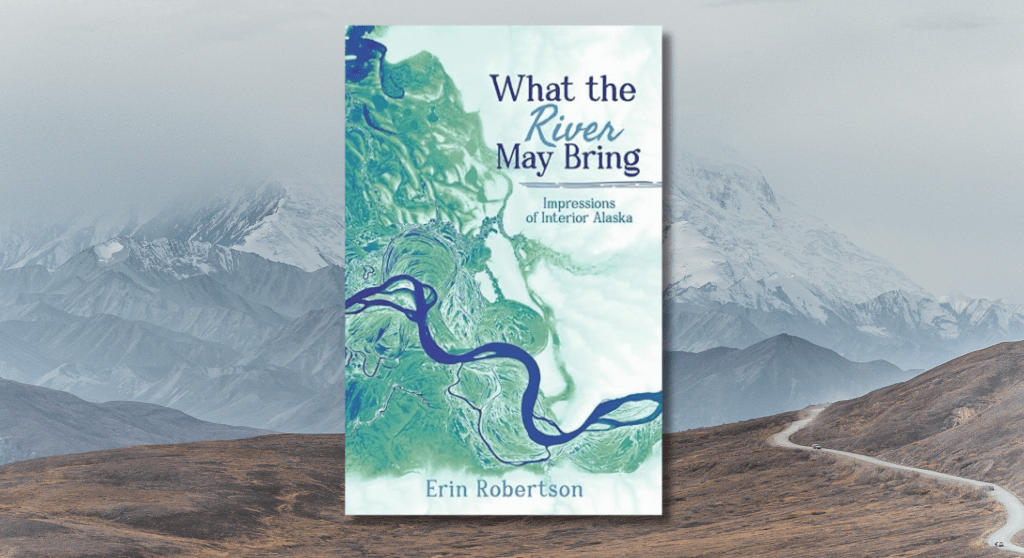
WHAT THE RIVER MAY BRING: IMPRESSIONS OF INTERIOR ALASKA BY ERIN ROBERTSON
A BOOK REVIEW BY SHELLI ROTTSCHAFER
Robertson gathers her words to advocate for the land and the confluence of both the Koyukuk and Yukon Rivers. During her time in the Koyukuk National Wildlife Refuge she was embedded with biologists, collaborating with her craft through the Artist-In-Residence program “Voices of the Wilderness”.
Her poetry draws us in, witnesses to her experiences upon this land, and helps us envision her impressions of interior Alaska. It all begins, “when the float plane’s buzz fades” as she first settles into her sub-arctic residency. She meets the, “devoted swans, tender loons, [and] dancing cranes.” She follows moose tracks and moss lined trails. These relationships with the other-than-human creatures she encounters bring her company.
Glaciers, and clouds, and wild country greet her. Upon arrival in the Alaska Interior she leaves behind “creature comforts” and chooses a new freedom; trading suburbia, her partner and children, for a growing winter white and jagged mountains. It’s a new opening, a new era of possibility for her. “Wilderness Eve” seems to recollect a childlike wonder, a new version of awaiting gifts below a Christmas Tree:
waiting to see
what this wilderness holds
sleepless and sleepy
dreaming the space
and the silence (21).
Her time in Alaska and her observations while there is an unveiling where she comes to realize:
I knew I hit the lottery
but hadn’t quite known
how many riches there’d be (25).
Robertson marvels at nature’s natural wonders. For her, the Yukon River inspires just like Georgia O’Keefe’s infamous cloud-scapes or French Impressionists’ swirling lines. The river:
It bends and dapples and distorts…
Adding and subtracting shades (27).
Still, “You never know what / the river may bring… Everything comes down the river / if you watch long enough” (29). And yet, like the old adage, one can never step in the same river twice, its purge and rejuvenation brings new waters that can both cleanse and drown.
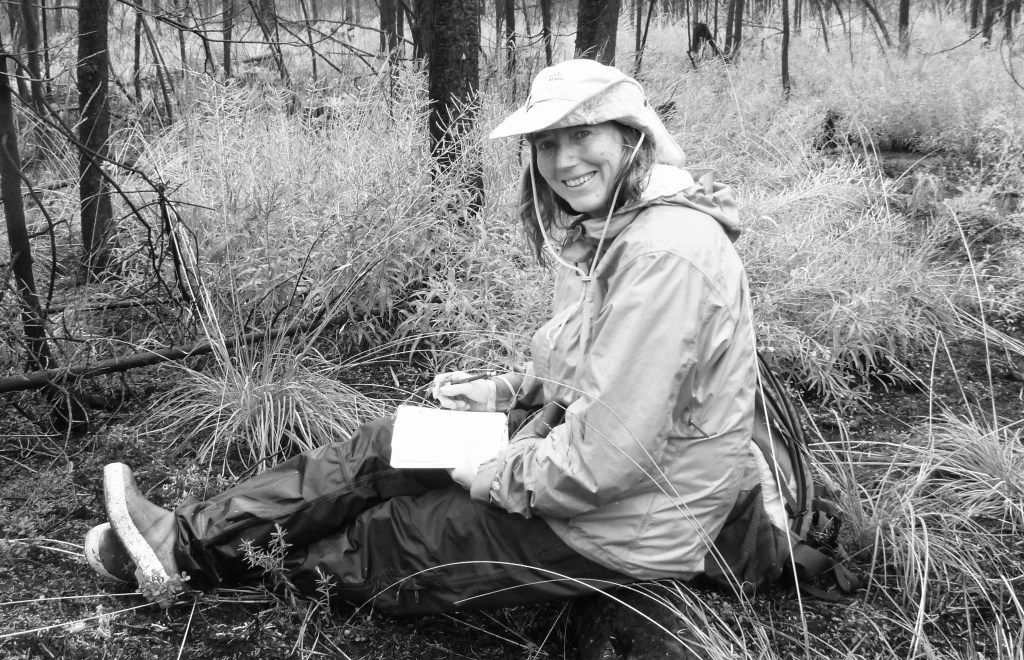
In her poetic meanderings, Robertson also takes on the persona of “Other Animals” like otter, caribou, peregrines, and Swainson’s Thrush. She watches their lives, their passage onto new territory, and their passing into the beyond. It’s a moment, a flicker, a stillness juxtaposed to the more rapid pace of her life back “home” in Colorado.
Fire, too is a constant, not only in the Alaskan Interior but throughout the Mountain West like Robertson’s home upon the Front Range. She notes:
after the fire
naked birches are
black and white tapers
all blown out (56).
Even after a “Severe Burn” she comments on the stark beauty:
The burn dazzles
despite a blackened past (57).
Seemingly, it is a reality that we all have to come to accept because out of destruction, the ashes can reinvent a newness, a regrowth, another possibility.
Robertson’s experience as an Artist-In-Residence is a testament to her “Vocation” (105). She embraces where this has taken her:
so many options open
when you go where you’re called
when you do what you love
when you toss every last bitter pill aside…
the earth is humming
with so many ways to play
what will you try next? (105).
This is the challenge that she sets before us. In her closing poem, “Accounting for Awe” she sets us straight, like one hiking boot in front of the other and asks:
What is the sum of these days of devotion?
An accounting of the endless ways to direct awe.
Anywhere you look there’s a one-inch bit of wonder…
To not let it all burn yet (107).
Here is our reason, in our act of love for nature, we will find compassion for ourselves.
Boulder County Poet Erin Robertson carries this love for nature and compassion forward. She is the founder of BoCo Wild Writers where she teaches outdoor nature writing classes. Her work can be found at http://www.erinrobertson.org
WHAT THE RIVER MAY BRING: IMPRESSIONS OF INTERIOR ALASKA
BY ERIN ROBERTSON
AVAILABLE THROUGH RAW EARTH INK
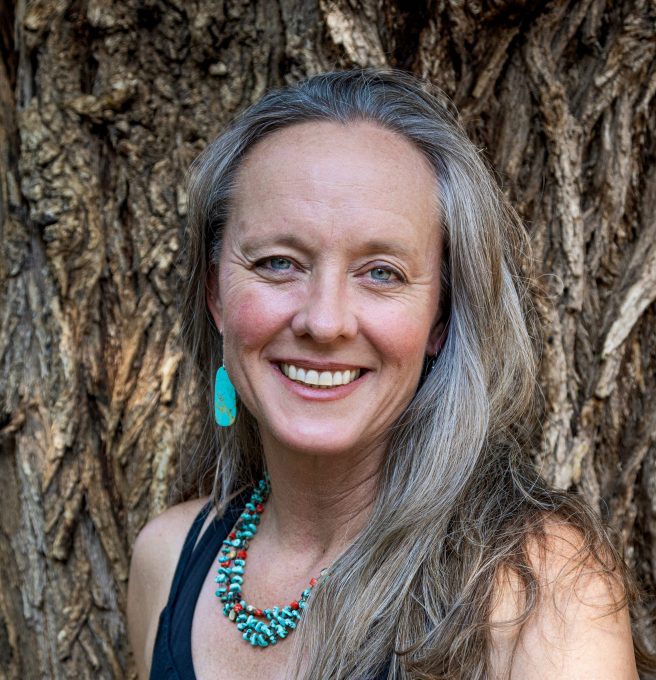
Shelli Rottschafer (she / her / ella) completed her doctorate from the University of New Mexico, Albuquerque (2005) in Latin American Contemporary Literature. From 2006 until 2023 Rottschafer taught at a small liberal arts college in Grand Rapids, Michigan as a Professor of Spanish. She also holds an MFA in Creative Writing with a concentration in Poetry and coursework in Nature Writing from Western Colorado University (2025).
Shelli’s home state is Michigan, yet her wanderlust turns her gaze toward her new querencia within the Mountain West where she lives, loves, and writes in Louisville, Colorado and El Prado, Nuevo México with her partner, photographer Daniel Combs and their Pyrenees-Border Collie Rescue.
Discover more of Shelli’s work at: www.shellirottschaferauthor.com












 south broadway press