han’s solo – mark blickley and keith goldstein

Keith Goldstein - Acadia NP.jpg

sbgs cowskull
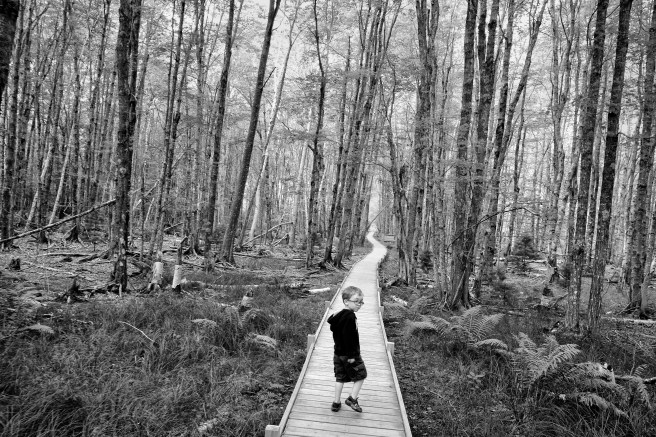
Editor’s note: the following piece is an ekphrasis, a rhetorical exercise where usually an artist bases a piece of writing off of an image. In this case, Mark Blickley based the following story off of Keith Goldstein’s image above, a picture of his son at Acadia National Park.

sbgs cowskull

I’ve had this recurring Bridge Dream for nearly fifteen years. It first appeared one night after being exhausted by cram studying for my Bar Mitzvah. In this initial fantasy I was a swaddled infant left on the very beginning of a long and twisting walkway through a vibrant yet desolate forest. I was crying and there was blood from my bris seeping through the fabric covering my groin. We don’t need to dig Freud up from his grave to figure out I was about to undergo a ritual of manhood, so I must’ve been thinking about the genital mutilation that first signaled my acceptance into the tribe. What’s quite disturbing about this recurring dream as it appears today is that after fourteen years of experiencing it, I’ve only move forward incrementally from the bloody infant that was first placed on this forest path, into a six year old boy that balks at moving forward. In the real world I’m about to turned twenty-eight.

My name’s Han because my parents are both Star Wars freaks and the worship of this film series is the only real religion practiced in my household. They obviously were not the only disciples. When I was in Pre-K, there was another boy named Han as well as a girl named Leia.

What’s strange about my abandoned boy at the bridge recurring dream is that it’s always just a prologue to whatever else I’ll be dreaming that night. This winding walkway always introduces whatever anxious or peaceful visions my brain has decided to focus on that night—nightmare, erotic ecstasy, exciting adventures, idyllic beauty.

These days in my dream I am a first-grader who is really hesitant about moving forward, but I also see it as my feet turning into the classic ballet 4th position. My mother taught ballet for years so perhaps my foot position on the bridge is a nod to her. Once again I don’t need to disinter Freud to figure out this bridge snakes into a representation of my life’s journey. By the way, did you know that babies double their birth size by age five months? Yet in my recurring dream I remained a crying, bleeding infant for years —no physical growth, no emotional growth.

I’m a bit confused about relationships with women. My testosterone tells me to be more aggressive and not to feel so shy and unworthy. I’m always terrified of saying the wrong thing. In High School I didn’t really have a girlfriend because I always hung out within this circle of friends that were both males and females. Most activities were communal, not individual dates. Recently I joined a dating app called Bumble. On Bumble only women can initiate first contact which I like because it reduces the stress of rejection, yet I’ve been registered on this app for five months and have yet to receive a single hit.

I’m presently undergoing E.M.D.R. (eye movement desensitization and reprocessing) therapy, which also includes hand tapping and listening to ambient sounds, like ocean waves, via headphones that seesaw these sounds from ear to ear to promote a kind of aural hypnosis. One of the side effects of this treatment is that it can cause vivid, realistic dreams, but my recurring dream happened years before I entered therapy. My therapist insists I keep a journal between sessions in order to maintain the session’s progress she insists is occurring.

My shrink Martha works for the V.A. but please don’t think I’m some sort of Veteran war hero suffering from PTSD. I never even enlisted in the War Against Christmas, yet I’ve never known a world without suicide bombings, school shootings and acts of terrorism that take place in my backyard, not in some distant land. Martha is also an ordained Lutheran pastor but she never mentions God in any of our sessions.

I tell Martha I’m so sick of reading/hearing reasons why Millennials can’t grow up. My shrink calls it a “First World” problem not unique to young men my age. I am depressed and anxious all the time but don’t know why. I am always smiling and laughing at jokes I don’t think are funny so people won’t discover how unhappy I am. I feel like I’m faking everything. Being an adult to me means not doing things you enjoy doing, yet that’s nuts because my parents still act like kids at Star Wars Conventions.

Why am I so miserable? I had everything I was supposed to need while growing up— emotional and financial security, a good education and now I have a more than decent paying job. I do feel guilty that they are so many less fortunate than me and know it is unmanly to be so constantly sad. Every day there’s somebody crying out what privileged assholes we Millennials are, so I always feel pressured to pretend I’m happy.

My shrink says I should spend less time always surrounding myself with people and more time being alone, even if it means being bored at first. But I can’t relax by myself. I tried all different kinds of things, but I can’t slow down my goddamn anxious thoughts. I’ve tried drugs, porn, video games and even different kinds of meditation—Zen Meditation with mindfulness on breathing and intentionally focusing on the moment. Then I did Metta meditation to focus on a loving kindness towards myself as well as empathy for other people. In my final workshop I studied Sufi mediation to try to achieve mystical union with a Supreme Being.

In every class and workshop I’ve taken, I seem to be the only one who can’t obtain this metaphysical knowledge and peace. I would often comfort myself in class by thinking my fellow students are just bullshitting their enlightenment to try to make me feel like shit—but thoughts like that defeat the entire purpose of meditation, which is to get to know myself and pull away from the outside world to focus on my inner world, instead of blaming everyone else for my failure. Do you understand how fucked up a person I am? Hell, I even get sad deleting old tweets because it feels like I’m flushing away a big part of who I was and who I am.

Last month Martha suggested I try using a weighted blanket that applies deep pressure touch. She says it simulates the feeling of being comforted, like a swaddled baby, and is supposed to help my insomnia and anxiety. So instead of fighting my anxieties like a real man, I retreat into acting like a fucking baby again, all tucked inside my crib beneath a blanket with 30 pounds of pellets sewn into it. So far it hasn’t worked.

When I ask Martha how she arrives at the concept of what exactly my emotional age is, she turns the question back on me and asks what do I believe is my emotional age? I tell her I don’t know anything except first my dick is snipped at birth and then as I advance in life I have my balls constantly broken by social proclamations that I MUST BE SUCCESSFUL!

I worry I’ll never live up to my own expectations. I grew up being told I could be anything I wanted to be, but I’m coming to the realization that I’m not as smart, talented or special as I thought I was and that fuels an obsession with having to succeed. My friends and I seem to be growing up poorer than our parents. My Mom and Dad can afford to go to Star Wars conventions all over the world but my important travel plans are still handcuffed by student loans.

I get incredibly stressed over not being able to find a WiFi spot, forgetting passwords to online accounts, the buffering sign when I’m streaming online—it’s like taunting me that my life is going in circles, like the areola of a maternal tit. I stress when unable to find my T.V. remote just as my favorite Netflix show is starting.

Why am I unable to advance past the age of six in my recurring dream? Is it because I’m a victim of helicopter parenting? During my childhood my Mom and Dad hovered over every experience and problem I had growing up. Cell phones are the longest umbilical cords in the world. I was taught to be afraid of strangers, playing sports, sexual contact. Is that why they claim we Millennials act more like children than adults?

This outburst of self-pity is very tiring, so I’m going to disappear under my state of the art weighted blanket and hope tonight is the night it crushes my recurring dream of being a child stranded on a spooky bridge inside a dying, primeval forest. And if my heavy blankie is unable to extinguish the dream, perhaps when I wake up I will have at least gained a year of emotional age so I will be a seven year old boy on that walkway, just three quarters away from achieving my true age of twenty-eight.

sbgs cowskull

Mark Blickley is a proud member of the Dramatists Guild and PEN American Center as well as the recipient of a MacArthur Foundation Scholarship Award for Drama. He is the author of Sacred Misfits (Red Hen Press), Weathered Reports: Trump Surrogate Quotes from the Underground (Moira Books) and the forthcoming text based art book, Dream Streams (Clare Songbirds Publishing). His video, Widow’s Peek: The Kiss of Death, was selected to the 2018 International Experimental Film Festival in Bilbao, Spain. He is a 2018 Audie Award Finalist for his contribution to the original audio book, Nevertheless We Persisted. 

Keith Goldstein is a freelance photographer and photo editor in New York City.  Keith began exhibiting his photography since the1980’s. His work has appeared in many publications including  ABC News Australia, Now Public, Flak Magazine, JPEG Magazine, Time. His work is included various private collections and in the Erie Art Museum, Brooklyn Museum, and the S.K. Neuman Culture Center, Brno, Czechoslovakia. Website

four hybrids – howie good

_DSC0295 (2)

Miss Plum in the Bedroom with the Candlestick

Crime was common back then, and the law itself often criminal. Nobody was safe from the thugs prowling the city. It took a constant and wearying vigilance to survive. If I happened to fall asleep, I’d wake up afraid. I think I was afraid she wouldn’t be there, peering out through a crack in the curtains. Why you here? I asked the first time she appeared. She just gave a fuzzy, fragile smile. The ambiguity was intentional. When you leave details out, it opens up possibilities for what can be – an ancient tree whose entwined branches support 34 brilliant candles.

Shredded

Private lives are now lived in public. That’s the problem with putting Velveeta on enchiladas. It’s only a matter of time before the celebrity chefs start to show up. I pedal away as if I have to actually get somewhere. Everyone I owe an explanation tries following me – sons, daughters, parents, co-workers, etc. We’re a wandering soap opera. “You can’t paint them trees,” protesters yell from the sidewalk. I just want some semblance of normality back in my life, some sort of quiet, and my heart to stop agonizing like a flock of gulls being sucked into a jet engine.

Shadowlands

When you look back over your shoulder, you see yourself looking quizzically back at you. You always assumed that you’d been given up for adoption. Now, more than 35 years later, you know. It’s night, and everything is also nothing, the dark howls and whimpers of women in search of their shadows.

The Later Years

Given a choice, I would want to be the sort of shrewd, goatish old man it’s said Rodin was, strolling about the boulevards and back alleys of Paris, while the work in marble went on nevertheless in his head and a young Russian-born French lady leaned lightly on his arm, and if her eyes were a little too wide apart, or if she didn’t actually read any of the books he recommended, he wouldn’t care, because it had just turned spring, and the air was like a mix of wine and brandy, and they were always at least somewhat drunk.

sbgs cowskull

Howie Good, Ph.D., a journalism professor at SUNY New Paltz, is the author of The Loser’s Guide to Street Fighting, winner of the 2017 Lorien Prize from Thoughtcrime Press, and Dangerous Acts Starring Unstable Elements, winner of the 2015 Press Americana Prize for Poetry, among other books. He co-edits the literary journals UnLost and Unbroken with Dale Wisely.

Photo: @sweetdangerzack

submit to south broadway ghost society.

eyes – dave owens

x9apT

Two sour faced guards escorted teenager Daniel Warren into the interview cell, shackled him to the metal grommets bolted to the table, and pushed him down into a chair. The boy’s orange prisoner suit did not fit, but someone, perhaps one of the guards, rolled the cuffs and sleeves up so he wouldn’t trip and fall. The lock clattered after the door slammed shut.

To the state appointed psychologist Raoul Hadras, the young man who sat in silence across from him at the table appeared not unlike many of the other troubled youths of this generation – thin, only a few weeks past his fifteenth birthday, a dozen pimples on his face, and expressive brown eyes. A shock of blond hair completed the image.
Daniel murdered his father and mother if the police report proved true. After his arrest, he demanded the death penalty from the court appointed attorney, and created quite a scene in the courtroom when the attorney plead not guilty on his behalf. The judge also thought the demand strange and questioned the boy’s sanity.

Most other youths Raoul evaluated often claimed insanity, and enacted performances that would make movie stars jealous – anything to avoid justice.

Daniel sat with yes turned down, and did not speak.

“May I call you Dan?” The doctor made a note in the evaluation folder.

“Sure. Why not? You wanna find out why I killed my old man.” The boy fidgeted in the chair, but did not try to escape the restraints. “I wanna die.”

“I must determine if you are fit to stand trial.”

“Yeah.” The voice came slow and sullen.

“So. May I call you Dan?” Raoul’s question, fashioned to create a familiar, less formal atmosphere, dated back to the time of Freud. The ploy worked sometimes, but sometimes it did not.

No answer. Raoul tried again with a gentle tone in his voice. “May I call you Dan?”

“I don’t care what you call me. Send me back to my cell,” he snapped back.

“Sometimes circumstances cause us to do things we wouldn’t normally do. Would you please tell me about what happened?”

“He deserved it. Am I done?”

“Not quite. Why do you say he deserved it?” His question probed for anything to free the boy from his defensive shell.

“He beat me and my mother up all the time. When I was a little kid, he’d jerk me up by my arm and whip me with that leather belt of his. I hated the belt. I got whipped even if I didn’t do nothin’.”

“Your mother too?” Situations like the boy described usually meant the abuse affected other family members. Raoul understood the answer.

“Yeah, she got it bad. If she tried to protect me, he’d beat her with his fists. She didn’t tell people what he did, but behind her back everyone talked about her black eyes and the bruises all over her arms, and face. I got into fights with kids who said things about her.”

“Many fights?” The question sought to let deep emotions rise. He made another note in the folder.

Dan avoided the question. “My mother. I loved her. I didn’t kill her like the police said. I didn’t do it.”

“But you did kill your father?”

“Yeah.” His head rolled back and he stared at the ceiling. “Like I said. He had it comin’.”
Trigger point. The father. Raoul wondered what other triggers might provoke Dan to continue his story. “So you blame your father for your crime?”

Dan kept his gaze focused on the ceiling. “Everyone hated him.”

“Everyone?”

His head fell forward and his eyes locked onto Raoul’s face. “Everyone.”

“Please explain.”

The face softened for a moment. “His eyes frightened everyone. One of my friends, Jimmy, came to the house one night after school.” Dad screamed at him to get out.”

“That’s all your father said?”

“Uh, huh. He stared at Jimmy with those cold blue eyes – they could see right through you. When I try to sleep I see them. They’re always in my dreams. I didn’t like to sleep. Neighbors avoided him. They’d go to the other side of the street when they saw him comin’.”

“It’s called post traumatic stress, Dan. He frightened you the night you killed him?”

“I came home from school late. I heard him telling from the street. When I went inside the house everything was broken. Smashed chairs, curtains ripped off the windows. I went into the kitchen. Dad grabbed the refrigerator and threw it on the floor. He swung at Mom and missed, but his second punch hit her in the stomach. She fell down. I went over to her and tried to help, but he grabbed me by the shirt and threw me into the counter by the sink. Then he turned back to Mom. I knew he was gonna hurt her more.”

His eyes smoldered with tears and his head dropped to his chest.

“Relax for a minute, Dan. I understand why you are frightened. I want to help.”

Dan disregarded Raoul’s comment and continued. “I got up and took one of the broken chair’s legs and swung it as hard as I could. I hit him on the back of his head. He turned and started to get up, but I hit him again. I hit him two more times before he fell. I went to Mom. She said ‘Run Danny, run. He’ll kill you for sure if he catches you. Please run. I love you.’ Last time I heard Mom’s voice.” He jerked his head to the side and shook it. His wet cheeks glistened in the light of the single bulb that swung from a wire above his head.

Raoul took a handkerchief from his pocket and went to the other side of the table to wipe the boy’s tears. “Calm, calm. Nobody will hurt you while you’re with me.” Genuine sadness gripped the doctor and he felt his own eyes water. He thought to leave the handkerchief with Dan, but remembered the restraints and realized the pointlessness of such an act. He returned to his seat, sat in silence, while he made a few more notes in the folder.

Dan’s chin fell back onto his chest. His voice lowered and he mumbled, “Found the gun – Dad’s nine millimeter, in the stand by the bed where he kept it, made sure it was loaded, tucked it into my pants, and ran. I went across the street to Mrs. Thompson’s house. Her lights were off. She wasn’t home, so I ran around to the back, jumped the fence and hid under some cucumber vines. I tried to hold my breath, but was breathing too hard.” He swallowed, and waited a moment before he continued. “I thought he might hear my breathing so I crawled over the back fence and ran down the alley. There’s an old wooden shed there. I went in and hid behind some boxes.”

“And . . .” Raoul’s voice faded into a whisper.

“I heard his crazy screams. He was trying to find me. I kept as quiet as I could because I was scared more than ever before. I heard his shoes crunchin’ in the alley gravel. When I peeked through a crack in the wall I saw him standin’ outside the shed, I held my breath and hoped he wouldn’t hear me. I hoped he’d go away. He didn’t. He pushed through the broken door and came into the shed yelling ‘little bastard! I’ll break your neck and piss on you. Come on out coward!’”

The doctor’s voice became sympathetic for the first time since the interview began. “Now I understand.”

“After I made sure a round was in the chamber.” The boy continued as if he could not hold back the story. Tormented words gushed from his lips at a frantic pace. “I crawled out from behind the crates and held the gun where he couldn’t see it. He moved, and I shot him in the chest, but he wasn’t dead.” His voice quieted when he remembered the moment. “I shot him in the head two times, but he’s here with me. I have to die to get rid of him. I want to die! It’s the only way I can escape.”

The softness of the boy’s voice surprised Raoul. “You’ve no need to fear your father. I think you acted in self-defense and I’ll inform the authorities. I see a full life in front of you.” Raoul wrote another note in the folder. “Your father’s gone and he can’t hurt you anymore.” He raised his head and noticed the change in Dan’s eyes.

Cold, ice blue eyes glared at the doctor. “I’m not dead.”

sbgs cowskull

David Alan Owens’ stories and non-fiction works have been published internationally. From Alien Dimensions magazine, the High Strange Horror Anthology, and other periodicals, his audiences are as varied as his stories. He prefers to write science fiction, but sometimes a story of a different genre asks to be written. He lives in Murfreesboro, Tennessee with his wife Ann and his Boston Terrier, Mayla.

Photo: @sweetdangerzack

bag of eyes – david rawson

When I took Holly to the waterfront, she told me I was destined to be a father.

“You’re going to have a girl,” she said. “And you’re going to raise her alone.”

Holly and I had been hanging out a lot the last few weeks, staying up til 4am walking around her neighborhood. One night we laid down in the middle of the street at the end of the cul de sac. No cars came. And if they had, we would have seen them coming. As I curled up in one of the blankets we had brought with us, Holly climbed up a tree that the cul de sac had been built around. It stood surrounded by pavement on all sides. I had to look down as she climbed because small leaves, twigs, and dust fell from where she rustled. I protected my eyes, and even though nothing had gotten in them, I felt them swell and water.

This trip to the waterfront was my attempt to expand our relationship, to begin to define it. I was nineteen and barely knew myself, let alone how to date this beautiful independent woman who, although she was my age, had secrets in her eyes I could not begin to uncover. She was a lion. She had an unruly mane of hair that she was always trying to move out of her eyes. She was looking out at the water. We barely spoke. I did not know how to respond. I knew I did not want kids, but I never told people I dated what I really wanted. I didn’t want to scare anyone off.

“Yeah, I haven’t given it a lot of thought, to be honest,” I said. “It all depends on the person, you know?”

But she had already decided I would be alone. Whoever the mother would be was already gone, unreachable. Although Holly was a few feet away from me, she could have been a sea away.

We sat on the rock by the waterfront on the same blankets we had used in the cul de sac. She was telling me she hated her nose. She said she thinks it is too big. She didn’t look at me. She looked at the water. I didn’t know what to say. It was a big nose if you isolated it, if you took it out of context and held it in your palm. I imagined holding her nose in my hand. She looked down at her stomach.

“I’m going to get a nose job my last year of college. And I’ll probably have my stomach done.”

She did not mention her eyes. She loved her glasses. The way she stroked the frames gently with her index fingers. The glasses framed her eyes perfectly, and she knew it. The nerdy infatuation I felt for her intensified every time she tilted her head down and looked up at me, when my world became those eyes perfectly framed.

The whole time we were talking, I had been watching two brothers, no older than twelve. Their father was nearby sitting down in a chair he had brought with him, a retractable one he had brought in a bag slung over his shoulder. He had a simple fishing rod that he held loosely in his hand. Every once in a while, he brought up a fish. His two boys were doing something on a bit of pavement down from us, near the cooler the father was placing the fish in. They were quiet, looking down at the pavement, doing something with their hands, like tracing something out deliberately.

After the boys left with their father, Holly and I stood up to leave. And we could see down the way to the pavemented area, and we could see what the boys had been doing so meticulously. Twenty-three stiff fish bodies laid rotting in the sun. The father had not taken any of the fish to eat later. It struck me in the gut as a waste of life, to catch and discard on hot pavement. It was death without a function. And then I saw what the brothers had been doing so meticulously. They had taken out the eyes. Forty-six eyes altogether that they had cut out together, as a team. The eyes were nowhere to be seen. Perhaps they kept them. Somewhere there was a bag full of fish eyes.

I attempted to move the dead fish off the pavement into the water. I picked up two big sticks and attempted to move one, like I was using enormous chopsticks. Holly halfheartedly followed my lead. She said nothing. I could not measure her discomfort or shock. She would not look at me.

I got one fish into the water, but it floated vertically, its mouth open, holes for eyes.

When I dropped her off at her car after a silent drive back, she hugged me and looked up at my eyes for the first time that day. It became clear. We were not going to talk about the fish.

“You’ll probably name her something like Penelope. She’ll draw on your walls with crayon, but you won’t care. You’ll pick up a crayon and draw right along with her.”

I laughed a hollow laugh and nodded. “You can always wash a wall,” I said.

In the reflection of her car, I saw Penelope, but just for a brief moment. She was wearing a summer dress and ballet slippers, and the Robin’s Egg Blue crayon was tight in her hand as she drew a vertical line from as far as her arm would reach above her head to the moment she can feel the touch of her hand against her toes.

But then just as quickly as I had seen her, she was gone. And without consciously trying, another image flooded my brain: a small Ziploc bag full of fish eyes, in an underwear drawer somewhere, covered in t-shirts and boxers, a testament to a productive day.

cropped-0-planchette1.jpg

David Rawson is the author of A Jellyfish for Every Name and Proximity (ELJ Editions).

submit to south broadway ghost society.