Bill Wolak has just published his eighteenth book of poetry entitled All the Wind’s Unfinished Kisses with Ekstasis Editions. His collages have appeared as cover art for such magazines as Phoebe, Harbinger Asylum, Baldhip Magazine, Barfly Poetry Magazine, Ragazine, Cardinal Sins, Pithead Chapel, The Wire’s Dream, Thirteen Ways Magazine, Phantom Kangaroo, Rathalla Review, Free Lit Magazine, Typehouse Magazine, and Flare Magazine.
He’s only as secure as his tiny-cocked insecurities,
Two people, and there’s no individual between them.
Her mouth, her voice open merely as her legs are to whomever,
His thoughts, emotions hidden away in his pants,
Public miseducation, sexual oppression, violent obsessions.
Her place in the world limited to be the size of her ass,
His place condensed to be the size of his balls,
Social roles, miscommunication replicating genitalia.
Herself not seen through beauty’s blinding light of her face,
Himself not there, a cro-magnon autonomy.
Venus and Mars fall from the Heavens by earthly malice.
Ian Williams is a poet, musician, singer-songwriter, and sideshow performer from Denver, Colorado. Ian performs in local groups such as Caltrops, the sideshow-swing band Open Casket Revival and performs solo acts under the moniker Tantrik Nihilist. Primarily he is known as a multi-instrumentalist, lyricist, and songwriter. Having had scarce appearances in smaller publications years ago he is less known for what he feels are his finest works. This writer is looking forward to establishing themselves not only as the poet they’ve been for the last fifteen years, but for the poet they’ll be in future years and the poet he’ll be until his death.
A long time ago, Ann Marie Sekeres went to art school and learned to paint. She showed a bit around New York in the 90s, but didn’t get where she wanted to be, but did become a very happy museum and nonprofit publicity director and started a family. She found out about the procreate drawing app from an illustrator she hired, stole her kid’s iPad and has been drawing every day since. Follow her work at @annmarieprojects on Instagram.
Grace Gardiner is a British-American non-binary poet and burgeoning intermedia installation artist. They are currently pursuing their PhD in Creative Writing at the University of Missouri, Columbia, where they live with their partner and one too many brown recluses. Find them online at pearlsthatwere.tumblr.com.
The hands that caught me as I entered
the world were the same hands that examined
me at sixteen, back flattened against a white sheet.
There was no discussion of sexual activity,
birth control, or even menstruation.
This man revered by my mother,
told me I could lose weight, told me
to diet, that in his country people are hungry.
My own hands clutched the fabric,
tried to not cry the instant
tears that would come hot in the car.
My place in the world
welled inside me like the ghost
of a boulder, great and silent.
Sarah Lilius is the author of four chapbooks, including GIRL (dancing girl press, 2017), and Thirsty Bones (Blood Pudding Press, 2017). Her work has appeared in the Denver Quarterly, Pithead Chapel, Entropy, and Fourteen Hills. She lives in Virginia with her husband and sons. Her website is sarahlilius.com.
When I was five years old, I said to my mother, I want to be a frittata when I grow up.
No. she said. No, no baby. You can’t be a frittata. Why not? I asked. I love frittatas. I love cracking eggs, I love shredded cheese, and I love the little green bits that you mix into the bowl. Why can’t I be a frittata? Because you’re a Jew, baby. Jews can’t go in the oven, not ever again. Not a toaster oven? No. Not an easy bake oven? No. You can never think about being a frittata, nor write about being a frittata. If you dream about being a frittata, you must wake up and make yourself have new dreams. As Jews, we don’t use the oven. We don’t think about the oven. We can’t look at the oven. The oven is locked in a box, buried underground, and guarded by a man who swallowed the keys nearly a century ago. Those keys are never coming out. My mother put her arm around me and said, Just remember baby. The oven is buried so deep, no one can touch it again. You’ll never become a frittata.
I forgot about wanting to become a frittata. I thought about lots of things I could become instead. I was afraid of the oven, and I did not go near one for many years.
One day, I sat in my office and read that a man in a uniform rammed his truck into a protester’s leg and broke it. Before I could read it again, it was gone, his internal bleeding replaced with clickbait articles, the ambulance ride overridden by ten facts about a topic I could not remember. Four other protestors hit by the truck. An ad for a jacket to cover myself. Pepper spray to their eyes. An op-ed with comments that burned. The man’s uniform said: I-C-E. The protestor’s sign said: Never Again Para Nadie.
I opened my mouth, perched on the ledge of something I wanted to say. Before I could speak, eggs began pouring out. The yolk, wet and warm, dribbled down my lips. I collected them in my lap, and sat, waiting. I wanted an opening to grow in my computer screen, a hot gap I could crawl into. It just had to be large enough that someone else could climb into my body, sit swaying in my office chair, and I could become a frittata.
With each egg from my lips, I thought about a book I saw at my boyfriend’s house called Eggs and Cheese. It showed all the ways you could make eggs and cheese. An omelette, a souffle, a quiche, or a frittata.
My boyfriend did not have a book called Protesters and Cars, which showed all the ways protesters and cars could interact. A protester could ride in a car to a protest, or convince a car to honk in support. You could also hit a protester with a car, stop, then pump the gas pedal and drive through a line of protesters sitting cross-legged on the ground. These are all recipes in a book that has not yet been written.
There is no recipe for a protest. Just like my grandmother said, It’s all guesswork to decide which spices get simmered into the dish midway through. I have never read instructions about who gets to lock eyes with a Rhode Island license plate drawing close and fast.
My computer screen finally cracked open, and I found my grandmother sitting there like a settled stack of dishes. She said, Look up, there you are. She said,
If you want to use the oven then by the grace of God, use it. She said,
Before the existence of ovens, someone baked on hot stones outside and before there were hot stones, there was the sun on your back. She said,
When I bake, I don’t think about Jews and eggs and whether you’re allowed to crack open the ground and dig up boxes with keys in men’s stomachs. She said,
It runs down the back of your neck and trickles down your spine into new generations, then it spreads and sprouts on untouched ground. She said,
Your grandfather only eats cold cereal with milk because he is afraid of the oven. She said,
Breakfast is just news left unopened. She said, If you crawl in here with me you will find out that hiding from the oven is the same as hiding in the oven. The oven is made to be used.
I sat spitting eggs for three more hours, then I turned off my computer and made myself a frittata in my kitchen. I waited for my mother to get home.
Shoshana Lovett-Graff (she/her) is a white, Jewish queer writer originally from New Haven, Connecticut. Her work has been published in Pittsburgh Poetry Journal, The Flexible Persona (nominated for a Pushcart Prize), Atlas + Alice, Poetica, Blink-Ink, and more.
Lining them up against the brick wall,
there is nothing for the sun to bleach.
Tinny, tenacious shrieks
pierce the air and emit an aria.
Metallic, it leaves a poor taste on the tongue,
the kind of putrid fur no scraper can peel.
The sound of bones primordial
against a backdrop of bold, fuzzy shells
hangs over human heads,
calculating, ruminating, no other than a bored specter.
One person struggles to find meaning,
but is left with the other cradling the saw.
Trapped within the jungle’s fury,
even the bones are not themselves.
Morgan Ventura is a writer and folklorist from the Midwest. Her poetry has appeared in The Raven’s Perch, Really Serious Literature, Ghost City Review and is forthcoming in Clockwise Cat, while her essays have been featured in Jadaliyya and Folklore Thursday. When she is not interviewing archaeologists, she enjoys podcasts, experimental film, and exploring ruins. She splits her time between Oaxaca, Chicago, and the forests of Connecticut.
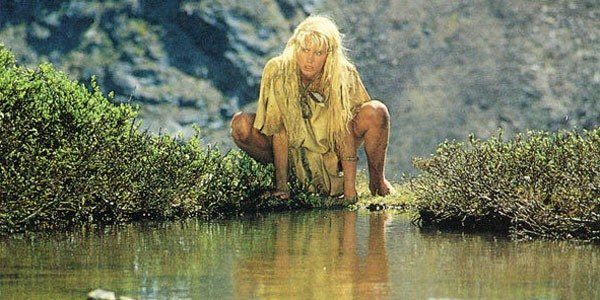
My father had a VHS tape of Clan of the Cave Bear. It had that same patina of heroism of the Kipling poems I memorized bouncing on his knee, my fee for the most dependable kind of love I got as a kid: that look in his eyes at my ability to memorize his idols. But in this movie, the hero was a woman. A Cro-Magnon girl, who can learn and adapt, unlike the Neanderthals who adopt her after the rest of her clan dies. Her ability to evolve and be different is seen as a threat, and one of the things she learns that a woman just idn’t supposed to know is how to hunt. She uses this hunting sling and she’s better at it than any of the men and for 1986, I guess this was a pretty big feminist move even though she slings it wearing an off-the-shoulder wolf skin that bares more than it covers.
She’s played by Daryl Hannah who my Daddy loved with his penchant for leggy blondes, but she’s hated by her adoptive clan for her blue eyes and light hair. She’s also raped more than once by the one who hates her most at age 10; she gives birth to his son at age 11. His spawn’s big ole Neanderthal head almost kills her coming out. I don’t know if Dad knew the book it was based on was written by a woman, who at the age of 40 felt like she’d hit her glass ceiling and was pissed, but I know he was in it for the action more than the proto-feminist dystopian themes.
It had this moment, see, this moment where the woman is holding a baby. They’re being stalked by a cave lion, and she knows if the baby dudn’t quiet down, they’ll both be eaten, so she tries to hush the baby, keep them hid and she hushes that baby alright, she hushes it dead. And yet another moment comes just like this one later on in the film. Though it seems unlikely, this I get. This I get now that I lived long enough to know that moments and people, whatever we can’t swallow, really, repeats on us. She gets this moment with another baby, not her baby, but a baby and another big animal trying to eat ‘em both and the baby starts crying and she starts hushin’ and she flashes back to that other baby and you can feel her change her mind. You can feel that spark light like when she invents fire in another part of the movie and they’re standing by a fire this time and you can just about feel her think, “awh, HELL no, hell no, man, I ain’t gonna hush this one to death, too.” So she holds that baby up like it was Simba. She waves that baby in a circle like saying come on and just you try and take us down. Make all the noise you want, baby, be as loud as you can. We’ll make a wall outta sound. She tucks that baby onto one hip with one hand and she puts some fire on a stave with the other and she goes absolutely berserk. All her squallin’ ain’t for nothing; she scares lion-death away acting crazy like that.
And I guess that film left its impression, and I mean more than just for the images I can’t unsee of women hunched over joyless taking it doggy style from the men. I mean I figured as a kid, there’s two options: you lay down, ball up, get real quiet and take it or you bawl til your voice drags you up and out with it, til your voice barrels 12-gauge dead-on, deafening, whatever’s comin’ for you.
Stina French has featured in many venues in Denver and Boulder, Co., and her work has appeared in Heavy Feather Review, Punch Drunk Press, and on the podcast Witchcraftsy. She is scratching at the window of her body, writing poems like passwords to get back in. To get forgived. To get at something like the truth. To get it to go down easy, or at all. She wears welts from the Bible Belt, her mother’s eyes in the red fall. She’s gone, hypergraphic. Writes on mirrors, car windows, shower walls. Buy her a drink or an expo marker. She’s seeking a home for her manuscript, Also Arc, Also Offering, a Southern-queerdo, coming-of-age memoir, in flash non-fiction and verse. She leads somatic (body-based) writing workshops and retreats focused on empowerment through exploring archetype and unearthing the body’s hidden stories.
I ask my sons about dogs. Today, dogs in paintings: why a dark tail curls out beneath the monk’s robe as he strangles a dog. My sons don’t eyeroll, even the living one. They look at me the way dogs do, wet and directly.
My live son asks what’s inside a dog and my dead son says shit. No one nods because we’re now in a sculpture room. The dog’s pelt grabs little spaces. Maybe he’s a going-to-sea-dog: his nails scratch at a saint’s knees, shellish pelt wrinkling. My dead son asks for a spear and I say no violence. I lift an apple again or a pomegranate but it doesn’t go anywhere because stones aren’t hungry.
Outside in the city someone’s posed between wings –this time blue for the endangered scrub jay. They’ve stopped in the kitsch, shoulder-high thin spot. My live son says this is stupid but he’d do it for his child. My dead son says well that’s it for the bloodline. I stitch blue to each boy whenever the paint flecks.
Little mouths in a river tingle or twitch. Back in the origin myth I nearly fall down the same step. Someone asks why even go to term with an accident/ stormstrike/ deathray/ baby, but it’s always too soon to ask art.
I ask my dead son if he’s feral now. Because even cities get lost, even a toddler saint’s head except for one lone stone curl caught in St. Isabel’s dress. My live son knows about cutting because he’s needed transfusions. My dead son knows other things. Someone with a nosebleed leaves 6 votive kleenex.
The devil asks why he wants to be loved by boot on his belly or hand on his neck so much. Moonfaced and sad as he chokes? Call flat dog. Gut-wrenched around another stone boot? Try tide-coming-in dog. My sons hang “gone fishing” signs though one’s really out scoring weed. What’s up, asks a stair. This is the elimination round, scrub jays, so whistle whistle into the last blue city.
Terri Witek is the author of 6 books of poems, most recently The Rape Kit, winner of the 2017 Slope Editions Prize judgedby Dawn Lundy Martin. Her poetry often traces the breakages between words and images, and has been included in American Poetry Review, Lana Turner, Poetry, Slate, Poesia Visual, Versal, and many other journals and anthologies. She has collaborated with Brazilian visual artist Cyriaco Lopes (cyriacolopes.com) since 2005–their works together include museum and gallery shows, performance and site-specific projects featured internationally in Valencia, New York, Seoul, Miami, Lisbon, and Rio de Janeiro. Collaborations with digital artist Matt Roberts (mattroberts.com) use augmented reality technology for smart phones to poetically map cities and have been featured in Manizales (Colombia), Glasgow, Vancouver, Lisbon, Miami, Santa Fe and Orlando. Witek directs Stetson’s undergraduate creative program and with Lopes teaches Poetry in the Expanded Field in Stetson University’s low-residency MFA of the Americas. terriwitek.com







 Terri Witek is the author of 6 books of poems, most recently The Rape Kit, winner of the 2017 Slope Editions Prize judgedby Dawn Lundy Martin. Her poetry often traces the breakages between words and images, and has been included in American Poetry Review, Lana Turner, Poetry, Slate, Poesia Visual, Versal, and many other journals and anthologies. She has collaborated with Brazilian visual artist Cyriaco Lopes (
 south broadway press