the shadows we make – evan james sheldon

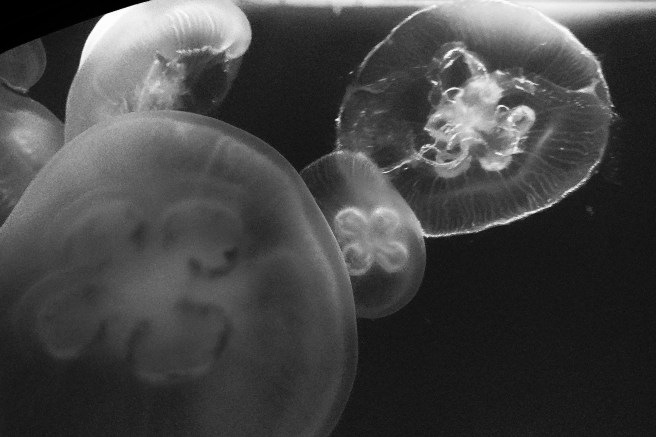
JellyfishB&W2 (1 of 1)

The girl was on her way to Walgreens to pick up her mother’s medication when she found the dead jellyfish on the street corner under that one lamppost that always worked. It wasn’t just one jellyfish, but twenty, thirty, maybe more. They lay in small iridescent globules, some strewn on the sidewalk, others slopped carelessly onto the edge of the sewer grate.

As she watched, wisps like smoke rose from the dead jellyfish and hung several feet about concrete, bobbing up and down like they were submerged in stormy waters. The girl thought the wisps must be the ghosts of all the jellyfish and she wondered when her mother died if she would be able to see her ghost rise and hover.

The girl had heard that jellyfish were biologically immortal, that they would naturally live forever, and she wondered if these dead before her had known it was coming, if they had planned their last days accordingly, or if they had been torn from a life everlasting like slaughtered angels.

The jellyfish ghosts cast morphing shadows on the dirty ground beneath the ever-steady lamplight, moving into and through one another, bringing out strange images from the cacophony of movement like unintentional shadow puppets. The girl pulled out strange, fantastical shapes as if she was laying on her back watching the clouds.

When she was healthy several years ago, the girl’s mother used to make shadow puppets with her hands on the wall of their apartment. She would turn off the lights and use a candle as backlight, so the images flickered and grew and danced on the wall with the slightest extra breath or movement in the air. A dove could become a dragon, a shark a leviathan, a butterfly a huge bird of prey, all if she laughed too near the candle. She learned to hold in the laughter, so the air would be still, so the shadows could be what her mother intended. Now, her mother’s hands have twisted into tough claws, slow moving and incapable of making anything like they used to.

The girl stood transfixed for a long time, watching the ghosts of the jellyfish paint in shadows on the concrete. If the ghosts of the jellyfish, continued only to bob foolishly, they’d be there forever. The thought made her angry and she screamed at the jellyfish to leave, to go, to get the hell out. They didn’t leave. They wouldn’t leave. She was crying soon and yelling unintelligibly—a deep throaty yell rising in pitch until it was more of a screech than anything. She balled her fists, she stomped her feet, knowing she was too old for a tantrum but unable to stop it erupting from her.

Why wouldn’t they leave? Didn’t they know they could go? Are they all so stupid just to bob there under the lamppost?

Her voice gave out and she rushed forward swatting at the ghosts and immediately pulled back her hand, stung. It wasn’t a sharp pain, or piercing, or electrifying like it might have been if the jellyfish had been alive, but rather a down-to-the-bone pain, like slow pressure on a deep bruise.

The girl left them there then, running off and forgetting her errand. Later when she was home, she remembered reading, though she couldn’t recall where, that a group of jellyfish was called a bloom or a smack. The text hadn’t specified if there was any difference between the application of the names.

Image result for jellyfish clip art black and white

Evan James Sheldon’s work has appeared in CHEAP POP, Ghost City Review, and Pithead Chapel, among others. He is an Assistant Editor for F(r)iction and an Outreach Assistant for Brink Literacy Project.

photo: @__varinia__
submit to south broadway ghost society.

things i hate: a process of progession – dalton telschow

IMG_3670

1. List Poems
2. Stealing memes and turning them into poems
3. Irony
4. Lists
5. Repetition
F. Inconsistentcy
7. Acting like something never happened
8. Continuing to hate at all
9. Seriously tho lists
10. Maybe structure? Order? 9a: am I a fan of the static? Am I encouraging it like I never was?Nurturing it like a baby bird when it’s actually a metaphor for chaos if I built that metaphor correctly. Put the right structure into it. Loved and tended to it like it was my child
11. I’m never having children. I’ve seen the wires of my mind, and I wouldn’t wish anyone else to be wrapped up in them.
12. I’m wrapping myself in wires and cables and playing guitar so loud that the tar retreats, if only for a moment
13. I’m learning to live in moments, and grateful there are so many of them
14. My god there are so many of them and a lot of my wires are frayed now
15. I’ve forgotten so many moments. My brain has been fried and smoked from pills and pot and I have failed to see the mechanics in coping. Now I just see the gears turning. Everywhere.
16. Apophenia is the perception that unrelated phenomena are connected
17. Fuck
18. My art shall be my children, and when I’m gone hopefully they help make this world a better place than when I got here
19. Hopefully
20. A better place
21. Than when I got here
22. Ending abruptly.

sbgs cowskull

Charles Dalton Telschow is a Denver artist on the cusp of 25, and he has just released his second book of original poetry, “Blueprints For Bridgeburning”, available on Bandcamp. Telschow is also the man behind the upcoming local solo music act, The Polite Heretic.

photo: @fm.ghost

submit to south broadway ghost society.

hydronicus invicta – c.c. hannett / kmwgh

seigar crucifix head

Sonic-tidal | Pareidolia | How does a whirlpool breathe? I see what you did there |
You blew out the stretch marks of your blimpish gut | Popped yrself a pair of gills |
Oxygenic tummy wounds | Flabby respirators | I get it | Vision returned in the form
of engorged areola | Optic tentacles | Gastropodic Nips | Auditory axilla | To tell
you a secret is to endure rough odors | But how do you eat? How do you eat with
waves? You punctured your own belly button, is it? With those long and jagged nails
| You’ve filed w/ barnacles | You fisted the pit; an orifice | Broke off your little
slashers | Stabbed ‘em into dentures | That hungry tummy chews for itself | Gored |
Self-mutilation as a method to resurrect and experience the joys of experience |
Fulfilling scars—

cropped-0-planchette.jpg

Kris Hall / C. C. Hannett / kmwgh is a writer who feels queasy when he identifies himself as a writer. Or anything, really. Author of I Gave This Dream to a Color, Triune, and SAGA ctrl (Spuyten Duyvil) + a number of chapbooks. He is the event organizer for Quake: An Everett Lit Crawl and Poetry: Uncharted. Currently, he is the Managing Editor for Really Serious Literature (@rlysrslit) and their Disappearing Chapbook Series. Work has been placed with Softblow, DREGINALD, Gramma, Juked, etc. He currently lives with his wife and three animals somewhere in the PNW and/or behind you.

Photo: @jseigar

Submit to South Broadway Ghost Society.

blindfold chess – mark j. mitchell

_DSC0110

A memory built
of white and black squares
where pieces you
can’t quite see walk,
hop and battle.

Sets get mixed—
his queen doesn’t match
your castle
and liveried knights
wander questlessly.

You focus your
weary brain, fierce
as any bishop’s but
you just can’t remember
your next move.

cropped-0-planchette.jpg

Mark J. Mitchell’s latest novel, The Magic War just appeared from Loose Leaves Publishing .A Full length collection of poems will released next year by Encircle Publications.  He studied writing at UC Santa Cruz under Raymond Carver and George Hitchcock. His work has appeared in the several anthologies and hundreds of periodicals. Three of his chapbooks— Three Visitors, Lent, 1999, and Artifacts and Relics—and the novel, Knight Prisoner are available through Amazon and Barnes and Noble.  He lives with his wife the activist and documentarian, Joan Juster and makes a living pointing out pretty things in San Francisco.

A meager online presence can be found at https://www.facebook.com/MarkJMitchellwriter/

Photo: @sweetdangerzack

submit to south broadway ghost society.


lake effect snow – r. gerry fabian

0 0 lake effect

You come up from bayou country
all skinny and tanned
with your herbal teas
and crushed roots
warning of magic voodoo spells
in an accent barely understandable.

This is western Pennsylvania
where hex signs are powerful
and pig iron and slag
heat muscles forged from steel.
The people here
eat scrapple and pierogies
for breakfast
and
dance in blizzards
just to entertain themselves.

0 planchette

R. Gerry Fabian is a retired English instructor. He has been publishing poetry since 1972 in various poetry magazines. His web page is rgerryfabian.wordpress.com. He is the editor of Raw Dog Press. His novels, Memphis Masquerade, Getting Lucky (The Story) and published poetry book, Parallels are available at Smashwords and all other ebook stores. Seventh Sense, his third novel has been published by Smashwords. His second book of published poems, Coming Out Of The Atlantic is slated for publication in 2019.

submit to south broadway ghost society.

growing a pair (of horns) – heidi gonzalez

horns

I know how to survive
With rats scattered in the attic
Of my head space
I know how to survive
Without a drop of body in water
From the end of a week to chapter 24 of a book
I know how to survive
With people pulling my hair
Spitting in my face because they hate that I am
.
.
.
Can I write myself an end where
Everyone disappears and
Is it possible to write a scene
Where the little girl grows horns
To keep herself safe
From harm
99 highways
99 pathways to take.
I can cross every single one
Letting the ocean wave
Send me on a different way
Past mountains of straw
[*Missing the green parts
Past whining bitches
Who never get enough of spitting in my hair]

cropped-0-planchette.jpg

Heidi Miranda is a poet that writes about LGBT issues as well as the fight to balance mental health and the ongoing journey of self discovery. Her work is soon to be featured in Harvard’s newsletter, Palabritas. She is currently working on a novel and is active on social media [Instagram: @weepingblueberry].

photo: Vincent Erhart via Unsplash

submit to south broadway ghost society.

bag of eyes – david rawson

When I took Holly to the waterfront, she told me I was destined to be a father.

“You’re going to have a girl,” she said. “And you’re going to raise her alone.”

Holly and I had been hanging out a lot the last few weeks, staying up til 4am walking around her neighborhood. One night we laid down in the middle of the street at the end of the cul de sac. No cars came. And if they had, we would have seen them coming. As I curled up in one of the blankets we had brought with us, Holly climbed up a tree that the cul de sac had been built around. It stood surrounded by pavement on all sides. I had to look down as she climbed because small leaves, twigs, and dust fell from where she rustled. I protected my eyes, and even though nothing had gotten in them, I felt them swell and water.

This trip to the waterfront was my attempt to expand our relationship, to begin to define it. I was nineteen and barely knew myself, let alone how to date this beautiful independent woman who, although she was my age, had secrets in her eyes I could not begin to uncover. She was a lion. She had an unruly mane of hair that she was always trying to move out of her eyes. She was looking out at the water. We barely spoke. I did not know how to respond. I knew I did not want kids, but I never told people I dated what I really wanted. I didn’t want to scare anyone off.

“Yeah, I haven’t given it a lot of thought, to be honest,” I said. “It all depends on the person, you know?”

But she had already decided I would be alone. Whoever the mother would be was already gone, unreachable. Although Holly was a few feet away from me, she could have been a sea away.

We sat on the rock by the waterfront on the same blankets we had used in the cul de sac. She was telling me she hated her nose. She said she thinks it is too big. She didn’t look at me. She looked at the water. I didn’t know what to say. It was a big nose if you isolated it, if you took it out of context and held it in your palm. I imagined holding her nose in my hand. She looked down at her stomach.

“I’m going to get a nose job my last year of college. And I’ll probably have my stomach done.”

She did not mention her eyes. She loved her glasses. The way she stroked the frames gently with her index fingers. The glasses framed her eyes perfectly, and she knew it. The nerdy infatuation I felt for her intensified every time she tilted her head down and looked up at me, when my world became those eyes perfectly framed.

The whole time we were talking, I had been watching two brothers, no older than twelve. Their father was nearby sitting down in a chair he had brought with him, a retractable one he had brought in a bag slung over his shoulder. He had a simple fishing rod that he held loosely in his hand. Every once in a while, he brought up a fish. His two boys were doing something on a bit of pavement down from us, near the cooler the father was placing the fish in. They were quiet, looking down at the pavement, doing something with their hands, like tracing something out deliberately.

After the boys left with their father, Holly and I stood up to leave. And we could see down the way to the pavemented area, and we could see what the boys had been doing so meticulously. Twenty-three stiff fish bodies laid rotting in the sun. The father had not taken any of the fish to eat later. It struck me in the gut as a waste of life, to catch and discard on hot pavement. It was death without a function. And then I saw what the brothers had been doing so meticulously. They had taken out the eyes. Forty-six eyes altogether that they had cut out together, as a team. The eyes were nowhere to be seen. Perhaps they kept them. Somewhere there was a bag full of fish eyes.

I attempted to move the dead fish off the pavement into the water. I picked up two big sticks and attempted to move one, like I was using enormous chopsticks. Holly halfheartedly followed my lead. She said nothing. I could not measure her discomfort or shock. She would not look at me.

I got one fish into the water, but it floated vertically, its mouth open, holes for eyes.

When I dropped her off at her car after a silent drive back, she hugged me and looked up at my eyes for the first time that day. It became clear. We were not going to talk about the fish.

“You’ll probably name her something like Penelope. She’ll draw on your walls with crayon, but you won’t care. You’ll pick up a crayon and draw right along with her.”

I laughed a hollow laugh and nodded. “You can always wash a wall,” I said.

In the reflection of her car, I saw Penelope, but just for a brief moment. She was wearing a summer dress and ballet slippers, and the Robin’s Egg Blue crayon was tight in her hand as she drew a vertical line from as far as her arm would reach above her head to the moment she can feel the touch of her hand against her toes.

But then just as quickly as I had seen her, she was gone. And without consciously trying, another image flooded my brain: a small Ziploc bag full of fish eyes, in an underwear drawer somewhere, covered in t-shirts and boxers, a testament to a productive day.

cropped-0-planchette1.jpg

David Rawson is the author of A Jellyfish for Every Name and Proximity (ELJ Editions).

submit to south broadway ghost society.

down the cellar stairs – william doreski

Corkscrewing down the cellar stairs,
I dare the worn planks to creak
or otherwise betray me. Pie-slice
wedge-steps work a right angle.
The handrail’s a linear sketch,
a crippled M-shape warped
along the concrete foundation,
then bent across a partition
painted gray half a century past.

Framed in dark, the lit stairway
flowers like something sinister,
something overripe and seeding
in the ruined old greenhouse in France
I visited decades ago.
Monet would have liked that greenhouse
with its slats and lattices of sun
trilling through the broken glass.

No natural light to ease this cellar,
no lambent blossoms run wild—
only muscled shadows thick enough
to trouble me as I descend
to face a house-wide expanse
of dusty floor and clumsy objects
of competing dimensions conspiring
in shades too subtle to parse.

cropped-cropped-cropped-sobogoso.png

William Doreski has published three critical studies and several collections of poetry. His work has appeared in various journals. He has taught writing and literature at Emerson, Goddard, Boston University, and Keene State College. His new poetry collection is A Black River, A Dark Fall.

submit to soboghoso.