I finally stood, happy at disrobement Brought about by some principalities Some fundamental truths not escaped Alone, free, tied to each being Nakedness in the forming. I tried to put a stop to it Afraid once, though only once Allowing layer upon layer to melt Slither away into better forms – Serve better suited seekers And quickly I latched on to the fact of my emblazoned bare Such a funny patch; so many distinct markings – though all in all a large converging pink Naked, as naked as one may be.
Abhishek Todmal is a writer based in Pune, India. He is currently working on his first novel – a piece of comedic fiction. His poetry has most recently been featured in an issue of DASH Literary Journal. Amongst other things, he enjoys keeping active and loitering aimlessly under the sun.
A poem which may be mistaken for the thank you letter I read out loud to the funders of the prestigious fellowship I won last summer, a fellowship which did absolutely fuck all to save my Autistic Black Muslim Body from being interrogated by those CBP/TSA terrorists at the airport
It strikes me as odd that this school, this fellowship, has no protocols in place for students that are forcibly interrogated at the border. I guess I shouldn’t expect much from an institution, and I guess I should bite my tongue and do the polite thing, talk about how amazing my trip was. But my trip was not amazing. It was fraught, painful, nerve-wracking. I was sick from the moment I got there to the moment I left. I walked into all types of bureaucratic walls—people not believing I was actually there to do research, and so forth. Worst of all, when I needed medical help, I had to pay out of pocket because the insurance was a formality. Oh sure, they reimbursed me for the expenses, but only partially. The idea of a medical evacuation was dangled before me, but I quickly lost hope in that. I was sick to my stomach the day I boarded my return flight, cutting my trip a full month short. Besides pain, all I had on my mind was TSA/CBP. Would they harass me? Where is home for someone like me? I am an Autistic Somali Man traveling from Kenya—that’s a perfect terrorist profile I fit. 20 Some hours later, I arrived in the states. They ask me pedantic questions about my research and MN Nice me with “good for you.” They do all this as they shuffle me into a tertiary screening line, confronted by lazy feds with mustard stains on their plaid shirts. I know what questions they want to ask me, because I’ve seen this movie before. But I refuse to answer their questions. I watch the older Somali man – the only other person asked to go to this special line before we can leave the airport – duck his head and smile and comply with their hellacious line of questioning. I stand my ground like a Zimmerman defense. But I am also weak. I can barely stand. They threaten to go through my luggage down to the underwear. To confiscate my devices and see who I’ve been talking to. We can do this the easy way or the hard way, they tell me. I can feel my heartbeat racing every time I recall this memory. There are no words to describe how livid I was when I finally got home—after answering their stupid questions, knowing I had no choice, feeling like a failure for acquiescing. I emailed my contacts at the university, both in my department and at the fellowship. There were a bunch of emails back and forth, a lot of concern and apologizing, but I knew nothing would come of it. I knew I would not see justice, just as I knew I was labeled a terrorist from a piece of shit country the moment I was born. I reached out to CAIR, the ACLU, filed formal complaints with CBP. Nothing nothing nothing came of any of it. All of this reinforced the idea that my life is worthless. Absolutely meaningless. And that is why I do the work I do, write the way I do, and live the way I do. I have no choice. I wish I could say I’ll be applying for this fellowship again. I have no reason to. And if I could go back in time, I wouldn’t have applied in the first place. Thanks for your time.
*Author’s Note: All of this really happened, from the events in the poem, to my reading this to the people who partially funded my trip. I was supposed to be more grateful, I guess? Funny, I’ve never felt good about thanking white people for anything, least of all a few measly dollars. Sometimes poems are all we have to cuss people out with. And if they wanna cuss back, well, I guess they’ll have to learn how to write poetry first. That’s a joke. Laugh./
Said Shaiye is an Autistic Somali Writer & Photographer. His debut book, Are You Borg Now? was a 2022 Minnesota Book Award Finalist in Creative Nonfiction & Memoir. He has contributed essays to the anthologies Muslim American Writers at Home, The Texas Review’s All-Poetry Issue, and We Are Meant to Rise: Voices for Justice from Minneapolis to the World. He has published poetry & prose in Obsidian, Brittle Paper,Pithead Chapel, 580 Split, Entropy, Diagram, Rigorous, Night Heron Barks, and elsewhere. He holds an MFA from the University of Minnesota, where he was a Graduate Instructor of Creative Writing, as well as a Judd International Research Fellow. He teaches writing to Autistic kids through Unrestricted Interest, as well as in the English Departments of several colleges in the Twin Cities.
This poem is from South Broadway Press’ new anthology, Dwell: Poems About Home.Purchase here.
it’s no longer the Elysian Fields, this barrio, but the shrine of the sinner is still decorated in the pocket park across from the elementary school and the bakery
El Tiradito may be crumbling but notes from the heartbroken still decorate the grave of the unknown some say a man killed in a knife fight over a woman buried on unconsecrated ground as doves wheel from the cathedral
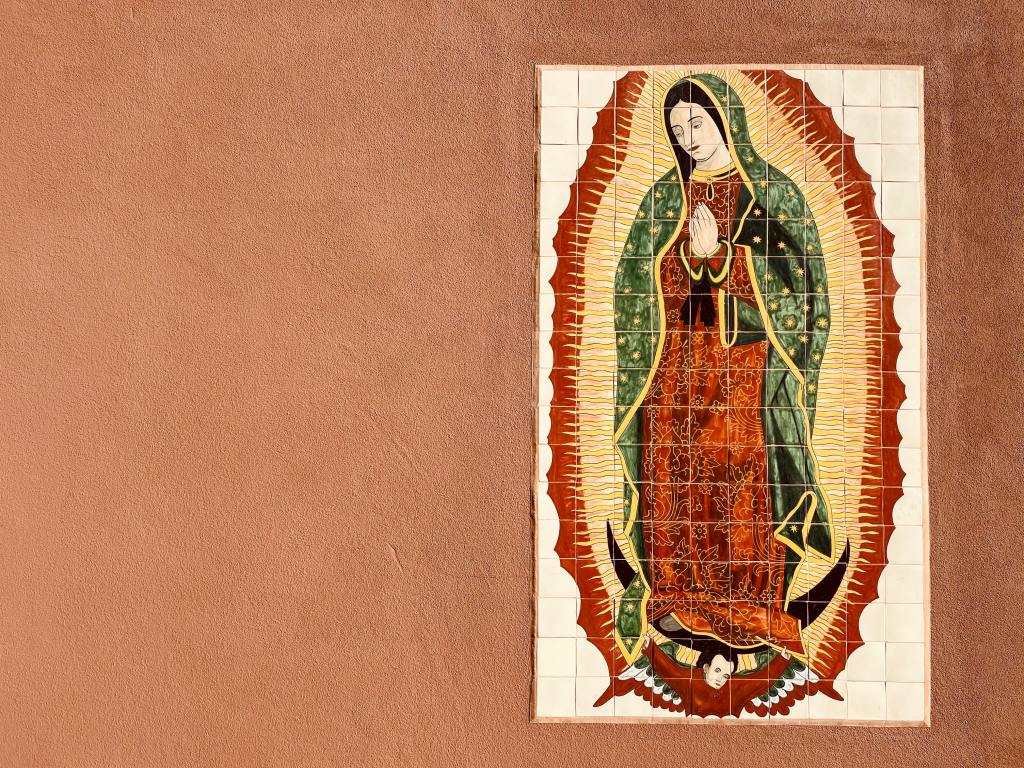
wishes on slips of paper pushed between adobe bricks a panhandler asked for money but I refused walking away from the great altar of the Virgin of Guadalupe
I’m neither wholly good nor bad I don’t even try anymore to be myself because I don’t know who that is although I did buy a slice of jelly roll and two doughnuts at Estrella’s
and all that is left at the bottom of the paper bag is crumbs but whether for birds or wind— you tell me— I can’t decide
Miriam Sagan is the author of over thirty books of poetry, fiction, and memoir. Her most recent include Bluebeard’s Castle (Red Mountain, 2019) and A Hundred Cups of Coffee (Tres Chicas, 2019). She is a two-time winner of the New Mexico/Arizona Book Awards as well as a recipient of the City of Santa Fe Mayor’s Award for Excellence in the Arts and a New Mexico Literary Arts Gratitude Award. She has been a writer in residence in four national parks, Yaddo, MacDowell, Gullkistan in Iceland, Kura Studio in Japan, and a dozen more remote and interesting places. She works with text and sculptural installation as part of the creative team Maternal Mitochondria in venues ranging from RV Parks to galleries. She founded and directed the creative writing program at Santa Fe Community College until her retirement.
She stands there, clearly, near me A girl, not so small Ten years or more I think Also blonde With brown eyes Same as me And she speaks to me in German No English? I say No. Why young lady We are not in Germany Nobody here knows German I have to know German She tells me I have to write in German What did you write then? My dreams And nobody can see Just me And now you I am just a foreigner in your life No. You are my dream In the United States, I dreamed of you in German And I wrote everything down At that moment, I realized That girl and me – we Are the same woman And I remember very well why I couldn’t write in English In my American West My American mother would read everything And my Romanian father was telling me Green horses on the walls And suddenly I see clearly That the dreams I wrote down at age 10 Have all come true I cannot believe that But am I simply happy And also a little alone with myself And together with this world
Mein Traum Original German
Sie steht da, klar, in meiner Nähe Ein Mädchen, nicht so klein Seit zehn Jahre oder so Ich glaube Auch blond Mit braunen Augen Das gleich wie ich Und sie spreche zu mir auf Deutsch Kein English? Sag ich Nein. Wie so Liebling? Wir sind nicht in Deutschland Niemand hier kennt Deutsch Ich muss Deutsch kennen Sie mir sagt Ich muss auf Deutsch schreiben Was hast du dann geschrieben? Meine Träume Und niemand kann sehen Nur ich Und jetzt du Was ist dann passiert? Ich bin nur Ausländer in dein Leben Nein. Du bist mein Traum In der Vereinigte Staaten hab ich an dich auf Deutsch getraumt Und ich hab alles geschrieben In diesen Moment, mir war klar Das dieses Mädchen und ich Sind die gleiche Frau Und ich erinnere mich sehr warum ich konnte auf English nicht schreiben In meinem Amerikanische West Meine Amerikanische Mutter wurde alles lesen Und meine Rumänisch Vater wurde mir sagen Grüne Pferde an den Wänden Und plötzlich sehe ich klar Das meine Träume geschriebt auf nur zehn Jahren Sind ganz passiert Ich kann das nicht glauben Aber bin ich einfach glücklich Und auch ein bisschen allein mit meinen Selbst Und zusammen mit dieser Welt
Cristina A. Bejan is an award-winning Romanian-American historian, theatre artist, and poet. A Rhodes and Fulbright scholar, she is a professor at Metropolitan State University of Denver. Bejan received her DPhil (PhD) in Modern History from the University of Oxford. A playwright and spoken word poet (her stage name is Lady Godiva), her creative work has appeared in the US, UK, Romania, and Vanuatu. In addition to many scholarly articles, she has published a poetry book (Green Horses on the Walls), history book (Intellectuals and Fascism in Interwar Romania), and a play in Voices on the Move (eds. Radulescu and Cazan).
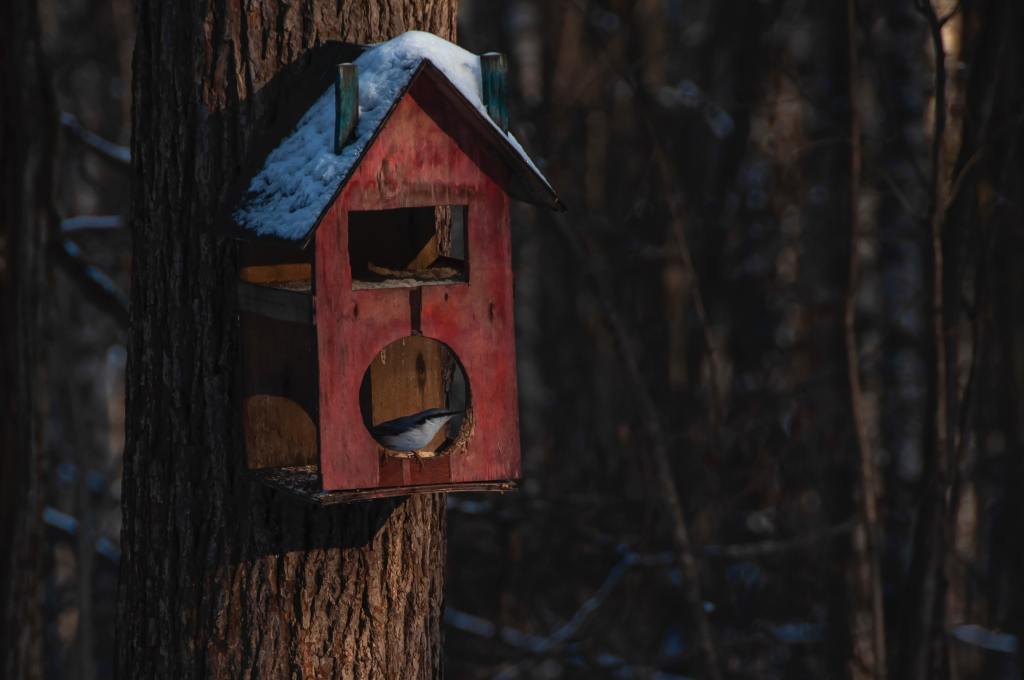
I pretend the red-breasted nuthatches know what you might have said beneath the plum tree last spring before your cell phone rang and you took the call that said your mother had only hours left to live so you ran to your Subaru and took off for Boston and left me holding the thread of a message that might have been only connection and which I wanted to be love, the kind of love that makes swallows dive and nuthatches hang upside down.
Now these little birds flit about in winter’s snow, back and forth above where we sat on a blue fleece blanket, and they tweet what you haven’t, that you miss me and will get back as soon as you can. You have had the estate to manage for your wayward sister and her addictions which you feel responsible for now that neither of you have a parent, no one in the old house to hold things together.
Your family tree snapped. Your sister floated off like letters let go into the wind. Invoices you never intend to pay. The sketch you made of me with my blouse hanging off my shoulder when the sun’s warmth gave me hope that you felt the same correspondence I do; we are meant to be together. And my breast was warm, wanting to be touched; breast cancer took her. Maybe your genes are faulty.
Those little birds continue our talk in the crotch of the trees. Bluejays push them away from the feeder, but they return all flibbertigibbet, so here I’ve drawn a nuthatch on a postcard and colored the breast pink to say spring will come again and I am still here for you, hearing nuthatches tuck away what they need for later.
Tricia Knoll is an aging poet living alone in the woods in Vermont on the unceded land of the Abenaki. Her work appears widely in journals and anthologies. Her recent collection Checkered Mates (Kelsay Books) focuses on relationships that work and those that don’t. Website: triciaknoll.com
The cold stars clicking their claws together like crabs in a tank. History changes and runs off the page like butter. The world has been dragged through me, and I’ve been dragged through the world. We’re even. Stars twirl over stinking trenches, beginning a subtle magnetic resurrection that will take all time and never end. The mind is a machine to move matter. The scenes are super modern. The earth has us, and we multiply. Founded in an impulse of wild lonely need, not serious planning. The stars dissolve in my mouth not my hand. Let this life not be a torment. Let the stars stop shaking. Please, God. I will turn my greatest tricks for you.
Zack Kopp is a freelance writer, editor, photographer, graphic artist, and literary agent currently living in Denver, Colorado. His informal history of the Beat Generation’s connections with Denver was published by The History Press in 2015. Kopp’s books are available at Amazon, and you can find his blog at the website for his indie hybrid press at www.campelasticity.com featuring interviews and articles and links to other websites. His improvised novel, Public Hair, was described by one critic as “simultaneously the best and worst book ever.” The latest chapter of Kopp’s “fantastic biography” (Cf. Billy Childish), Henry Crank’s History of Wonders is expected in 2022.
Come, again, and walk beside me down the verdant path, ‘cross this deathly sprawl, reading poetry from tombstones and the yellowed pages of your tattered Lorca. How sweet the ballads and laments on the breeze that sift through soft yews— just yonder— that shake like fists at wrought-iron gates— at Heaven— clutching their red burdens (in clusters) like beating hearts to breasts of evergreen. Dance with me to the whispers of cypress trees— so tall they cut the sky, bloodying what God painted blue, and the laughter of boys and girls, as they duck and dart from behind the pale bounty of this garden of stone, reveling in perpetual games of tag and Hide & Seek. Will you find me at dewy dawn amongst sprays of grocery store bouquets in cellophane wrappings that cry silent tears? Or in the cold of a moonrise, contemplating our stars and the gossip of earthworms? When…o when, will I see you, again? Will memory outlast the letters of my name? Loneliness the promise? There is no end (so it seems) to this longing, our endless game (Who hides? Who seeks?), just a stone on my pillow and the endless promise of evergreen.
David Estringel is a Xicanx writer/poet with works published in literary publications, such as The Opiate, Azahares, Cephalorpress, Lahar, Poetry Ni, DREICH, Somos En Escrito, Ethel, The Milk House, Beir Bua Journal, and The Blue Nib. His first collection of poetry and short fiction Indelible Fingerprints was published April 2019, followed Blood Honey and Cold Comfort House in 2022. David has written five poetry chapbooks, Punctures, PeripherieS, Eating Pears on the Rooftop, as well as Golden Calves and Blue (coming 2023). His new book of micro poetry little punctures will be released in December 2022. Connect with David on Twitter @The_Booky_Man and his website www.davidaestringel.com.
Om of the lawnmower motor, the meditative motion begins, this tracing of the sacred square.
Castes least enlightened outsource, content to admire aesthetics from afar. The devout deny such urges, don robes of an ancestral order: button down western shirts, before mounting mini John Deeres, while those nearest nirvana self-propel, lean step by measured step into each swath as if laying down something native on a Kansas prairie.
Cut grass like incense awakens the senses.
Emptying themselves of the envy within the outward gaze across the fence, these Midwestern monks are quite conscious of their lot, rectangular orbits mere representations of the workings and wonder of the cosmos.
Prostration is sometimes required, negotiating with the earth over weeds noxious, obnoxious, other blessed imperfections.
A single blade clings to the sweat on an arm, the rest released to the currents of June rain or a.m. sprinklers, the mandala regenerating perpetually.
Each steward inhales, exhales, accepting this perfection ephemeral, embracing this transience and a want for nothing.
Boyd Bauman grew up on a small ranch south of Bern, Kansas. His dad was a storyteller and his mom the family scribe. He has published two books of poetry: Cleave and Scheherazade Plays the Chestnut Tree Café. After stints in New York, Colorado, Alaska, Japan, and Vietnam, Boyd now is a librarian and writer in Kansas City, inspired by his three lovely muses. Visit at boydbauman.weebly.com.
This poem is from South Broadway Press’ new anthology, Dwell: Poems About Home.Purchase here.
Sittin’ at the kitchen table—cup of black coffee in one hand, cigarette in the other—I look past catches of blue paint and the remains of flies on screen door mesh, toward the sorghum field just beyond the ranch gate. Death’s stillness—a gravity all its own—has seeped into every corner, permeated the grout of tiled countertops and spaces in between fruit magnates on the old, white Frigidaire like the smell of rabbit in the oven or hints of storm riding out on the breeze. Life’s left the room—no pulse under these linoleum tiles—it seems, leaving it darker, a bit colder, despite morning’s come to call through the window above the sink. I take another sip—bitter on the tongue—then a drag (or two), finding myself—absent-minded–fingering the contents of a chipped, pink and white bowl of green stamp china (of which she was so proud). Four pennies, two dimes, and a nickel. Two rusty paper clips. A half-used packet of B&C headache powder. A dead fly. I remember eating from it—sweetened raspberries, red and golden, from bushes in the garden—when I was small. How I’d toss them back in grubby fistfuls, between chokes on the juice, as honied explosions—sour and sweet—took me to Heaven and back then ‘round, again, while she looked out the screen door, tossing hair from her eyes—cup of black coffee in one hand, cigarette in the other—staring at my father working in the field, beyond.
David Estringel is a Xicanx writer/poet with works published in literary publications, such as The Opiate, Azahares, Cephalorpress, Lahar, Poetry Ni, DREICH, Somos En Escrito, Ethel, The Milk House, Beir Bua Journal, and The Blue Nib. His first collection of poetry and short fiction Indelible Fingerprints was published April 2019, followed Blood Honey and Cold Comfort House in 2022. David has written five poetry chapbooks, Punctures, PeripherieS, Eating Pears on the Rooftop, as well as Golden Calves and Blue (coming 2023). His new book of micro poetry little punctures will be released in December 2022. Connect with David on Twitter @The_Booky_Man and his website www.davidaestringel.com.
This poem is from South Broadway Press’ new anthology, Dwell: Poems About Home.Purchase here.
Growing up, my home was a closet. Not the metaphorical closet where I tucked my sexuality. More precisely, my home was an 8x11in guide to Colorado fish my grandfather gave me to mold my sexuality. Which I tucked inside my closet. In which were tucked letters to my adolescent loves like Jamie, Ally, Shelly, and Jack (especially to Jack). In which, I dreamed of our skeletal home without closets. Where my mother did not tuck her guilt, and the father did not tuck his abusive addictions. Where Jack drove the Hot Wheels car he gave me after our play date. Just like Ken in Aqua’s Barbie Doll.
There is no instruction manual with the postscript delivered by the owl to your closet proclaiming, “You’re a homosexual, Harry.” By trial and error, you come to understand the fragility of home. And the fragility of queer. And how both must often be constructed like lean-tos on the pull-out couches of allies.
Like tornados, like earthquakes, like tsunamis, like men in I.C.E. uniforms, my nature was a disaster a home could not weather. So, home became a lonely rainbow. A refraction of tears staining pictures of cutthroat trout.
Whether by cosmic dramatic irony or systematic oppression, when your home is queer, so often your home becomes a bar. Where fags bundle like fags. And smoke fags. And drink like, well, like fish. Most of whom are obsessed with being fish. So, I learned a new language that gave transformative space to my transient home. Sashay! Shontay! Cinched! Boots the house down! Beat for the gods!
I learned that language, too, was a home. Ours was one that could not be deciphered. Because no one cares to decipher why our family struggles with substance abuse at nearly twice the average rate. How our expansive forest of intersectional trees denoting our lineage drinks from a stigmatized watering hole. Yet, the branches stay sturdy enough for us to take our lives at five times the average rate.
I have read enough obituaries to know how mine may sound. Taken unexpectedly. After a long struggle. As if the struggle was never an indication of the homophobe. Or the revolver. Or how unsurprisingly often they’re the same. I mean, the gay homophobe with a revolver. Taking a family with him that would have died to show him how to live. In a home called queer.
I will be survived by a long list of family that never embraced me. With no mention of the love that allowed me to survive.
But I have found home.
My home is not a structure I ride shotgun to in Jack’s hot wheel car. Home is not a bed on which I lay my head when the world insists I don’t belong. My home cannot be taken by a natural or xenophobic disaster. Home is not a mortality statistic. My home is not an early grave.
My home is queer.
And I vow my home will always be open to anyone who thinks theirs is just a closet filled with unread love letters.
Caleb Ferganchick is a rural, queer, slam poet activist and author of Poetry Heels (2018). His work has been featured and published by the South Broadway Ghost Society (2020, 2021), “Slam Ur Ex ((the podcast))” (2020), and the Colorado Mesa University Literary Review. He organizes the annual “Slamming Bricks” poetry slam competition in honor of the 1969 Stonewall Riots and serves as a board member to Western Colorado Writer’s Form. A SUP river guide, Caleb also dreams of establishing a queer commune with a river otter rescue and falconry. He lives in Grand Junction, Colorado.
This poem is from South Broadway Press’ new anthology, Dwell: Poems About Home.Purchase here.










 south broadway press