I am dreaming of An Alabama night- Crickets chirping; echoing Of sentiment, breaking The song of the loon Diving, strutting Through phrases, phases Of a honeysuckle Milk glass moon Whose distant sway Ripples, pools, pulls Pebbled ponds, precious pearls Where locals gather To swim, fish, skip stones Across reflections of sky and stars.
I am. falling, failing- Form fleeing a cold city An asp escaping This fruitless orchard A moth chained by the Candlelight of a distant beacon.
I close my eyes See the pines, skies White wings, fluttering Glittering patchwork Transforming. I am again A small-town boy Taking the back road, Wooded path winding To the Jackson-Slaughter bridge; Racing in the pecan grove, Chasing shadows, fireflies; Laughing, dreaming, laying Staring, believing- feeling The force; the iron vein Of a vanishing home- Remembering more from Windows that never close A place I no longer belong.
M. Palowski Moore is a poet, writer and storyteller. He has five volumes of poetry, including the Lambda Award nominee BURNING BLUE. His compositions reflect diverse themes and interpretations of prejudice, racism, socioeconomic inequality, homophobia and systemic oppression. He is a contributing poet to the Civil Rights Memorial Center (SPLC) community poem A CIVIL COMMUNITY, a new exhibit that will be featured inside the final gallery of The Civil Rights Memorial Center.
This poem is from South Broadway Press’ new anthology, Dwell: Poems About Home.Purchase here.
Every body has a right to shelter in a home. To be safe from cold, the heat, the storm.
///
We want a house built by the people / we want walls of justice / we want liberation / we want windows and doors of possibility / look outside / in a world where everyone has a home / anything is possible / how do we transform /
///
“Home is where the heart is.” The heart is the size of your fist. Some things are worth fighting for.
///
Homelessness is not a choice.
Criminalizing survival is unconstitutional.[1]
///
The body— my body is made of rooms of memory— The body— my body is made of hallways— The body— my body does not remember— The body— my body remembers everything
///
Here is my skin. Imagine all of the things I have touched. Here are my bones.
///
I do not remember leaving the dwelling of my mother’s body. I do not remember being born.
///
What does it mean to care for another?
[1] Denverhomelessoutloud.org
Liza Sparks (she/her) is an intersectional feminist, writer, poet, and creative. She is a brown-multiracial-queer-woman living and working in Colorado. Her work has appeared with Ghost City Review, Bozalta Collective, Cosmonauts Avenue, and many others; and is forthcoming with Honey Literary, Split This Rock’s social justice database—The Quarry, and will be included in Nonwhite and Woman Anthology published by Woodhall Press in 2022. Liza was a semifinalist for Button Poetry’s Chapbook contest in 2018 and was a finalist for Denver Lighthouse Writers Workshop Emerging Writer Fellowship in Poetry in 2020 and 2019. She is a poetry reader for The Chestnut Review. You can read more of Liza’s work at lizasparks.com, IG @sparksliza534, or TW @lizathepoet.
This poem is from South Broadway Press’ new anthology, Dwell: Poems About Home.Purchase here.
You open the apartment door and it is just wood. Wood behind the door. You need to enter your apartment. To sleep. To work. To clean. You burrow into the wood with a small drill bore. You carve a desk inside the wood. You leave legs of the wood in each corner of the room so the wood roof doesn’t collapse on you, crushed by mahogany in the night. You wake one day and it is raining paper. A hole has split in the wood from all the paper where it was leaking from the bathtub upstairs. The paper is covered in all your upstairs neighbor’s poetry. Your upstairs neighbor is always so loud, crying for whole weeks at a time. Your neighbor is so loud the sound bleeds through the mahogany. The mahogany is now spilling into your bed, your bed you carved yourself out of the desk, the desk which appeared behind the door, the apartment which was drowned in poetry. The future that is always words.
Wheeler Light is an MFA candidate at the University of Virginia. His work has appeared or is forthcoming in Hobart, Pretty Owl Poetry, The Penn Review, and Broadsided Press, among others. His work can be found at www.wheelerlight.net
This poem is from South Broadway Press’ new anthology, Dwell: Poems About Home.Purchase here.
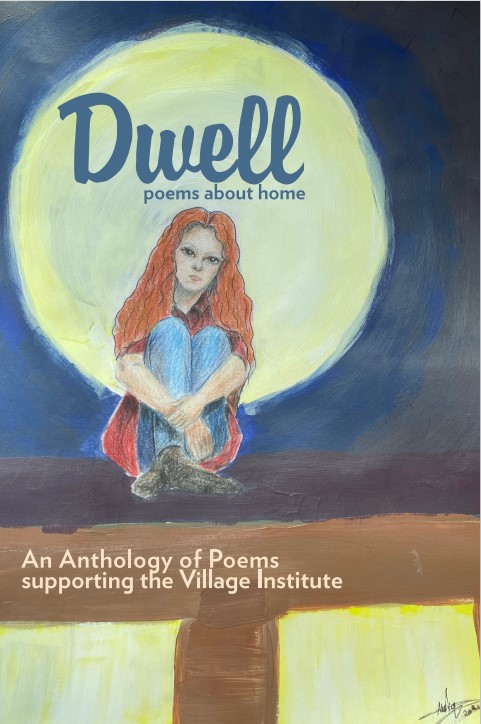
South Broadway Press is partnering with the Village Institute to raise money for their operations. To do this, we have created an anthology of poetry entitled “Dwell”, which we will be providing copies of to supporters who donate $20 or more.
The Village Institute is a live/learn/work center designed with and for refugee families in Northwest Aurora. As it says on their website, they “help families build wealth, worth, and wellbeing by bringing housing, language learning, job readiness workshops, and mental health services all under one roof.”
“Dwell” is an anthology of poems about our personal and collective identity of home. It is a full-length collection of over 35 poets meditating on themes of love, immigration, grief, homelessness, and impermanence, among other topics. The anthology features the work of such poets as Caleb Ferganchick, Abigail Chabitnoy, Crisosto Apache, Aerik Francis, Wheeler Light, Said Shaye, Liza Sparks, Zack Kopp, Jessica Rigney, and many more.
Thank you to LiveWork Denver, who provided a generous grant to make this anthology a reality. In line with the mission of this book, LiveWork Denver does incredible work to create access to homeownership for folks who may otherwise feel ownership is out of reach, including facilitating opportunities in community housing, co-buying, cooperatives and live/work spaces.
Thank you for your support. All donations and shares are very appreciated!
Erin told me her face was falling. We sat on a motel bed in downtown Anaheim, each of us with stones inside our bodies where organs used to be. Hand to her face she placed her fingers at her jaw and said, it’s sagging. Like a landslide.
Our foundations were made from the gulfs created in the void of saltwater and sun; we were grown from the melting glaciers. Skeletons shaped from every piece of rock we had once picked up from the tongue of the shore because we thought it was pretty, replacing the bone until we were both ambling monuments.
In the motel in downtown Anaheim, we cracked geodes against one another with enough force to break them open to see if our guts were quartz. The same sort of rock scientists on playgrounds smashing stones to see if there were hidden crystals, only we were older, and our shared insides didn’t carry crystals…as we found out. Sharp fragments splintered and dented the cold bedcovers, rock people applying pressure as a kind of embrace.
And her face was falling like how Venice is sinking, and the world is impermanent, so we split our skin open to find anything secreted from the soft outsides. The shells of our exteriors thawed like those candles whose wax peels away to reveal tiny gems, but really, it’s just a trinket more like trash than treasure.
Structures like bones crease into putty like how memorials fall and become their own grave markers, and on a floral smoke-smelling comforter in a strip mall in Anaheim, I ease into the rock rain of my own face and the spring that found itself seeping out of the remains of my body. Our mingled landslide faces and surfaces liquified with only the memory of boulder bodies and gritted organs left in our wake.
Tomorrow we’d go back to carrying our stones.
Jane-Rebecca Cannarella (she/her) is a writer and editor living in Philadelphia. She is the editor of HOOT Review and Meow Meow Pow Pow Lit, and a former genre editor at Lunch Ticket. She’s the author of Better Bones and Marrow, both published by Thirty West Publishing House, The Guessing Game published by BA Press, and Thirst and Frost forthcoming from Vegetarian Alcoholic Press.
His name was Pietro Ludivicci, and he was in love with symmetry.
Those statues of his were carved with a delicate accuracy, angels and saints poised to bless or condemn, their pale faces set in expressions of aloof piety. That marble virgin of his was housed inside the chapel, the object of awe among the townspeople. For the sculptor had rendered the stone folds of her clothing as soft-looking as fabric.
The flawless beauty of Ludivicci’s creations was rivaled only by the appearance of the sculptor himself. With his tight curls, regal nose, cherubic lips, and mahogany eyes, it was as if he were the personification of the suppleness of youth. How lovely, this Pietro!
Of course, the young women of the town were hopelessly taken with him. Why, even the mayor’s wife fondly referred to him as her first love! A cacophony of tokens, flowers, letters, and gifts took up permanent residence outside his door. In the marketplace, women would tarry and stare, and those bold enough to proposition him always received the same answer: a curl of the lip, and a flat “I’d rather not”. You see, Ludivicci was a paramour of human beauty- and perfection his muse. How could he settle for anything else in a lover?
These harsh rejections were hard on the ladies of the town. Many would weep, and some would pull at their hair. Young Viola, who cleaned the sculptor’s apartment, witnessed countless of these spurnings. In the smoky bars, her father, the innkeeper, and the older townsmen would snidely remark that Ludivicci may as well wed one of his statues.
There came a day, as the harvest-season came round, that the sculptor unexpectedly stopped accepting commissions. For seventeen days on end, he vanished from the eyes of the community. Circulating whispers suggested illness, or even his death. Viola of course knew that the artist was not dead at all. He had thrown himself into his newest project.
Ludivicci the recluse remained shut up in his apartment, his door opening only to receive the bread and wine he paid Viola to purchase for him. During these visits, the girl caught glimpses of a form standing in the center of his room- a new statue, perhaps? Alas, she could never get a good enough look, as the sculptor would pay her what was owed and then slam the door with a force that made the frame creak.
The longer Pietro Ludivicci was in isolation, the more fanciful the rumors about him became. He had certainly lost his sanity, most agreed. Signora Columbo swore she had spotted him at the temple, worshipping the pagan gods! How could he have fallen so far? Poor Pietro! A red-cheeked and mortified Viola confessed to her sister as they lay in bed one night that she had caught the sculptor cradling what seemed to be the face of his passion project and kissing its lips!
Months passed before Ludivicci was spotted in public again. He looked certainly worse for wear, with dark shadows underneath his eyes, an unkempt beard, and his shoulder-length hair hanging in an unruly tangle.
His sculpting seemed to be abandoned as a thing of the past, as he had emerged from his isolation with nothing to show for it. If one would catch him walking about in town or marketplace and inquire about his work, he would stare back with haunted, glassy eyes and mutter something about having more important matters to pursue.
No one quite knew where the woman had come from. The way the innkeeper told it, she had knocked upon the inn’s door late one night (the night before Ludivicci returned to society) and requested residence. Said her name was Giana Aldi. She had paid him handsomely for room and board from a fine leather coin purse that hung from her waist. She was a painter, this woman, who wished to work undisturbed within the rooms. Why is it that this town is the place of so many fussy artists? The innkeeper bemoaned to his wife and daughters as they, dazed and recently roused from sleep, stumbled to prepare a room.
Soon enough, the town forgot their fascination with Ludivicci in favor of the mysterious Giana Aldi. It was if she had been carved from marble, as such flawlessness seemed unnatural. Smooth dark locks flowed down her back to her waist, and large black eyes were framed by heavy lashes. They seemed to see into one’s heart, and one couldn’t help but feel naked and exposed under her gaze.
She was stern and dedicated to her art with a borderline religious fervour. Her neighbors took notice, with news of her traveling within hours. Who was she? Perhaps she and Ludivicci would be the perfect match for one another. Two kindred spirits, parallel in looks and practice.
Evidently, Ludivicci was enthralled by her as well. Every evening, he would stand at her balcony, wildly waving bouquets of flowers, imploring her to come down and speak to him. No one ever saw Giana Aldi do so much as open her window. Late into the night, the sculptor would cry, shout, and even sing love poetry! Poor Ludivicci was in such a state of ruin by the seventh night, yet he persisted. Having enough of this, the innkeeper accosted him on the street, ordering him to give it up at once! Ludivicci, likely emboldened by the wine running through his body, declared that he would never stop his pursuit until he heard word from the lady herself.
It is said, and there have been several witnesses to this, that Giana Aldi appeared on the balcony then. Leaning over its edge, raven hair spilling over her shoulders, her disdainful shout could be heard by all:
“I’d rather not!”
Gracie Nordgren is a Creative Writing student at the University of Colorado Boulder. She enjoys daydreaming and pomegranates, and would very much like to travel to Venus. Her work has appeared in Kalopsia Literary Journal, The University of Colorado Boulder Honors Journal, and Cathartic Youth Literary Magazine, among others.
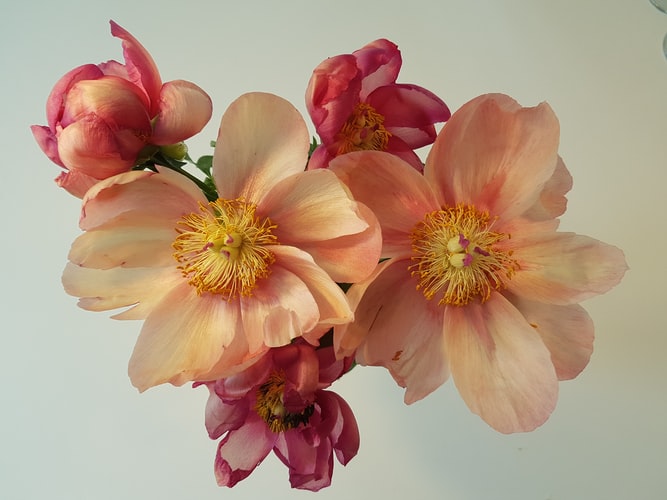
Oh poets and their peonies! “As big as human heads” Jane Kenyon exalts, her pen heavy with extravagant language, enormous metaphors as big as life.
The perfume of such heady description smothers me, face-first in the reproduction of perfumed pistol and stamen. Yet it keeps the real makings of this craft at a distance.
Amongst poets, there’s a secret censorship of creation surrounding their beloved peonies— afraid too close they’ll catch the inner workings of such art.
Aware they’ll see, let’s be honest, the ants. Mary Oliver admits they exist. That something dark and alien spiders across this beauty.
She knows that a necessity for budding is this cutting, this eating. Knows that the cataract of leaves covering the bud must feed the hungry just enough. Must just hold back the swarm to unlock the flower’s form.
These thousand tiny bites release a poem as well. The flowering depends on it yet can also kill. So we unleash the ants but prevent such furtive legs from going too far within. Allow the justice of devouring so that the exquisite sweetness opens.
Inside any creation is a little taste of destruction. To pretend otherwise would be outrageous.
Amy Wray Irish (she/her/hers) grew up near Chicago, received her MFA from the University of Notre Dame, then fled the Midwest for Colorado sunshine. She has been published in Spit Poet Zine and Thought for Food; she has work upcoming in Progenitor and Chiaroscuro. Her third chapbook, Breathing Fire, won the 2020 Fledge Competition and is now available from MiddleCreek Publishing. For more information go to amywrayirish.com.
his lips were purple and his breath was gone after I tried to blow it back inside of him but it blew my hair up over my crying eyes as I listened for his heart and checked for his pulse, a man so full of life the night before, but a heart attack woke him long enough to reach over to my bed to wake me up so I could save his life. I remained asleep as we both fell out onto the floor in between our beds his dead body pinning me into a rug burn that did not heal for weeks after his life force passed through mine and left me standing there, gazing at him there in the middle of the floor– done and over with and never again–until I realized his life force found refuge in mine when I heard him laughing inside of me.
Kevin Ridgeway is the author of Too Young to Know (Stubborn Mule Press) and nine chapbooks of poetry including Grandma Goes to Rehab (Analog Submission Press, UK). His work can recently be found in Slipstream, Chiron Review, Nerve Cowboy, Plainsongs, San Pedro River Review, The Cape Rock, Trailer Park Quarterly, Main Street Rag, Cultural Weekly and The American Journal of Poetry, among others. He lives and writes in Long Beach, CA.
a sketch of the 12 bar blues, approximate C major, central and key. now I play occasionally
in passing at a party – my close friends onto my limited repertoire but acquaintances somewhat impressed. especially since it seems I can improvise; just fiddle it a little with the left hand over pentatonic scales. that’s how you do it – learn how to play like it’s nothing. be casual – order in spanish and in french when you all go on holiday. know
how to wire a plug at the table. how to drive cars manual. spell certain words. play a little piano. how to write a poem about doing other things.
DS Maolalai (he/him) has been nominated eight times for Best of the Net and five times for the Pushcart Prize. His poetry has been released in two collections, “Love is Breaking Plates in the Garden” (Encircle Press, 2016) and “Sad Havoc Among the Birds” (Turas Press, 2019)
Eli Whittington is a mediocre farmer and an okay parent. They enjoy long walks on rhe forest floor because the ocean is really far from here, and kind of scary. They are the author of ‘Treat me Like you Treat me like you Earth’ published by the late Suspect Press. They also have two tracks of spoken word on Black Marlet Translation’s Punketry album. They are really bad at playing banjo, but will always be, more punk than Brice.
Elizathebeth.com has poems on it that are nearly impossible to read on a phone.














 south broadway press