Crepuscular, adj., the behavior of animals most active at twilight | Neal Allen Shipley

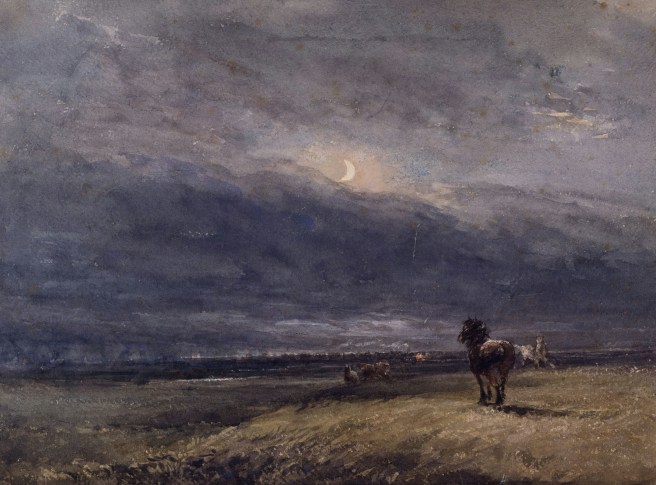
Image: The Night Train by David Cox

Crepuscular, adj., the behavior of animals most active at twilight

For Ash
BY NEAL ALLEN SHIPLEY

          It’s cold but the sky is clear, cleaved:
bright pink sits on blue and there are no clouds, but a stripe
of white would be poetic. This administration will ban the sky
if they can, executives ordering it to stop changing color – trying
to administer a world where there is only day and night.

Imagine, refusing to believe in twilight while the sun seeps
into the gums of the horizon – denying nightfall on a summer evening
when you savor sunset, still warm and purple on your tongue.
Hunting is restricted between sunset and dusk when these animals
are most active – to feed, to court – at the height of their power:

    *

          Odocoileus hemionus, mule deer
feed selectively at dusk, choosing the parts of sagebrush
that are most nutritious. Site-faithful, they return only to the safest,
most bountiful grounds, pawing the soft loam of your back yard
so close we could hand-feed them if we weren’t so loud.

You call me but you’re worried about other things – the dog
I pretend to hate is sick and it’s probably just normal shit, but still.
I forget to tell you that I know twilight is real, that it’s the most
beautiful time of day, the mountains’ silhouette like thick walls of a bowl
thrown up by practiced hands to protect us in this conservative city.

    *

          Vulpes vulpes pick-pocket their predators
in the gloaming, stealing yesterday’s prime rib for tomorrow’s supper.
The red fox knows to keep away from traffic – has learned to scent
the carbon steel of their hunter’s rifle on the wind, stow their stolen
goods deep beneath the snow where it will keep until leaner times.

This administration has convinced themselves there is only high
noon, masculine sun scorching the earth shadowless, baking
them where they stand without reprieve – the delicate frills of dawn
too dangerous for them, nighttime dragging her slow fingers down
their chests, the cold dew of Spring fresh in the corners of their mouths.

    *

          Canis latrans call to their young with soft woofs
when the sun sinks almost completely, a nightlight deep
within the mountains – small howls that make you lower your joint.
I tell you about the time a coyote invaded my cul de sac growing up,
our neighbors shepherding their dogs inside to avoid a slaughter.

You tell me the coyote is a mean bitch, but you’re meaner.
If they’re a threat, we’ll bring the girls inside and I’ll fight
this administration tooth and claw with you until it’s just
another neighborhood dog, one we’ve seen before, docile;
we stay outside with the joint, the soft glow of dusk around us.

Neal Allen Shipley (he/him) is a behavior analyst living in Colorado with a modest collection of pets and an unhinged collection of plants. His work has been nominated for the Pushcart Prize and appears in Creation Magazine, The Talon Review, and SCAB Magazine, among others. Despite the horrors, he loves a fancy hot dog. You can find him on Instagram @nealio9

Starting Another Day | Lorraine Caputo

Image: Korsika II by Karin Luts, 1959

Starting Another Day

BY LORENA CAPUTO

To the reggae rhythms
on his radio, a man
pushes his coconut
cart up the street, the juice
sloshing in its clear bin,
the coconut sweets &
his dark skin gleam in this
morning’s hesitant sun.

Poet-translator Lorraine Caputo’s works appear internationally in over 500 journals and 24 collections of poetry – including In the Jaguar Valley (dancing girl press, 2023). She is a Best of the Net and Pushcart Prize nominee. She journeys through Latin America, listening to the voices of the pueblos and Earth.

Two Poems // Deb Keane

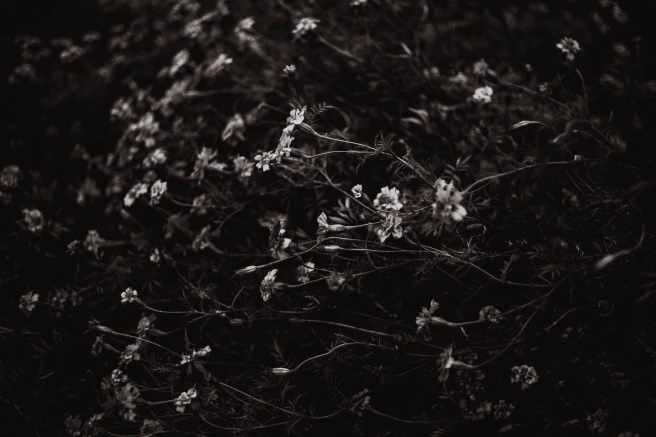
Image: Roxana Zerni

Wildflower’s Performance Review

BY DEB KEANE

A wildflower sways in the meadow,
I keep a schedule of appointments.

A wildflower sways in the meadow,
I submit paperwork electronically.

A wildflower sways in the meadow,
I restart my computer, then do it again.
Then again.

A wildflower sways in the meadow,
I calculate my quarterly productivity.

A wildflower sways in the meadow,
I check my retirement account.

A wildflower sways in the meadow,
I call IT about my computer, and then restart it again.

A wildflower sways in the meadow,
I forget my password.

A wildflower sways in the meadow,
I stare at the wall where a window could be,
imagine the sunshine,
imagine the grasses,
sway a little.

This Neighborhood is Mine

BY DEB KEANE

Walking my new neighborhood,
I see chickens
at the crossroads of [redacted] and [redacted].

I see flowering trees,
tulips and wandering vines
at every glance.

Little libraries,
green grass,
all these people strolling.

At the corner of [redacted] and [redacted],
I see Mother Earth herself
plump with her own love.

It feels years away–
the vandalism,
the break-in,
the gunshot,
the husband.

It’s only been a few miles.

I promise to keep my new address
a secret.

This new world is just for me,
where it’s safe.

Deb Keane (she/her) is the author of hundreds of daily poems. She simultaneously squirms at and strives for creative vulnerability in her everyday.

Summer Silence | Jacob Butlett

Image: Jason Mayer

Summer Silence

BY JACOB BUTLETT

In my dreams psalms of rain
echo and echo around a cabin
my parents rented one summer.

I stand invisible beside my nine-
year-old self as he gazes beyond
the window overlooking twilight.

Rain slants past the poplars,
and this fog, thick as a noose,
winds itself around the heart

of the woods, where a lake,
pale-faced, mirrors lightning.
My younger self sees no danger,

only the innocence of boyhood.
My younger self rests his head
against the pane as if to dream,

too, of the mud, worm-wrung,
that will wriggle between his toes
when he stomps and laughs

in the grass after the thunderstorm.
But as he closes his eyes,
I turn around, hoping to catch

a glimpse of my parents laughing
in the kitchenette’s stovelight.
Before I awake each time, I find

their silence staggering shadow-
like across the wooden floor,
reaching out to touch my heart.

How foolish of my younger self
to assume life is merely stitched
in rainsong. How foolish of him

to mistake each hum of thunder
for lullabies, to mistake our parents’
silence for anything but silence.

Jacob Butlett (he/him/his) is a gay poet from Iowa. Jacob’s creative works have been published in many journals, including South Broadway Ghost Society, Colorado ReviewLunch Ticket, and Into the Void. In December 2024, Kelsay Books published Jacob’s debut book of poems, Stars Burning Night’s Quiet Rhapsody

Two Poems // Daniel Brennan

Image: Kwoan by Fons Heijnsbroek

No One Follows You Home After the 4th of July Orgy

BY DANIEL BRENNAN

Bone bent out of shape by the bombs against your back.
You shuffle down the shadowed boardwalk,
still ringing with a body high, the sea-reeds stalking
in formation about you. The moon talks back,
scolding you, your skin riddled with cartographer’s notes;
men’s hands leave a mark on whatever they can.
You’re alone again. Lonely again. It’s always again. Can
you ever make these hungers more than just ghosts?
In the back of your throat are the words you keeping humming
to yourself in the dark: this is what I wanted. Anyone
could find you here, their fishbowl eyes pooled with longing
for more than the whiplash, the burn, the coming
and going in dark rooms where you can be anyone or no one
at all. Fireworks in chorus against your back. Siren song almost done.

Keepsakes

BY DANIEL BRENNAN

The stretch of their soft tissue
unimaginable, as all the best myths are. Our friend
describes their faces, the salt & pepper
stubble of one man, the jaw made
uneven by surgery of another, eyes
and lips and the pained expressions
as his fist slides inside them. He has them
all ranked and filed, these men, these
men with their immense hungers which I,
patron saint of squeamish doubt, cannot fathom.
Like a promise, or a lie, even, it is
all about the delivery; the coning shape
your hand must take as, bathed
in its appropriate lubricants, it enters
another body like parishioners
entering their house of worship.
My friend fists all kinds of men; daddies
with 2-bedroom bungalows in the Pines and
young finance professionals he’s cruised
at the gym and off-Broadway understudies
alike. I am jealous of my friend, and of these
men; not that I trust my body enough
to harbor such a kink, but I envy
that they know what they want, know
how to give it a name, to ask and
most assuredly (to our shock) receive.
His face takes on a fevered veil
as he tells us how it feels: to be
so close to the center of heat, pressing into
a body’s dire vulnerabilities, to feel
your own hand wrapped in wet warmth
like a newborn wrapped in a towel. He
is sole proprietor of this vice, the tight
lip of flesh surrendering; the names
of these men held in the back of his throat
like a keepsake When we laugh, it is
because we are cowards; we know that our bodies
lack the faith required to wield such palaces
within us, cathedrals welcoming
the wound fist of a God. My friend,
he discovers new pleasure
each night, and what has my disbelief
provided? Pained smile, stifled laugh,
soft well of an empty bed.

Daniel Brennan (he/him) is a queer writer and coffee devotee from New York. Sometimes he’s in love, just as often he’s not. His poetry has been nominated for the Pushcart Prize/Best of the Net, and has appeared in numerous publications, including The Penn Review, Sho Poetry Journal, and Trampset. He can be found on Twitter @DanielJBrennan_

Spin the Bottle | Brian Dickson

Image: Donna Brown

Spin the Bottle

BY BRIAN DICKSON

Three-liter Cola,
zeppelin of delight
and angst, we
imagined your dares
at once contained
and floating
to our bodies.

We imagined each
empty spin—
steady propeller
or crash against
knees, crunch
of plastic, bunch
of: do it like this.

We imagine how
simple a twist
of the wrist
until our turn,
a bumbled one,
bounce of the bottle,
tilt of the world
lasting the longest
seconds.

Look how you
settled, the unholy
and holy—genesis
of desire swelling
in gasps.

When not teaching at the Community College of Denver, Brian Dickson avoids driving as much as possible to connect with the quotidian and the sacred. He also serves as an editor for New Feathers Anthology as well. His chapbook, A Child’s Sketch of the Afterlife, recently came out from Finishing Line Press. Find him at www.dicksonwrites.com.

Anatomy of a Poet, or This Ol’ House

Image: Hadassah Carlson

Anatomy of a Poet, or This Ol’ House

BY DAVID ESTRINGEL

roof tiles gray and thin
falling away in the sun
like ash ‘round my feet

windows cloud and warp
with the long passing of one
too many hothouse summers

the paint outside cracks
and flakes – bare patch betrayals
ebbing pulse lull

the kitchen screen door
sticks—hinges in need of grease—
in its ever-shrinking frame

floorboards ‘round the stove
creak and sink underfoot, it’ll
need a cleaning soon

pictures on the wall
faded, some slipped from the hook,
crash down in silent thuds

dust storms in dark corners,
settles ‘round pillows and teacups
I write “Wash me, please”

but

the studs are solid,
foundation holding strong. Ghosts
seem to know their place

and

the morning cock still
crows in the yard, pecking at
its lil yellow stones

David Estringel is a Xicanx writer, Professor of English, and EIC with words at The OpiateCephalopressDreichBeir Bua JournalLiterary HeistThe Blue NibThe Milk House, and Poetry NI. David has published seven poetry/hybrid collections, six poetry chapbooks, and one co-authored novel Escaping Emily through Thirty West Publishing House. Connect with David on X @The_Booky_Man and his website www.davidestringel.com.

Luigi Mangione | Hilary Sideris

Image: Derek Story

Luigi Mangione

BY HILARY SIDERIS

On December 4, 2024, 27-year-old engineer Luigi Mangione assassinated Brian
Thompson, CEO of UnitedHealthcare—who had made millions denying claims—
outside New York’s Midtown Hilton.

Baby Lulu, as they call him,
has many TikTok wives. One in Beijing

cooks puttanesca with penne.
My husband, which is Luigi Mangione,

she says, stirring red pepper in her sauce,
needs comfort food from his culture.

Others cut wedding cake with their hero,
whose black lashes & threaded brows,

so tender & misunderstood, accentuate
the necessary beauty of his deed.

Does his anachronistic name kindle
some ancient hope, conjure a revolution

fought on Garibaldi’s side against
a crooked pope? Lesson Learned,

The Wall Street Journal intones,
Tighter Security Priority for CEOs.

Hilary Sideris is the author of Calliope (Broadstone Books), Liberty Laundry (Dos Madres Press), Animals in English (Dos Madres Press), The Silent B (Dos Madres Press), Un Amore Veloce (Kelsay Books), The Inclination to Make Waves (Big Wonderful LLC,) and Most Likely to Die (Poets Wear Prada Press).

In the back of my mind, you died. | Latoya Wilkinson

Image: Harrison Fitts

In the back of my mind, you died.

BY LATOYA WILKINSON

I find comfort in stillness
when blades kiss my skin
and thundered tongues
hail down my name.
In the grey,
I close my eyes—

and let the rain mourn
me.

Latoya Wilkinson is 20 years old. She is currently a rising Senior at the University At Albany, studying Journalism and English. She doesn’t have any intentions of being a poet, but she took two poetry classes and realized that she would much rather write than breathe—and that says a lot.

A Fallen Yew | Salvatore Difalco

Image: Wixina Tresse

A Fallen Yew

BY SALVATORE DIFALCO

I passed it unawares, others fallen, rotting
with perfume pervasive as the gnats
forming my halo and feasting delicately
on the membranes of my ears and eyes.

I knew the yew had metaphorical heft,
but failed to remember the sources.
Nowadays memory fails faster than legs
which also begin to falter halfway.

Nothing prepares you for death—
isn’t quite true. We know in our bones
that shadow from the hill will only
lengthen as the day wears on.

Yew, I never knew you in your glory,
having never walked these woods.
But is it a crime to feel no sadness
for a tree that perished naturally?

I walk toward a clearing, heavy
in my heart and heavier-legged
as I seek something more than
communion with a natural death.

Salvatore Difalco is a Sicilian Canadian poet and storyteller. His work appears in a number of print and online journals.