Untitled | Miriam Sagan

Image: Fr. Daniel Ciucci

Untitled

it’s no longer the Elysian Fields, this
barrio, but the shrine of the sinner is
still decorated in the pocket park
across from the elementary school
and the bakery

El Tiradito may be crumbling
but notes from the heartbroken still
decorate the grave of the unknown
some say a man
killed in a knife fight
over a woman
buried on unconsecrated ground
as doves wheel from the
cathedral

wishes on slips of paper
pushed between adobe bricks
a panhandler asked for
money but I refused
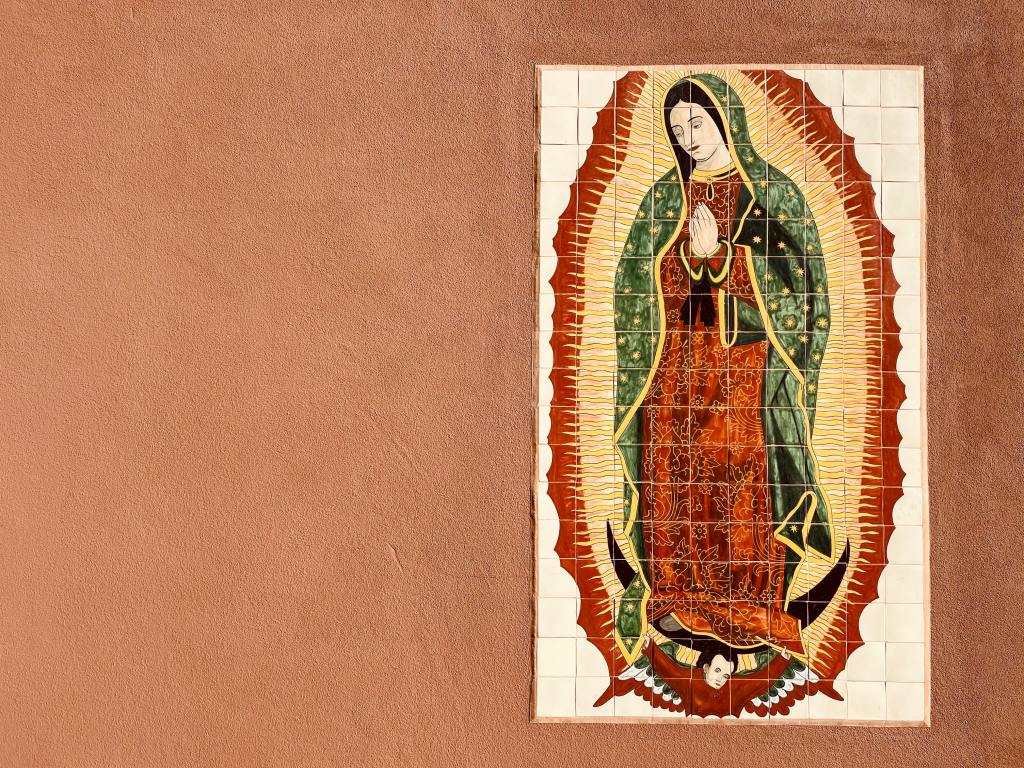
walking away from the great altar
of the Virgin of Guadalupe

I’m neither wholly good nor
bad I don’t even try anymore
to be myself
because I don’t know
who that is
although I did buy a slice
of jelly roll and two
doughnuts at Estrella’s

and all that is left
at the bottom of the paper
bag is crumbs
but whether for birds
or wind—
you tell me—
I can’t decide

Miriam Sagan is the author of over thirty books of poetry, fiction, and memoir. Her most recent include Bluebeard’s Castle (Red Mountain, 2019) and A Hundred Cups of Coffee (Tres Chicas, 2019). She is a two-time winner of the New Mexico/Arizona Book Awards as well as a recipient of the City of Santa Fe Mayor’s Award for Excellence in the Arts and a New Mexico Literary Arts Gratitude Award. She has been a writer in residence in four national parks, Yaddo, MacDowell, Gullkistan in Iceland, Kura Studio in Japan, and a dozen more remote and interesting places. She works with text and sculptural installation as part of the creative team Maternal Mitochondria in venues ranging from RV Parks to galleries. She founded and directed the creative writing program at Santa Fe Community College until her retirement.
The Stars | Zack Kopp

Image: Zoltan Tasi

The Stars

The cold stars clicking their claws together like crabs in a tank. History changes and runs off the page like butter. The world has been dragged through me, and I’ve been dragged through the world. We’re even. Stars twirl over stinking trenches, beginning a subtle magnetic resurrection that will take all time and never end. The mind is a machine to move matter. The scenes are super modern. The earth has us, and we multiply. Founded in an impulse of wild lonely need, not serious planning. The stars dissolve in my mouth not my hand. Let this life not be a torment. Let the stars stop shaking. Please, God. I will turn my greatest tricks for you.

Zack Kopp is a freelance writer, editor, photographer, graphic artist, and literary agent currently living in Denver, Colorado. His informal history of the Beat Generation’s connections with Denver was published by The History Press in 2015. Kopp’s books are available at Amazon, and you can find his blog at the website for his indie hybrid press at www.campelasticity.com featuring interviews and articles and links to other websites. His improvised novel, Public Hair, was described by one critic as “simultaneously the best and worst book ever.” The latest chapter of Kopp’s “fantastic biography” (Cf. Billy Childish), Henry Crank’s History of Wonders is expected in 2022.

Delayed Homecoming | Jayati Das

Image: Philip Myrtorp

Delayed Homecoming

For Tina and Ra

There are quite a few miles that crevice you from home,

Like the zip of your suitcase that flies between hope and not-hope.

I can only imagine how the fridge door must be slamming, unlike the one back here—

Extended supplies shunting faster than Turner’s baby,

The one that cries but never comes.

Do you wake each day to a finite line

And trace back the rhino’s trail 

You had smiled about the other day?

Does Bishop speak clearer now

And blur your vocabulary?

I am afraid I will forget your smiling hair

And the exact shade of your red lipstick

(The traces are already starting to drift).

Lie to me when I ask about happiness

Or perhaps halt the track of my question

(‘Are you home yet?’)

With a whistle or a red flag,

For then I can at least begin to unmemorise

Your face greeting me in some departure lounge.

Jayati Das is a research scholar from Tezpur University, India, and holds a Master’s degrees in English Literature frotm the University of Delhi. Her areas of research include representations of the Vietnam War, masculinity studies, and queer cinema. She has won over a dozen prizes in creative writing at the college and university levels. Several of her poems and stories have been published in The Assam Tribune, The Sentinel, and e-magazines like The Golden Line, including a story in an anthology titled DU Love. Her published research includes essays on the Mizo poet, Mona Zote, race in Othello, and on Pedro Almodóvar’s cinema.

This poem is from South Broadway Press’ new anthology, 
Dwell: Poems About Home. Purchase here.

Days of Red and Gold | David Estringel

Image: Jakub Dziubak

Days of Red and Gold

Sittin’ at the kitchen table—cup of black coffee in one hand, cigarette in the other—I look past catches of blue paint and the remains of flies on screen door mesh, toward the sorghum field just beyond the ranch gate. Death’s stillness—a gravity all its own—has seeped into every corner, permeated the grout of tiled countertops and spaces in between fruit magnates on the old, white Frigidaire like the smell of rabbit in the oven or hints of storm riding out on the breeze. Life’s left the room—no pulse under these linoleum tiles—it seems, leaving it darker, a bit colder, despite morning’s come to call through the window above the sink. I take another sip—bitter on the tongue—then a drag (or two), finding myself—absent-minded–fingering the contents of a chipped, pink and white bowl of green stamp china (of which she was so proud). Four pennies, two dimes, and a nickel. Two rusty paper clips. A half-used packet of B&C headache powder. A dead fly. I remember eating from it—sweetened raspberries, red and golden, from bushes in the garden—when I was small. How I’d toss them back in grubby fistfuls, between chokes on the juice, as honied explosions—sour and sweet—took me to Heaven and back then ‘round, again, while she looked out the screen door, tossing hair from her eyes—cup of black coffee in one hand, cigarette in the other—staring at my father working in the field, beyond.

David Estringel is a Xicanx writer/poet with works published in literary publications, such as The Opiate, Azahares, Cephalorpress, Lahar, Poetry Ni, DREICH, Somos En Escrito, Ethel, The Milk House, Beir Bua Journal, and The Blue Nib. His first collection of poetry and short fiction Indelible Fingerprints was published April 2019, followed Blood Honey and Cold Comfort House in 2022. David has written five poetry chapbooks, Punctures, PeripherieS, Eating Pears on the Rooftop, as well as Golden Calves and Blue (coming 2023). His new book of micro poetry little punctures will be released in December 2022. Connect with David on Twitter @The_Booky_Man and his website www.davidaestringel.com

This poem is from South Broadway Press’ new anthology, 
Dwell: Poems About Home. Purchase here.

Dingle Bay, Summer 2012 | Sean Woodard

Image: Xulong Liu

Along the cliffs of Ceann Sibéal
herds of sheep graze, weighed
down by crimped fleece.

Rough-hewn Celtic crosses,
slathered in dust and moss,
peek out from brittle underbrush.

A boat slices through still bay waters,
inboard motor stirring up foam
as the throttle is revved.

A gray dorsal fin approaches the vessel.
With a barrel roll and flick of his flukes,
Fungie the bottlenose dolphin launches

into the air, slips back under the surface,
and reemerges to nuzzle starboard
and port sides with his rostrum.

The Ring of Kerry is bathed in gold
as Dingle’s red and white lighthouse guides
Fungie back to the bosom of the Atlantic Ocean.


Sean Woodard (he/him) is a doctoral student at the University of Texas at Arlington. He also serves as the film editor for Drunk Monkeys. His creative works has appeared in NonBinary ReviewThe Cost of Paper Vol. 4, and Found Polaroids, among other publications. You may follow him at http://seanwoodard.com, Twitter @seanwoodard7326 and Instagram @swoodard7326.

Trying to Explain America to My In-Laws | Keri Withington

Image: Specphotops

Yes, Florida’s also in the South.
Yes, we’ve been there.
Yes, we’re planning to go there again,
maybe this summer;
no, we didn’t know anyone in that school,
but yes, we all know someone in that school.

Yes, the kids are safe…well, not really safe.
I talked to M this morning about what to do:
whether to wait in the first fire alarm,
how to listen in hallways,
where to hide if she needed to.

Then I sent her to school
with her cello
and packed lunch
as if this were normal.

As if I should be talking to her about survival,
instead of test scores and school dances.
As if any of us know what 6th grade is like
when you’re worried about making it home alive.
Yes, I say, I realize this is not normal. Yes is to say,
I know the rest of the world doesn’t understand,
and neither do we. No, I say, it won’t make anything change.
It won’t end America’s love affair with guns
because we’ve seen that we’ll let children die over and
over again and that’s what it means.

I stop and think and almost finish.
We’ll let children die before we run background checks.
We’ll let children die before we stop automatic
and armor-piercing and the hard-on for the NRA.

But I realize all those are just conditionals
to the central fact, and the fact of the matter is
America let’s its children die.

We’ve been letting them die.

I remember Columbine;
I remember Sandy Hook.
I remember all the stories in between
and all the schools since.

Yes, I say, America.


Keri Withington (she/her) is an educator, vegan, and pandemic gardener. Her poems have appeared in numerous journals and anthologies, including The Wild Word and Blue Fifth Review. She has published two chapbooks: Constellations of Freckles (Dancing Girl Press) and Beckoning from the Waves (Plan B Press). Withington lives with her husband, three children, and four fur babies in the Appalachian foothills. You can find her in Zoom classes for Pellissippi State, trying to turn her yard into an orchard, or on FB (@KeriWithingtonWriter).

Where Do People Go When They Die? | Kevin Ridgeway

Image: Pawel Czerwinski

his lips were purple
and his breath was gone
after I tried to blow it back inside of him
but it blew my hair up over my crying eyes
as I listened for his heart and checked
for his pulse, a man so full of life
the night before, but a heart attack woke him
long enough to reach over to my bed
to wake me up so I could save his life.
I remained asleep as we both fell out
onto the floor in between our beds
his dead body pinning me into a rug burn
that did not heal for weeks after his life force
passed through mine and left me standing there,
gazing at him there in the middle of the floor–
done and over with and never again–until
I realized his life force found refuge in mine
when I heard him laughing inside of me.


Kevin Ridgeway is the author of Too Young to Know (Stubborn Mule Press) and nine chapbooks of poetry including Grandma Goes to Rehab (Analog Submission Press, UK). His work can recently be found in Slipstream, Chiron Review, Nerve Cowboy, Plainsongs, San Pedro River Review, The Cape Rock, Trailer Park Quarterly, Main Street Rag, Cultural Weekly and The American Journal of Poetry, among others. He lives and writes in Long Beach, CA.

Fiddle with the left hand | D.S. Maolalai

Image: Steven Johnson

a sketch of the 12
bar blues, approximate
C major, central
and key. now
I play occasionally

in passing at a party –
my close friends onto
my limited repertoire
but acquaintances somewhat
impressed. especially
since it seems
I can improvise;
just fiddle it a little
with the left hand
over pentatonic
scales. that’s how
you do it – learn
how to play
like it’s nothing. be casual –
order in spanish
and in french when you all
go on holiday. know

how to wire
a plug at the table. how to drive
cars manual. spell
certain words. play
a little piano. how
to write a poem
about doing
other things.


DS Maolalai (he/him) has been nominated eight times for Best of the Net and five times for the Pushcart Prize. His poetry has been released in two collections, “Love is Breaking Plates in the Garden” (Encircle Press, 2016) and “Sad Havoc Among the Birds” (Turas Press, 2019)

Erasure | Caleb Ferganchick

Image: Dylan Nolte

Caleb’s poem has very specific formatting to it. Please click the link below to view their poem, “Erasure”.


Caleb Ferganchick is a rural queer, slam poet activist, and author of Poetry Heels (2018). His work has been featured and published by the South Broadway Ghost Society (2020), Slam Ur Ex ((the podcast)) (2020), and the Colorado Mesa University Literary Review. He organizes the annual Slamming Bricks poetry slam competition in honor of the 1969 Stonewall Riots and coaches high school speech and debate. An aspiring professional SUP surfer, he also dreams of establishing a queer commune with a river otter rescue and falconry. He lives in Grand Junction, Colorado.
Website | Instagram | Twitter

[schema geometrica][Día de Los Muertos][CON JEFE CRUZ]| Dennis Hinrichsen

Image: Jazz Borquez
                              —I kill indiscriminately // I breathe the same // 

& yet I can plant these copper-colored seeds saying // this is
for you // mariposa // para tu Día de los Muertos you leave 
so many behind I think I am part of that parade poking 
dying earth // neck bones’ sweet ridges offered to sun //
skull breaking through the sheen of work’s liqueur //
el jefe Cruz observing // then shouting // oye // too deep //
or too close // already the acres // in spring // a sea of milkweed //
& so I jump like the young boy I am no longer una Danza
de los Viejitos & continue working down the line // seed &
seed // a campesino finally // once this skin is flensed to laddered
bone // grin—all teeth // black sockets alive & laughing //
—O mountain hectares covered in orange // the sheer volume
of you now // the sheeted square footage // sound of the wings
un grito de vida I keep hearing in this nightmare world // hiss—
I cannot bear to say it—as if from a herbicide

w/a half-life & a means of migration


Dennis Hinrichsen’s most recent book is This Is Where I Live Now I Have Nowhere Else To Go, winner of the 2020 Grid Poetry Prize, and [q / lear], a chapbook from Green Linden Press. He has new poems appearing or forthcoming in Canary, The Night Heron Barks, Map Literary, Otoliths, and Under A Warm Green Linden. He lives in Lansing, Michigan where from May 2017 – April 2019 he was the area’s first Poet Laureate.