She eyes the tired roadhouse tucked between junk yards filled with car doors and still-good hubcaps,
hickory smoke heavy on night air, rubbing against her like a cat. Inside, past shadowy booths
grimy with time, guitars draw her in with a walkin’ blues line, shuffle through 12 bars like they mean it.
Ya feelin’ blue? the drummer growls, and the crowd spills onto the dance floor where she joins women with tight jeans
and tight smiles, moving alone, faces painted hopeful. When the tune slows, she takes the hand of a sad-eyed guy—
they slide and sway, his breath on her neck a sweet refrain in a song of love gone wrong.
Susan Carman is a Pushcart Prize nominee, and served as poetry editor for Kansas City Voices. Her poetry appeared most recently in I-70 Review, Heartland! Poetry of Love, Resistance & Solidarity, and the anthologies Curating Home and The Shining Years. Retired from non-profit management, she lives in Overland Park, Kansas, where she is an ESL volunteer.
This poem is from South Broadway Press’ new anthology, Dwell: Poems About Home.Purchase here.
Growing up, my home was a closet. Not the metaphorical closet where I tucked my sexuality. More precisely, my home was an 8x11in guide to Colorado fish my grandfather gave me to mold my sexuality. Which I tucked inside my closet. In which were tucked letters to my adolescent loves like Jamie, Ally, Shelly, and Jack (especially to Jack). In which, I dreamed of our skeletal home without closets. Where my mother did not tuck her guilt, and the father did not tuck his abusive addictions. Where Jack drove the Hot Wheels car he gave me after our play date. Just like Ken in Aqua’s Barbie Doll.
There is no instruction manual with the postscript delivered by the owl to your closet proclaiming, “You’re a homosexual, Harry.” By trial and error, you come to understand the fragility of home. And the fragility of queer. And how both must often be constructed like lean-tos on the pull-out couches of allies.
Like tornados, like earthquakes, like tsunamis, like men in I.C.E. uniforms, my nature was a disaster a home could not weather. So, home became a lonely rainbow. A refraction of tears staining pictures of cutthroat trout.
Whether by cosmic dramatic irony or systematic oppression, when your home is queer, so often your home becomes a bar. Where fags bundle like fags. And smoke fags. And drink like, well, like fish. Most of whom are obsessed with being fish. So, I learned a new language that gave transformative space to my transient home. Sashay! Shontay! Cinched! Boots the house down! Beat for the gods!
I learned that language, too, was a home. Ours was one that could not be deciphered. Because no one cares to decipher why our family struggles with substance abuse at nearly twice the average rate. How our expansive forest of intersectional trees denoting our lineage drinks from a stigmatized watering hole. Yet, the branches stay sturdy enough for us to take our lives at five times the average rate.
I have read enough obituaries to know how mine may sound. Taken unexpectedly. After a long struggle. As if the struggle was never an indication of the homophobe. Or the revolver. Or how unsurprisingly often they’re the same. I mean, the gay homophobe with a revolver. Taking a family with him that would have died to show him how to live. In a home called queer.
I will be survived by a long list of family that never embraced me. With no mention of the love that allowed me to survive.
But I have found home.
My home is not a structure I ride shotgun to in Jack’s hot wheel car. Home is not a bed on which I lay my head when the world insists I don’t belong. My home cannot be taken by a natural or xenophobic disaster. Home is not a mortality statistic. My home is not an early grave.
My home is queer.
And I vow my home will always be open to anyone who thinks theirs is just a closet filled with unread love letters.
Caleb Ferganchick is a rural, queer, slam poet activist and author of Poetry Heels (2018). His work has been featured and published by the South Broadway Ghost Society (2020, 2021), “Slam Ur Ex ((the podcast))” (2020), and the Colorado Mesa University Literary Review. He organizes the annual “Slamming Bricks” poetry slam competition in honor of the 1969 Stonewall Riots and serves as a board member to Western Colorado Writer’s Form. A SUP river guide, Caleb also dreams of establishing a queer commune with a river otter rescue and falconry. He lives in Grand Junction, Colorado.
This poem is from South Broadway Press’ new anthology, Dwell: Poems About Home.Purchase here.
And here you are standing two feet bare on the floor of your kitchen turning back to the wall behind as though he were standing bare-footed there with you again as he did those years prior. Before the days dissolved into the rising of time immemorial and you who had just kept your head above water now live in the after so far below you have come to know the nocturnal creatures who in quiet habits roam from shore to shore only under all the weight of dark stars. What can you do but let flow through your fingers—the now and him too though he was yours for a time and gave you such happiness. The distances between keep widening and soon it will be that you cannot recall his eyes or the scent amongst his thick curls. Turns out you knew—had known all along this was coming. It was why you held him close for so long why you saved him in dreams so many times you lost count. It was the one sure thing you held in your heart and though you knew it to be true you gave him everything even so—even though you knew in the coming years he would be gone from you. And here you are standing two feet bare on the floor of your kitchen turning back to the wall behind you as though he were standing bare-footed there.
Jessica Rigney is a poet, artist, and filmmaker. She is the author of Follow a Field: a Photographic & Poetic Essay (2016), Entre Nous (2017), Careful Packages (2019), and Something Whole (2021). Her work was nominated for a Pushcart Prize in 2022. She lives and wanders in Colorado and northern New Mexico, where she films and collects feathers and stones. www.jessicarigney.com
This poem is from South Broadway Press’ new anthology, Dwell: Poems About Home.Purchase here.
There is no such second place in the world where so many noteworthy moments have been saved. How many of your breaths flickered on the walls, how many of your tears soaked the floor, nobody knows. A part of your heart will stay here forever, no matter where the wings of fate take you. It’s a magic point, the mind remembers it as the heart longs for it, one and only—home.
Norbert Góra is a 32-year-old poet and writer from Poland. He is the author of more than 100 poems which have been published in poetry anthologies in USA, UK, India, Nigeria, Kenya and Australia.
This poem is from South Broadway Press’ new anthology, Dwell: Poems About Home.Purchase here.
The nt. is cold & flesh is sold in galleries just down the road
Long spaces of silence are speech & the stars are knives
that stab @ your eyes
You stumble home past churches & brick shit-houses
all the pots & pans hating the buildings they live in
All the houses are heads & the windows are eyes
each house has a different haircut
@ home,
this is goddam
serious business, lazy
electric red lilies asleep in the window, your eyes
playing tennis w/ stars & light
in a glass frying pan
all nt.
Other times it’s a joyride,
exhaust pipes flashing in the sunset—zoom—
You get there. You have dreams. You love someone.
The only certainty infection w/ illusion. Some people are there. You
try to make plans. It breaks down. You keep going. It hurts.
There are books, statues. It breaks down again. You keep going.
You’re the only one there. You’re the only thing real.
A storm of light on the plane of time.
Zack Kopp is a freelance writer, editor, photographer, graphic artist, and literary agent currently living in Denver, Colorado. His informal history of the Beat Generation’s connections with Denver was published by The History Press in 2015. Kopp’s books are available at Amazon, and you can find his blog at the website for his indie hybrid press at www.campelasticity.com featuring interviews and articles and links to other websites. His improvised novel, Public Hair, was described by one critic as “simultaneously the best and worst book ever.” The latest chapter of Kopp’s “fantastic biography” (Cf. Billy Childish), Henry Crank’s History of Wonders is expected in 2022.
This poem is from South Broadway Press’ new anthology, Dwell: Poems About Home.Purchase here.
as in the one who feeds you with her chest, the one who housed you next to her most sacred innards, the one your eyes search for as you cry.
a woman in relation to a child or children to whom she has given birth; [3]
the unparalleled truth of motherhood: only one person will ever birth you.
the unbearable truth of motherhood: no world she births you into will as be as safe as the one she made.
(also in extended use) a woman who undertakes the responsibilities of a parent toward a child [4]
every place that has ever felt like a second home to me has had the influence of a woman who houses the strength and presence of a whirlwind framing everything from the door to the walls to my heart.
I am queer noir. The smoked clenched night. The dark alley, The pissed stained bathroom club floor. I am the slammed door of rejection. The constant rampant tapping to let me in. The hot palpitation of a night. The hookup line and sinker.
I am the low end speaker, the part of you that know’s something’s wrong.
I hold the light of morning inside my heart.
I am queer noir.
Cipriano Ortega (they/them) has been fortunate enough to have their work recognized and shown both nationally and internationally. Cipriano strives to create works of art that probe the mind and make people question what they perceive as the normative. Whether that is shown in music, theater, visual art or some sort of culmination of all of the above; Cipriano enjoys blending all creative forms of expression. As a sociological artist, Cipriano deconstructs the worlds around them and observes it under a nihilistic perspective. As an indigenous POC, they also have no choice but to deal with colonialism head on by making it a daily practice to see the divisions we as a society create and continue to make the ‘normative.’
I hadn’t seen the woman from Chicago in months though the guy still walked their hulking labrador.
But this was the city in sickness and in health, it wasn’t polite to impose.
Under what conditions might a sheet by the road not assume a body? The shroud
stained funereal so near to the point of some levied labor.
Is there a condition in which a ghost is not suspected?
Plastic bags trawl the landscape. Stone beds wait for us to seed.
The clementines congeal into the grapes shrink past sweetness and affix themselves
in the rot of last month’s spinach. Already dust settles in the bedroom and piss from a recalculating cat
shadows the tile in the study if you know where to look.
Last week I found a sand dollar with only a small hole left of center, I reminded myself
even the winged rats had to eat, had to play some part, so we’re told.
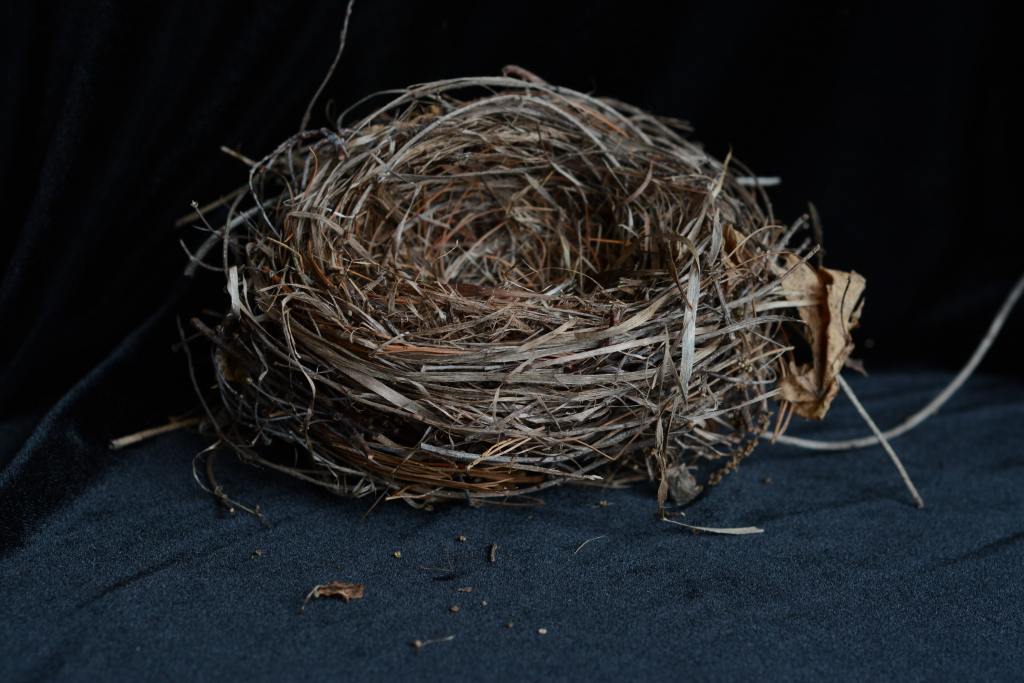
Even birds, requiring something solid to alight have been known to thread the nest with our disposal.
This morning I saw the black spot my left ovary a cavity
from which my ark had wrested in motion. But what about the body
that might or might not have been underneath the sheet?
The condition always the same:
Let me be some manner of ship or yes, again, a fish
suited to these streets
Abigail Chabitnoy, member of the Tangirnaq Native Village in Kodiak, is the author of How to Dress a Fish (Wesleyan 2019), shortlisted for the 2020 International Griffin Prize for Poetry and winner of the 2020 Colorado Book Award, and the linocut illustrated chapbook Converging Lines of Light (Flower Press 2021). Her poems have appeared in Hayden’s Ferry Review, Boston Review, Tin House, Gulf Coast, LitHub, and Red Ink, among others. She currently teaches at the Institute of American Indian Arts and Eastern Oregon University low-residency MFA programs as well as Lighthouse in Denver. Find her at salmonfisherpoet.com.
She tried to tell me that the past could be simply abandoned like unclaimed baggage at the airport or bus station,
or even, one day, with the closing of a door and the turning of a key—
left behind forever in the rear-view mirror like a house full of someone else’s belongings (not yours, not anymore) in a town full of strangers who never did you any favors.
But, I say the past can slip a microchip on you when you’re not looking;
I say the past always knows your current GPS location.
Jason Ryberg is the author of fourteen books of poetry, six screenplays, a few short stories, a box full of folders, notebooks and scraps of paper that could one day be (loosely) construed as a novel, and, a couple of angry letters to various magazine and newspaper editors. He is currently an artist-in-residence at both The Prospero Institute of Disquieted P/o/e/t/i/c/s and the Osage Arts Community, and is an editor and designer at Spartan Books. His latest collection of poems is Are You Sure Kerouac Done It This Way!? (co-authored with John Dorsey, and Victor Clevenger, OAC Books, 2021). He lives part-time in Kansas City, MO with a rooster named Little Red and a billygoat named Giuseppe and part-time somewhere in the Ozarks, near the Gasconade River, where there are also many strange and wonderful woodland critters.
This poem is from South Broadway Press’ new anthology, Dwell: Poems About Home.Purchase here.










 south broadway press