morbid savior born
on the doorstep of a corporation
the poor, voracious, gorge the forfeited thorns of corrupt senators opportunistic authoritarians they savor disproportionate offshore fortunes worship incorruptible corpses while gormandizing landlords orbit our torn world
i am the disorder in my aborted
forty fourth form
orthodox corpus
my torso deteriorates at the crematorium
or by ordinary worms
elaborate airport territories
vacant expanses for corona
dictatorial
not for foreign territories or shores
commemorate our glorious world
commemorate our glorious world
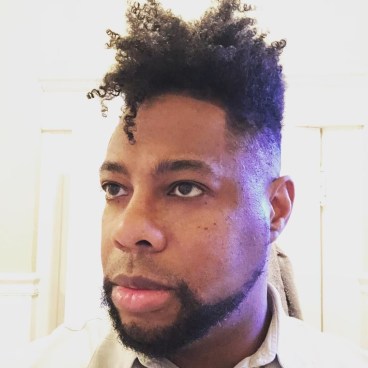
André O. Hoilette is a Jamaican born poet living in Denver. He is a Cave Canem alum and former editor of ambulant: A Journal of Poetry & Art and Nexus magazine. Hoilette is currently pursuing MFAs in Fiction and Poetry from Regis University. His work has been published in Stand Our Ground: Poems for Trayvon Martin and Marissa Alexander (A global anthology of social justice poetry) , Role Call, Bum Rush the Page: A Def Poetry Jam, Cave Canem 10th anniversary reader, milk magazine and other publications.
Our grandchildren are in the vanguard
of human evolution, autism possibly
the latest mutation, since change
has one leg up on adaptation.
Trouble is, the microbes
mutate faster than we do
and have had more practice.
In the matter of intelligence they
have outguessed us more than once.
It will require our best to see this through.
The past two Halloweens
my autistic grandson has gone
trick-or-treating as a hazmat zombie,
as if he owned a crystal ball
for the coronavirus.
Maybe we should turn our welfare
over to children, who might be
more adaptable than
millionaires over seventy
masquerading as world leaders.
Gerry Sloan is a poet and musician living in Fayetteville, Arkansas. He has two poetry collections: Paper Lanterns (2011) and Crossings: A Memoir in Verse (2017), recent work appearing in Elder Mountain, Cave Region Review, Xavier Review, and Slant. He often defaults to hot tea and old movies for solace.
grape grape apple apple pomegranate blues smokin’ in the alleyway moonlit dancin’ shoes
mint mint lemon lemon garlic ginger waltz old man in the dining hall says it’s not his fault
citrus citrus honey honey echinacea poem cursed if you go out to play blessed if you stay home
lime lime dandelion stingin’ nettle song bright eyed baby lookin’ up wonderin’ what went wrong
Brett Randell is a writer and musician who loves to play in regular venues, on rooftops, at yoga festivals, in bars, living rooms, and beyond. He is currently working on a novel while part of The Book Project at The Lighthouse Writer’s Workshop. Brett’s writing has appeared in Stain’d Magazine, Interkors, and The Blue Lake Review.
This poem is from our first print collection of poetry, “Thought For Food”, an anthology benefiting Denver Food Rescue. To support our fundraiser, please visit this link.
Someone set fire to the graveyard this morning. It wasn’t like anything you’ve ever seen. I didn’t get emotional when I saw it, unlike the blue hairs who stopped their Buicks on the side of 44th, genuflecting and crying and clutching the crosses around their necks. I pulled my truck over and got out just as sirens started up out east. I expected it to smell bad, like maybe the bodies and coffins would start burning too, but it just smelled like a campfire. I loved that smell. Especially with ribbons of raw venison skewered over top, blood and fat dripping into the heart of the pit. A thermos of whiskey in one hand and your old man leaning back in the chair adjacent, rolling smokes slow and careful like he’s got all the time in the world.
The fire felt right. Like cleansing the clutter that’s grown so slowly you don’t even notice until you can see it in the corners of your eyes when you try to relax. I’m not saying I did it, or that I even know who did. I’m just saying it didn’t strike me as an evil deed. I wish it could have been that easy when we gutted dad’s house and piled everything on the lawn for the estate sale. Just haul out that saggy blue couch and old tube TV and rip up the baby puke carpet and douse it all with a healthy dose of Boy Scout water and light it up. Howdy, Mrs. Johnson! Come on out from behind those curtains and bring some marshmallows! Dad would have wanted it that way, I bet.
Maybe an angel started the fire as a favor to the overused land. Fire brings up fresh grass and stronger trees. Maybe Michael the Archangel snuck down here with a can of lighter fluid. Maybe he knows that graveyards are a vanity that were never God’s wanting. Boy was that fire something.
Whoever did it knew what they were doing. When firemen started spraying water all over, I considered how much gasoline it would have taken to make sure those flames burned as fast and hot as they did. We’ve had a wet spring, so it wouldn’t have been easy. Then again, whoever did it could have gotten creative and sided with the three S’s — sodium chlorate crystals, sugar, and sulfuric acid. I sniffed the air. It was hard to say.
An old woman put her hand on my shoulder and asked if I had a relative in the graveyard on account of me watching for so long. Yes, I told her. She waited for more. Then her wrinkled face puckered up like a dog’s asshole and she went back to crying and saying over and over again Lord have mercy. I wanted to tell her, he does. Look straight ahead.
Patricia McCrystal is the recent recipient of the Slippery Elm Prose Prize and the founder of VIRAGO, a womxn’s writing circle. Her work can be found on PBS and in Heavy Feather Review, South Broadway Ghost Society, Birdy Magazine, and more. She’s pursuing her MFA in Fiction at Regis University.
The squirrel’s insides were draining out of its mouth
again as the day before.
Expansion: slipping away its squirrel-ness,
the thick and red of it,
jelly from a donut.
As pavement moves beneath me,
my closed eyes reveal
my mother leaving our family dog to die alone.
My mother only saw one being die.
Her mother’s breath stumbling
death yellow in the
muted light.
The harsh rhythm of the monitor
beginning to flatten into a continuous scream.
She watched her brother crawl on top of the body,
seeing her brother’s tears for the first time.
In the shower the next day,
through salt and hard water,
she saw her mother with her.
Her naked body, whole,
uncut.
My mother told me
that her mother’s breasts were
large and heavy and beautiful.
My mother is not usually so poetic.
Her brother would also die alone,
squatting on the damp concrete of
his father’s basement
or in
the fluorescent cave of the hospital.
My mind searches darkness
for details I’ve forgotten, or was
never told.
Sores for skin and holes for teeth.
The colorful toothbrush
I delivered to him
struggled against the
deep gray of his surroundings,
his broken-plate smile,
his voice thick with
gruff southern-ness.
I never saw his body
whole and complete
after he left.
Maybe his son saw him.
Air escapes
in fresh, burning bursts.
My body and mind turn
the corner.
My cousin,
born one day before me,
our baby hair matching,
fine and translucent.
His young body would
twist, and shake
knees kissing during late nights
of golden, childhood laughter.
The poster hanging on his
wall, beginning to fade.
Elvis’s slick black
hair almost white in places.
My cousin named his newborn
daughter Elena, and only knew
her a few short weeks
before he left.
Years of drowning led to
years of sobriety.
A girlfriend, stepdaughters.
What he called happiness,
through the digital blue of the screen.
Reaching out over miles
and years.
He wanted to
tell me about his life.
His baby.
The blood in my ears grows
louder as I near the end of my route.
Mind searching for a place
to hang my sadness.
No one ever confirmed
how or why he left.
Such a watery light.
Pale skin and summer freckles.
Pisces, double.
The end of the Zodiac
straddles the edge of the veil.
He was never here completely.
Two weeks after he left,
his daughter left too.
The light of the screen
again bringing its obituary,
its haunting.
The words,
“goodbye my angel”
all lowercase
raced toward me.
No capital letters
of devastation.
No place to hold greif.
The tightness in my chest twists
on each inhale.
Again, my closed eyes reveal
a picture of my cousin,
holding his newborn daughter.
Anxious curve of a smile,
a small bundle of pink.
Rubber presses the dark pavement in repetition.
The squirrel continues to shed its form.
When the flesh is gone, I am considering adding its bones to a shrine.
Small, white.
Solid and hard enough
to hold something.
This is the closest I have been to the process,
what happens after they leave.
I want to stay for the whole thing.
Ashley Howell Bunn is pursuing her MFA in poetry through Regis University where she is also a graduate writing consultant. She reads and helps develop community engagement for the literary journal Inverted Syntax. Her work has previously appeared in The Colorado Sun, the series Head Room Sessions, and more. When she isn’t writing, she teaches and practices yoga and runs a small personal business centered around healing. She lives in Denver, CO with her partner and child. Instagram: @howellandheal
especially after the last time
our pizza was made by hand
sanitizer, but I believe in second
toppings & chances. I wear my mask
covered with butterflies & wonder
if the young man in the next car
chuckles at me for taking that chance
in nature-filled protection
while he has no fabric for his mouth.
I don’t want to speak for him
as a ventriloquist but I am uneasy
& worried out here in my sky
watching for birds & clouds
& the coming storm that may
or may not happen. Of course
this is me daydreaming
of last year where every surface
was immaculate as we drift
together in a winged migration
back inside. I have to admit
I have cash to pay with & can
include a nice tip as I also have time
to embrace this time. We all can
wait outside together as three birds
swoop in a motion many never do.
After the cashier hands me my pizzas
in their warm boxes, I can pause
one more time here searching
to remember when I offered change
or leftover food to anyone as a cardinal
stops for a discarded crust.
Dennis Etzel Jr. lives in Topeka, Kansas with Carrie and the boys where he teaches English at Washburn University. His work has appeared in Denver Quarterly, Indiana Review, BlazeVOX, Fact-Simile, 1913: a journal of poetic forms, 3:AM, Tarpaulin Sky, DIAGRAM, and others.
Track the progression of comedic methodologies from the 1990s through the early and late 2000s, as demonstrated in the different stages of TheSimpsons (from satire—early ‘90s—to sitcom—mid ‘90s—to absurdist comedy—late ‘90s—to deconstructionist meta-parody—early 2000s—to randomized pop cultural overload—current)—as a show that persisted while changing to align with the comedic zeitgeist, to demonstrate the shift from postmodernism to metamodernism. Do this and don’t look out your window—one of many belonging to the tenement building you and your father have lived in all your life—and, whatever you do, definitely don’t go out the door and catch a cab to the hospice, at least not until you’re finished.
Connect these Simpson-stage-shifts to the shifts orchestrated by other popular comedies.
Anchor Man (which you and Dad would quote), in tandem with Family Guy (which only you would quote) popularized the absurdist non-sequitur pop cultural references and self-referential allusions to the pop cultural references (the ones they make). Anchorman as the shift toward absurdity and Family Guy toward non-sequitur meta-referential pop culture—FG commenting on the humor of Will Ferrell, and eventually even on itself (deconstruction). Simpsons had to change to keep up.
Remember the hinder-sounds of the door opening and closing around 8pm every night—after the two of you ate dinner, where he helped you with your homework, and if you finished quick enough he’d watch the first fifteen minutes of a rerun with you while getting ready (this happened less and less as you both grew older)—and how you’d strike out all the lights, after he’d said love you as the door shut, so the room danced with the shadows of the movement on the screen, and remained there in the dancing light until the door opened and closed again, around 6am (this time without a love you but instead a soft groan), and until the dancing shadows drowned in the sunlight streaming through the window you rarely looked out then, back when he could work, and even more rarely now.
Connect to Frederic Jameson’s diagnoses of postmodern culture, and thereby late capitalism, as schizophrenic—i.e. extends the symptoms of the psychoanalytic qualifications of Schizophrenia (unable to accede into the realm of language, thereby unable to form a solid identity—no “I”=no ego) to the masses in the form of pop cultural overload of disconnected webs of signifiers (e.g. MTV rapid fire television) that confuse the subject and make critical thinking near impossible—let alone clear thinking, let alone human connection outside the network of pop-cultural reference. Argue that pop culture has only increased its rapid fire pace.
Connect to escaping into the naked glow in the dark of the living/dining room (first from the television, then the computer, now both), and to the way the nature of that escape changed as plot and image changed, and how the shouting and the crying and the laughing from the other apartments, and out the window, first made the quiet of yours feel loud but eventually became indistinguishable from the shouting and crying and laughing from the screen and from your body, as did the hinder-sounds of the door opening and closing and the love you’s and soft groans (which became first a light cough and then a violent hack and then a quiet but constant groan that you barely hear anymore because you don’t visit the hospice).
In postmodern pop culture the rapid fire imagery was slow enough to still allow for some forms of critique—thus the satire, sitcom, and abusurdist stages of the Simpsons. He wasn’t sick during these stages, though the coughing began toward the end of the third.
Anchorman as the justification for the type of absurd humor that makes the pop references of FamilyGuy a valid form—i.e. it executed absurdity in such a way that the masses could embrace. This is the limit of postmodernism and thereby late capitalism. The overload of the convoluted webs of interwoven signifying chains as only made possible by the existence of the internet. This shift is the movement toward meta-modernism: e.g. Youtube culture. You remember this shift because he bought a computer, despite the voicemails from the medical billing agencies, and he gave it to you for homework and said Stay classy San Diego, and instead of saying thank you, you said I feel like a talking baby punching Ferrell in the face for making Bewitched—in a good way, and he might have laughed were it not for the coughing and for not getting the reference.
Family Guy and Simpsons picked up on this shift, and the rapid-fire webs of signifiers became more convoluted, randomized, and meaningless outside of its own network of reference. He thought the Simpsons had fallen off. You disagreed.
Argue that postmodernism was less insidious than metamodernism because the speed and volume of despotic webs of signifiers has exploded with the development of the internet. The overload of self-referential nonsense make subversive critique near-impossible in that it is sucked into the meta-ironic whirlwind. When Dad said love you, you used to say it back, but then you just started to quote shows, and he knew what you meant; then you started to quote YouTube videos of clips from shows, and he didn’t.
Finish this soon so he can read it before he dies.
Wesley Hunt hails from Baltimore, Maryland, and is a writer, experimental filmmaker, musician, and connoisseur of fine Salisbury steak. He is a former editor at the literary magazine The Welter, and graduate of University of Baltimore. His words have appeared in publications such as Horror Sleaze Trash and The Fine Print. Listen to his music at treeforts.bandcamp.com. Or don’t. This is a democracy, after all.
I ask you ..to take this cup from me. I don’t want ..to die alone in a white room ..some Monday, my lungs ..full, but without ..a breath left.
[TV]
BY KEVIN RABAS
…….I. …….You can stop the TV, …….get off your phone, and write. …….It may hurt …….to think, but you can.
…….II. …….If you don’t write ……….or make songs …….or paint, you have ……….to go and live in some …….other person’s dream.
[unintended birthday gift]
BY KEVIN RABAS
The neighbors have it, the pastor and his 6 kids, held a bday party the night before the lockdown started, and now they’ve got it, every single one.
Past Poet Laureate of Kansas (2017-2019) Kevin Rabas teaches at Emporia State University, where he leads the poetry and playwriting tracks and chairs the Department of English, Modern Languages, and Journalism. He has thirteen books, including Lisa’s Flying Electric Piano, a Kansas Notable Book and Nelson Poetry Book Award winner. He is the recipient of the Emporia State President’s and Liberal Arts & Sciences Awards for Research and Creativity, and he is the winner of the Langston Hughes Award for Poetry.
YOU CAN VISIT OUR FUNDRAISER FOR THOUGHT FOR FOOD HERE.
In these times of COVID-19 and social isolation, many people are out of work and lacking the resources necessary to even feed themselves.
South Broadway Press, the parent LLC of South Broadway Ghost Society, would like to help suppport local non-profit Denver Food Rescue by raising funds through an anthology of poetry entitled “Thought For Food”.
What Denver Food Rescue does:
We increase health equity with Denver neighborhoods by rescuing high-quality, fresh produce and perishable foods that would otherwise be thrown away by grocery stores, farmers markets, and produce distributors. With the help of our amazing volunteers, the food we rescue is delivered (often biked!) to Denver neighborhoods for direct distribution at No Cost Grocery Programs (NCGPs). NCGPs are co-created with existing community organizations like schools, recreation centers, and nonprofits that are already established and trusted within the neighborhood, decreasing transportation barriers. Residents of the NCGP community lead the distribution of rescued food, and many also help with food rescue shifts. This participation decreases stigma of traditional food pantries, empowering each neighborhood to create a program that is appropriate for their culture & community.
“Food For Thought” will be an anthology featuring a single poem by each selected contributor. Copies of “Thought For Food” will be available to contributors for $6. They will sell to other folks for $15 each.
Poems can be on any theme. If you’d like to be prompted, consider writing on the theme of food, or on life in the face of a pandemic.
“Thought For Food” marks South Broadway Press’ first release.
Submissions for this project will close on May 11th of 2020.
We will accept previously published materials.
If you would like to submit please send an email to submissions@soboghoso.org with the following information:
Subject: THOUGHT FOR FOOD
Your name.
A brief 100-word-or-less bio.
Up to three poems as a Word document or a Google Doc. We are not paying contributors for this project, but contributor copies will be available at a discounted rate of $6 each.
Please email us at submissions@soboghoso.org with any questions.
First, election day, and then
not so strange being close in bed
but first being strange
but not being in bed
being in body kind;
being slow, being not hurried for pleasure
being not at all the fantasie in men’s eyes;
being two, but not us, we
being lips, being breasts,
being you, being me, the bed being round,
plunging line of winter being one,
careful we, cutting away what is death.
Not even necessary, love
but there is love
and earlier there was my sadness for summer again
and the black dog chewed a squirrel
winter people crawled into tin holes.
Election day, I choose you, choose me, choose you
and earlier, the old woman wheeled to the polling place by her son,
a great book in her lap
fat boy in a green jacket, sparrow on a black roof
orange room very dry
but not dry, very lonely
but not lonely
only the blue jay
only the blue jay pecking on the window
not flying but then flying
from the black roof
not hearing my own voice loving for a long time
and then not even necessary, love,
not so strange being close in bed
but first being strange
being in body kind
careful we
falling through the fruits of winter
cutting away what is death
Susan Zeni wants her poems to tell the stories of people living on the margins of society. She lived in Manhattan on Avenue A, in Chinatown and in Harlem for five years, Seattle for ten, and is now ensconced back in the Midwest after years of teaching community college. Publications and honors include a Lucille Medwick Award for a poem with an humanitarian theme, “Black Angel,” published in the New York Quarterly, danced by the Erick Hawkins dance troupe, and read up on stage with Gwendolyn Brooks; a Seattle Weekly portrait of Ralph and Mary moved out of their Second Avenue Hotel digs by the Seattle Art Museum; and “The Street Walker’s Guide to Wealth,”recently published by the Minneapolis StarTribune.
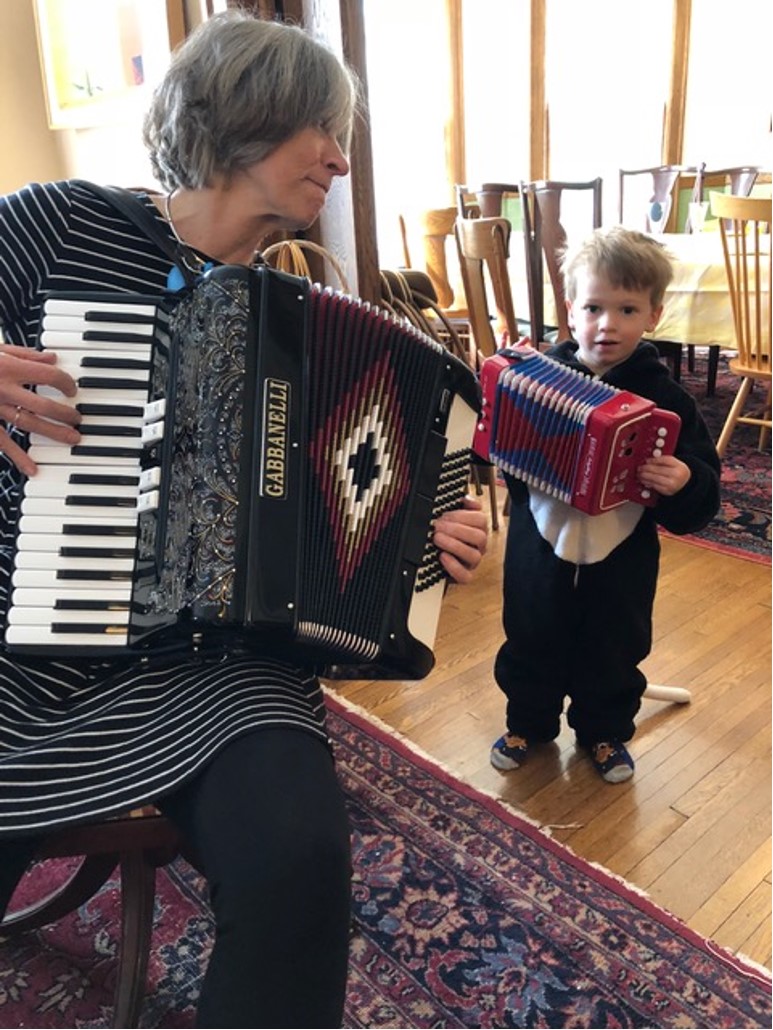
Susan gets her kicks playing accordion, having been in a number of bands, including the Polkastra and the all grrrl klezmer band, the Tsatskelehs, as well as performing solo at local art openings, Quaker events, and farmers’ markets.











 south broadway press