I got so drunk
I thought the
the manager
of the Chinese
takeout was
my psychiatrist
and I told him my
recent symptoms
and he increased
the dosage of my
fortune cookies,
but I was not
compliant and
barely even gave
General Tsao
a chance to kick
in and my bags
of unused ancient
medicine left an
oil stain on that
that nicotine yellow
hotel carpet with
my other unopened
prescriptions for
sushi and many
other potions from
far reaches of the
world colliding
several stories
beneath us on
the metropolitan
island streets
that breathe dirty
steam we are too
weak to breathe
in as we overdose
on over the counter
bullet proof glass
medicine with very
unpredictable side
effects that make
us hide here in
search of the
healing energy of
an uncharted sky.
Kevin Ridgeway is the author of Too Young to Know (Stubborn Mule Press). Recent work has appeared in Slipstream, Chiron Review, Nerve Cowboy, Main Street Rag, Cultural Weekly, Gasconade Review, The American Journal of Poetry and So it Goes: The Literary Journal of the Kurt Vonnegut Memorial Library, among others. A Pushcart Prize and Best of the Net nominee, he lives and writes in Long Beach, CA.
On the nights
with no degrees left
I tremble when
I think of you
cold and alone lying
on the dark earth where
her bones lay to rest
beside the bones of
her first son
I know you went there
as soon as you were
old enough to drive,
16 and your license was your
ticket to the graveyard.
Finally free
to be alone
in your obsession
Finally free
to grieve
Dear child, and you were
a child.
When your brother
was this age
he was your parent,
died a child.
You can fall
asleep with your family
every night
if you want to
think of them
before you dream
You do not have
to remember where
their flesh was buried
so long as you
let yourself melt
into their ghostly embrace
You can fall
asleep alone
if you want to
give yourself rest
from the memories
squeezing themselves
into your head
You can carry
yourself as you
wake in this world
if you want to
regulate yourself
help yourself
hold yourself
But you will never be
held by your mother again.
Your truth is in death
where your mind
will never go.
Let that be true for
just tonight.
Dream softly of
all that is left
on this earth
waiting
to decay
Funeral
At my funeral
there will be
only cut lilies
as decoration
so that everyone
will spend their time wondering
almost entirely
about the cut lilies.
How something so beautiful
could smell so bad;
how something
still living, can be dying,
or how something already dead
can still be living.
How long the liminal space
will last for them as humans,
how long it must feel for a lilly,
and if their perspective of
time even matters if
the process of death
is eternal
for every living one.
If we are all just living things dying
or dying things still living
sped up by life
sped up by work
sped up by stress
sped up by fear
and fear
and fear
and fear.
Their hands will touch
my face and they will
swallow the idea of me
Soak in the void
between the present
and imaginary daydreams
that could have happened
between us
if I had only
stayed alive
Trapped in the space
between reality
and dreams
And they will wonder
if it matters
or if it’s all about their perspective
afterall.
If it’s all about what they desire.
And they will wonder
why they ever fed
anything but desire
and pleasure
and love
and hope
Why they did anything
but move towards justice,
demand another world,
smell flowers
uncut,
and pray.
Kiss my forehead
and leave again
and begin again.
Hayden Dansky is a transgender nonbinary rural queer kid trying their best to not to be smothered by capitalism. Their poetry is a process of letting their flesh breathe, of finding oneself and sharing a body that is always in process. Their writing explores the depths of shame, darkness, queerness, addiction and grief. They create and collaborate with local experimental musicians and dancers to create performances that encompass multiple disciplines. They are also a food justice organizer and work to create more participatory and accessible food systems in Boulder, CO.
The moments I feel most lonely
are when I remember
I am not a coffee can full of gasoline
I am not a race car
in a black and white photograph
seemingly ripping a ditch into the universe
with a number etched into the side of my soul
I am not a prospector
chewing canary bones and digging for danger,
nor am I a coal miner
painting my skin daily
with the dankest of doom
I am not a boxer,
I am a punching bag
hanging in a sweat lodge
nailed to the blocks
forever waiting for the blank bullet
of a starter pistol
I have given into comforts
I have lost the panic of motivation
the friction of chattering teeth
no longer keeps me warm
my heart is glued back together
But where does that leave me?
This is not my first grave
This is not the first time I’m lamenting
a status that I never really had
I’m spinning off in every wrong direction
keeping my eyes peeled for the next
road of gold
The next masterpiece to dream
and steal
and squander
Until then, here I am
with another man’s lapels
in my clenched fists
in the middle of some house party
embarrassing myself to death
Jesse Lee Pacheco is a performance artist from Denver, CO. He’s a founding member of the Atlantic City arts collective, a group dedicated to exploring new artistic spaces and forms. Although he considers himself a multidisciplinary artist, poetry has a special place in his heart. He uses poetry to turn himself inside out, bringing his deepest parts to the surface. He would like to dedicate this piece to his brother Noah, for always believing in him.
I tried to write this poem on a typewriter.
The typewriter must be broken.
A blank page eats my fingertips.
I keep hammering space,
the only key still barely functioning,
until more and more blank pages
stare me in the face,
contemplating
the taste of my tongue.
I would throw it all out the window
if it weren’t for pigeons
bearing psalms of peace and vanity.
Over my shoulder
Robert Bly sits at a council fire
jacking off the ghost
of his younger self
while screaming something
about grief.
He is joined by the ghosts of
Abraham Lincoln and Hamlet’s father,
who chastise him with
banshee like battle hymns
and marching orders.
I can hardly hear them all
above the noise
of falling bombs,
bombs failing to hit the mark,
exploding in the periphery.
Ink splatters the blank
pages and my lips.
It tastes of blood.
Without story,
how can we
speak of god?
The long line of my forebears
steals letters from my head
with red hands
that tattoo sin into my skin.
I have sent many characters in
pursuit of an all-father
only to watch them fall
into the belly of the beast
becoming trapped behind
cage-like typewriter keys
when the sword of Hamlet proves
stronger than my pen.
Lincoln can no longer spell tragedy
with that hole in his skull.
Overhead a circling hawk cries Katsu!
Its sharp talons reflect the sun
as it lets fall another bomb.
Impact. Detonation.
That which is whole explodes into chaos,
chaos becomes equation,
equation becomes form, and as the pieces
of the body fall back to earth
I see the words that have yet to be written:
The council fire is embers.
Robert Bly is still muttering under his breath,
but Lincoln has run out of lines to read
and the ghost of Hamlet’s father
rests avenged.
The pigeons peck them all to pieces and
carry away some blank pages.
In the silence I notice
a pencil behind my ear.
It is short with no eraser,
badly bitten.
I stole the pencil from a young
fisherman by the name of Manolin,
who in search of the Old Man
hauled the pencil in from amid
the wreckage of the Pequod,
where it had come to rest
upon the deck within the claws
of a murdered Albatross.
The pencil has changed many hands.
The typewriter is still broken,
but it no longer matters.
With this pencil I shall carve
words into the blank page before me.
Overhead a hawk cries, Katsu!
John Haworth is a poet and writer in pursuit of a modern mythology. His work has appeared in Under the Devil’s Thumb, The Boulder Weekly, Spit Poet, and Braided Way. John is a self-educated bibliophile peering under every rock and twig for the answers to questions he can’t remember asking. He lives in Nederland Colorado and is not haunted by waters.
Alexandra Naughton is really cool and nice. She runs Be About It Press and writes poetry and novels. Find links to her work at alexandranaughton.com/publications
I slip from troubled dreams
into that half-asleep state
where nostalgia often visits.
A magical time of comfort,
suggestion, even whimsy,
where old realities intertwine
with imaginary tomorrows
and wistful impossibilities
becoming welcomed moments
a felicitous reprieve.
Too soon, always too soon,
the icy fingers of an emerging day
reach inside my reverie
gripping me like an insect
ensnared in the spider’s silk.
With desperate reluctance
I grudgingly submit,
the illusion dissipating
as mist to a warming wind.
Walking to another empty day,
I begin, with weary resolve,
to search a thousand yesterdays
for that dusty relic stashed
behind sparkling neon ornaments
of halcyon days and nights,
imperfect mementos of passersby,
even within the chain-draped sarcophagi
of those things best left untouched.
Maybe there will be something,
a recollection hidden or misplaced,
worthy yet of remembrance,
to make this day matter
enough to let me matter still.
But for every glint of light
there is a shadow clinging,
every joy countered by doubt,
each laugh a fresh tear,
any kindness an atrocity.
My search ends as treasure hunts do,
with frustration, angry distraction
and a deflating sense of futility.
Memories, it appears, only matter
to the rememberer in the end
and remembering anything alone
is so damn lonely.
As vivid dawn absorbs me
into encroaching radiance
the unnamable lust rises again.
I recognize it at once,
felt its dark caress before:
when the rocks far below
beckoned with enticing relief;
in the oncoming headlights
of another night traveler
or when this current chapter began
and I pursued it with such zeal.
But I was naïve and tentative
like a teenaged boy the first time.
I know much more now.
The prospect of a long life
filled with this kind of tomorrow
is much more terrifying to me
than an eternity with the dead,
kindred spirits always near
who lie upon me heavily
like a comfortable old sweater
on a chilly fall afternoon.
My thoughts turn to them.
I want to know what they know,
see what they’ve seen when
their forever moment drew them
into its unsympathetic embrace;
when, like frost under of rising sun,
fear and hatred fell away,
pain and worry ended.
I want to know what I’ll see.
Will they all be waiting?
Everyone I loved, wanted to love?
Will I, at last, be home?
I can’t really know
until I join them.
Rick Anderson is incarcerated in Sterling Correctional Facility, Sterling Colorado, where he works in the library,. Writing poetry helps Rick endure the hardships of life in prison, and often returns him to his beloved nature.
There are some rules, like to never wear shoes, that you just refuse to obey. You pick up a piece of wood and start to see it become a hand, but also stay a tree. At night you
anonymously paste drawings of giant babies around your neighborhood. The plaza is still named Generalissimo Francisco Franco, even though it’s over 40 years after the fall of the dictatorship. Gary says to you, “You better look at a gun; you don’t know what a gun really looks like.” So for Valentine’s Day he gets you a plastic AK-47. Pharaoh’s army falls back.
Howie Good is the author of three recent collections, I’m Not a Robot from Tolsun Books, The Titanic Sails at Dawn from Alien Buddha Press, and What It Is and How to Use It from Grey Book Press.
They’ve got post-modern
coming out the ears and
they can burp up contemporaries
just like that
but
where have all the French surrealists gone in Denver?
If I threw my shoe into the air
would it turn into a balloon?
They want to contextualize my shoes-
analyze them, analyze me, then compare
them to shoes of the past.
It makes my orangatang want to weep.
Our computers are draining our colors,
no longer can a man simply be
a walrus in a dream –
he must first be shown, first,
the circuits underneath.
Tom Christian is a queer poet currently living and working in Denver Colorado. At night he can be found wandering the streets, conversing with ghosts.
Elijah Lynch, aka Smiley Gatmouth (et.) is a writer, musician & educator from Denver, Colorado. He doesn’t play out much, but he quietly performs to himself and his ukulele almost every day on the lightrail. If you see him, you should probably ask him to play you a song.
The scene is in middle school, in two separate lines to electric chairs.
They won’t use the electricity. All we do is sit, they inject, and it’s done.
Then we get up and hop on over to the happy place–
a colorful room fluffed with pillows and stuffed
animals, the comfiest pile, the biggest slumber
party. Relax until sleep kicks in.
Before I know it, I’m next in line.
We’ve been chatting for a while, me and a tall, brown girl
who’s called up before me. Cheerily, she says she’ll see me soon. She means heaven.
Oh yeah, I say, casually. Casualties in the comfy room
didn’t occur to me. I’m called up next, and I’m at ease.
As I stroll to my death, a little thought asks,
But what about the novel? I realize I’m not ready to die.
I have a novel to write. The nurses, once so nice,
reveal themselves to be witches, escaped sirens from my story.
Lightning spews from their fingers when I run.
Ellen Huang is a cape-wearing mortal living her best life, with a BA in Writing & Theatre minor from Point Loma Nazarene University. She’s been known to possess vast knowledge of myths and fairy tales, as well as practically live in a prop closet full of exotic decorations. She has pieces published in Sirens Call, Wax Poetry and Art Magazine, HerStry, Diverging Magazine, Awkward Mermaid, Enchanted Conversation, Writers Ink, Between the Lines, Quail Bell Magazine, Ink & Nebula, Rigorous Magazine, Whispers, The Folks, Hummingbird Magazine, The Driftwood, The Gallery, and Perfume River Poetry Review. She enjoys reenacting movie scenes, burning things, and swimming in the sea. Follow if you wanna: worrydollsandfloatinglights.wordpress.com

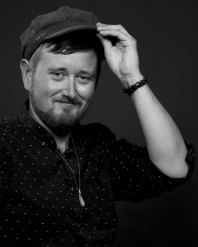

 Hayden Dansky is a transgender nonbinary rural queer kid trying their best to not to be smothered by capitalism. Their poetry is a process of letting their flesh breathe, of finding oneself and sharing a body that is always in process. Their writing explores the depths of shame, darkness, queerness, addiction and grief. They create and collaborate with local experimental musicians and dancers to create performances that encompass multiple disciplines. They are also a food justice organizer and work to create more participatory and accessible food systems in Boulder, CO.







 south broadway press