Fished a moth presumably Miller out the coffee pot presumably dead.
Again, no talent for judging life.
Everything learning to walk is Bambi except for people.
I hate moths and hate them more when they’re dying in front of me. So stunting. So honestly dying. The gall.
drank the coffee of course i drank the coffee boringly. To myself. I wouldn’t write the poem if I didn’t drink The Mothra Jus Wouldn’t submit the poem if I didn’t drink The Mothra Jus And there’s flavor in being misunderstood Pollinators. So, yes, down.
Burned my feet on the fire escape Where it dried out in a bad way something awful uncomfortably.
Then life again more than caffeinated only so poisoned
drowning those on the surface
underneath it’s downpour

you are very much
as the spring
this year

we can only pray
        hope is real
practice deep breaths
	plan in positive accord

as in what may grow

closer

perhaps the squirrels
will not eat the strawberries
but better
to put a barrier between
them and the fruit

I’m sure the weeds
and wild grass will
stay a few weeks
more green before
the summer sizzle

maybe we may
take advantage of
both the growing tumble
and the withering

to pull from the rain
and the land the best
we can

to add to the home
we share within us

set the table
prepare the meal
and may neither one
of us be cut
the cosmic within and without
BY TED VACA
YOU MIGHT WANT


to think deeply
about where you
come from

To Think Deeply About Where You Come From

TO
THINK		DEEPLY
ABOUT	       WHERE
YOU		COME

FROM

to think
deeply
about

to open the eternal
gold-fringe lined
burgundy curtain
on the stage manager's signal

let the show begin
step upon the stage
stomach in turmoil
mind electric
your eyes
             wide wild
             and excited

to accept what is
within
                            is without

to accept what is
                                            without is within

the universe  s
                 s            p
               l                  i
                      a   r


out and in
unfolds engulfs
consistently for a manufactured
lineage of time

the universe
                              doesn’t care about
                                                                     TIME

time manmade	           time the cursor
from birth to death	   and how much
                                           can you accomplish

time the accomplishment

                                            measure of worth and meaning

time the killer the waste of

                                           the sought after for proof of
                                           deeds and diplomas

the microscopic
                                            is 	C O S M I C
the cosmic is
                                                      microscopic

the embryo in their sack

utero evolving galaxies

spinning and star beings
born in a chemical-chance
at becoming only to be seen
in awe by the dark matter
that surrounds
Incomprehensible!
our eternal selfs
witnessed
mirrored not above
not below
but all around

breaking the novelty of direction
the compass explodes and the earthly mind
is set free of dimensions then intuned with the way
then again becoming unknown
as a dream
separated
from the expansion

we’ve not far to go
to reach & realize
Ted Vaca, Denver poet father lover crime fighter / semi holy somewhat sweet can be bitter / published here and there / Founder of The Mercury Cafe poetry slam / Coach of the 2006 Championship Denver Slam Team / Member of 1995 Championship slam team from Asheville NC / Intergalactic Provocateur
Incantation
to my Wisdom Teeth

I imagine you being lifted up and out
	easily
		not by the touch
of an object or an instrument
	or a hand
		but by way
of your own command.

I see you floating out
	as if you simply
		wanted to leave–
no force, no ache, no blood.

After,
	you are not gone from me
		but returned

to the Earth, to the Air.
	You are less bone
		than soil
less soil than sky.
You are four moons

in the soft night
	so there is no part of me
		that needs to be healed

only these glowing orbs
	that I have known.
		And now, they have
relinquished me.
Ode to the Barn Swallow

I love a beautiful bird
that cracks open the daybreak
and re-configures the setting

              of the sun. I take her into me.
              Everything I know of touch
              has been learned from the gloss
              of her feathers
              and the swallow
              down her orange throat.

                            When I am to finally live,
                            it will be with the arrival
                            of hope. The hope
                            that she will surrender
                            the whole sky
                            that was once under
                            her wings so that she

                            might return to me.
On Prince Edward Island

                a corridor opens
along a path of red pines

long necks
reaching toward a starless
November, dirt like burnt sugar
litters the path		I ache
to taste it
but pine needles lace
in and out, at once sharp,
and when the night settles, soft

I am searching for pieces of broken
              promises, but when I tire
I will turn myself in
Jessica Bagwell is primarily a poet, but also dabbles in creative nonfiction. Her work appears in Needle Poetry, Sorin Oak Review, and New Literati. In her poems, she pays homage to the lyric and explores formal experimentalism. When she is not writing, she enjoys practicing & teaching yoga, taking long walks, and sampling local breweries with her partner.
Our ship cuts a quiet wake across the Río de la Plata The harbor of Buenos Aires slow motions away from us The muddy haze of pollution hangs within the labyrinths of canyon streets, thick o’er the poor south barrios
~ ~ ~ ~ ~ ~ ~
The fringed skyline further behind us now The sun silverplates the water, dead fish bobbing Ships far asea coming in or leaving this port & to our east the dark risen shore of Uruguay
~ ~ ~ ~ ~ ~ ~
Wind strong up on the deck, slicing the bright sun That once-far bank & isles nearing, heavy with thick-leafed trees
Lorraine Caputo is a wandering troubadour whose poetry appears in over 400 journals on six continents, and 20 collections of poetry – including On Galápagos Shores (dancing girl press, 2019), Caribbean Interludes (Origami Poems Project, 2022) and the upcoming In the Jaguar Valley (dancing girl press, 2023). She also authors travel narratives, articles and guidebooks. Her writing has been honored by the Parliamentary Poet Laureate of Canada (2011) and thrice nominated for the Best of the Net. Caputo has done literary readings from Alaska to the Patagonia. She journeys through Latin America with her faithful knapsack Rocinante, listening to the voices of the pueblos and Earth. Follow her adventures at www.facebook.com/lorrainecaputo.wanderer or https://latinamericawanderer.wordpress.com.
a sweet ball, organic and tender, but it’s another to blank and piss and smack real
people around just to see what we can take until we eat us sugared flesh from candied bone this
unspooled ticking wild heart the last last god
As Hunger for Melon
How close sweetness is to rot. Begging and easy to want. Leave the hard-won water of astringent rind. Hold something darker in the mouth, something so close to loss you feel it on the bone. Give honey, give wine. Fill a plate, a belly, a chalice. Let the sick light of midday collapse the tender center; let the bees get drunk and dream through the neon bulldoze of the afternoon. Spit the seeds, or swallow. Cry when swallows slice the sky. Red life, swollen, falls out.
Magic Lessons (Meditations from an afternoon stroll)
The car that passed thumped a Fleetwood Mac bassline and deep inside my cranium I am still five years old afraid of spaces that contain only me; no guardian to hold. I catch a whiff of vinegar, and I think of my lover. His naturally upturned mouth, and his eyes soft like soil after the storm has passed. I look at the wildflowers, and think of all the graveyards I would like to contain me. Heart no longer beating, just a garden my grandmother used to tend to, once teeming with fuchsia and dandelion. In my dreams that night, I tell auntie Ayreen about she, who looked like lavender skies. Her head haloed with stray blonde strands, iridescent under the setting sun. There is magic in this earth. It lives in pinecones, in the sound of the TV from the next room, and in fields overrun with weeds; in the sea that roars itself a drumroll, perpetually announcing its undulating waves. The magic is the quiet victory of knowing the guarantees of the earth. The sun will rise and it will set, grief will endure and so will love. We’ve come so far that we can see it all coming. And yet – miraculously, tenderly, this special pocket of the universe surprises us anyway.
Do not say that you do not see what I see. Do not say that you do not feel the walls closing in on you, that you do not hear the click of the key turning, locking you in a box like a coffin, because
nothing is as simple as it seems.
Beyond the borders of those boxes that sort skin like laundry into darks and lights, coloured or white, telling tales about the danger posed by a single soot black sweater, hood pulled high, or a dress, red as blood, thrown in with crisp white sheets because
it only takes one drop;
at the limits of those labels that reduce people to chemical structures, to nothing but an arrangement of atoms on one side of a double bond — cis, as in same, ordinary, natural, normal — or the other — trans, as in different, unlike in nature, form, or quality,
unintelligible and illusory as such;
in between that fractured love that physicians tried (in vain) to set straight before issuing diagnoses of sexual deviation — sociopathic personality disturbances to be treated and tamed, banished to bathhouses first, then bedrooms, now stashed away in closets and being
dared to come out;
within those colossal cracks that some try to seal with pity, others with prayer, asking God for a miracle, a cure, something to ease the suffering and numb the pain they attribute to being broken because they cannot see the sunlight seeping through the cracks, cannot understand that
there is beauty in breaking;
there, in the spaces beyond and inbetween, at the edges of perception where people are othered and alienated, separated and segregated, where borders are built with walls made of bricks, not straw or sticks because there, a harmonious wind howls at the rising moon and life dances with liminality like
humans with nature.
Leighton Schreyer (he/they): is a queer, trans*, disabled writer and poet based out of Toronto who describes themselves as fundamentally unsatisfied with the status quo. Through their writing, Leighton strives to see the unseen and hear the unheard, to make the invisible visible and tell the untold. They use their writing as a tool for activism and empowerment, challenging readers to reflect on the biases and assumptions that shape worldviews. As a current medical student, Leighton is particularly interested in the intersection of health, arts, and the humanities, and is passionate about using stories, storytelling, writing, and poetry as powerful tools for healing and connection.
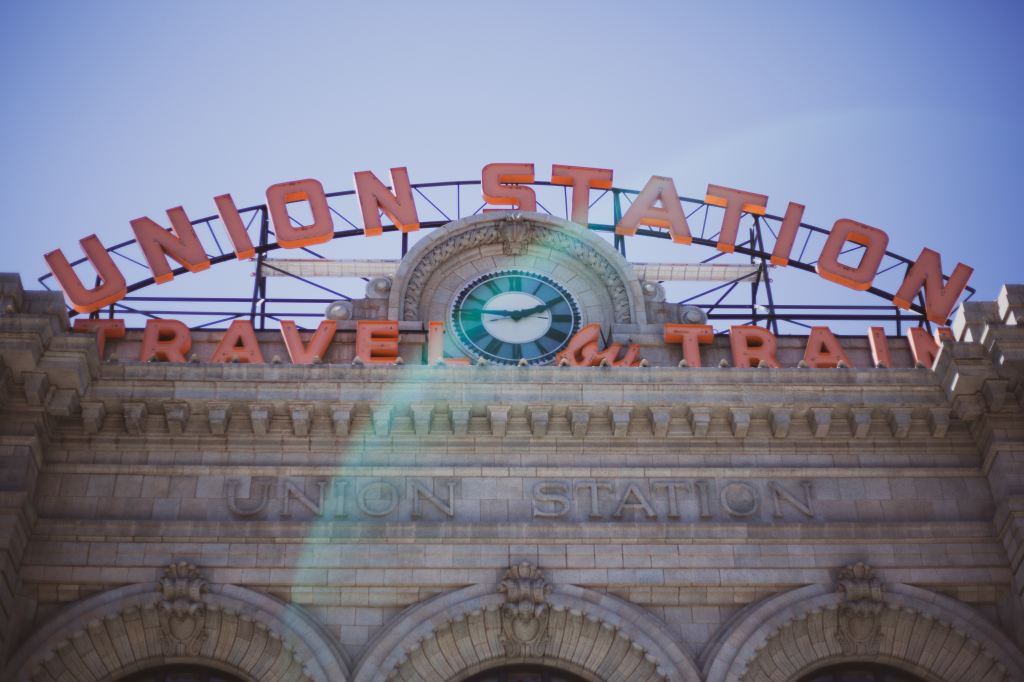
Outside the men’s restroom at Union Station trench coats heaped next to skis.
Inside the pile I am a carpet beetle minding the pockets.
Outside the pile I am the custodian with a side gig selling the larvae to the chocolate-covered- insect food truck, The Smooth Thorax.
Brian Dickson (he/him/his): When not teaching at the Community College of Denver, Brian avoids driving as much as possible to traipse around the front range region by foot, bike, bus or train with kids in tow. Somehow he also serves as an editor for New Feathers Anthology as well.
Maybe I should stop writing about glitter— but sometimes I wonder
if it’s the only proof still clinging to what’s left of us. Do you miss
the sparkle of my eye shadow? Golden branded butterfly kisses fluttered
onto your gilded cheeks. I guess I just like shiny things that stay. Like a shimmery
permanence, or a luster memento of everything I’ve loved enough to touch.
Another Period Poem
Fucking someone should be easy, but I’m on my period on a first date, and I want
to negotiate a scene— but not that one from The Shining. So anyway, a man walks into a bar
and I’m bleeding. He says I’m happy you decided to meet, and my smile lacks sparkle because I’m just here
for the ride, and one of us knows that’s not going to happen. I order something fruity with a tiny
umbrella. My cherry red lipstick ghosts into the soft red bar-light glow. I’m on his lap when I say we’re not
having sex. He puts his hands up— a surrender, says I’d just like to kiss you, and we do until I’m kissing
him with my eyes open: bored and waiting for the punchline. An older man walks into a bar, and I’m still bleeding.
He says I don’t drink but looks thirsty. I savor the thought of being a novelty, but he looks everywhere but me
and his fingers fidget, never reach for mine. He walks me home and doesn’t invite himself in.
A woman walks into a coffee shop, it’s a week and a half later and I’m still bleeding. I’m cursing the bloated
baggage of the breakup that brought this all on. She says I’d like to kiss you, and we do and she leaves. I want to feel
something, will myself to exchange numbness for lust. I’m empty and aching to be filled by something like soft
hands. The boy made of sand let himself be swallowed by a gentler sea. I wish
instead of blood I could bury him under the rough sheets of some unknown
bed. I don’t want to write another poem about this boy or my period,
but I guess I’ll opt for the latter because it’s the one that always comes back.
Tyler Hurula (she/her) is a poet born and raised in Denver, Colorado. She is queer, polyamorous, and lives with her wife and two cats. Author of Love Me Louder (Querencia Press). Her poems have been published previously in Anti-Heroin Chic, Aurum Journal, Quail Bell Magazine, Gnashing Teeth Publishing, and more. She values connection, authenticity, and vulnerability, and tries to encompass these values in her writing as well as everyday life.
Your right hand squeezes, hoping to milk blood from the stones of our body.
In its grip, you resurrect an age of tailfins and lunar discovery, but you also manifest the unholiest of sins, a generation of blind eyes and cancerous banks.
Consider how many of us descend to take communion at your altar rail.
Offer us your compassionate bread and a chalice of wine fermented from your tears.
With a single snap of your fingers, we will beat our wings to help rebuild your temples.
Cradle us ———— in your left hand.
Joshua Gage (he/him/his) is an ornery curmudgeon from Cleveland. His newest chapbook, blips on a screen, is available on Cuttlefish Books. He is a graduate of the Low Residency MFA Program in Creative Writing at Naropa University. He has a penchant for Pendleton shirts, Ethiopian coffee, and any poem strong enough to yank the breath out of his lungs. Follow him @pottygok.











 south broadway press