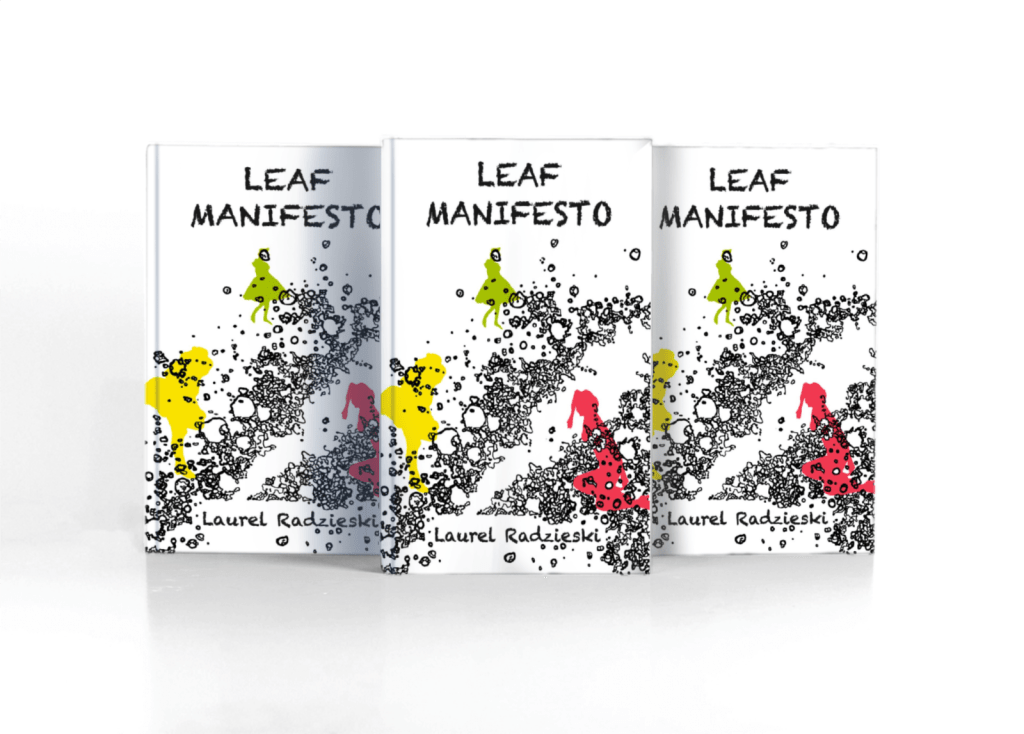
Book Review: Leaf Manifesto by Laurel Radzieski

WILD NATURE, WILD WOMEN, A WILD ECOPOETICS:
LAUREL RADZIESKI’S LEAF MANIFESTO

A BOOK REVIEW BY SHELLI ROTTSCHAFER

Laurel Radzieski welds her pen to manifest an embodied poetics and advocacy for the wild.  Wild nature. Wild Women.  This collection is unique because she plays upon the page physically and artistically in form, as many of these poems take shape within female curves. The growth from within is her child, and in this way the verse thrives.

The collection follows a flora lifecycle.  Each section reminds the reader of this beginning to end:  Seed, Germination, Sprout, Seedling, Sapling, Tree, Flowering, and ultimately the tempestuous Fruit.  Radzieski sets out upon her poetics journey stating, “One day I said aloud / I might like to be a tree” (11) and so she entices her reader to figure out what this may mean.

Throughout Leaf Manifesto Radzieski prompts us with questions: “What is a woman?” (15). And provides multiple choice answers, that only lead to more internalized questions.  Through this feminist lens she taunts her reader to poke at their own preconceived perceptions.  “Who gets to be a woman?” (16).  “What use is a woman?” (17).  “What’s it like to be a woman?” (21).  Once again, she tests her reader through a True / False dichotomy.  She dares us to shade in our answer fully with a #2 Lead Pencil.

In “How to Identify as a Tree” (38), Radzieski considers identity, origin, and belonging.  “Consider what others would want to know about your bark patterns and inner rings.”  Yet how a tree-body-person may appear doesn’t describe the within.  Rather, “roots and family tree” nudge toward fuller truths.  Especially as it oft happens, “If you are on unseeded land, know the history of the ground, how it got that way.”  In this way, Radzieski alludes to those who came before us.  She acknowledges that the land of her manifesto is of indigenous origins and birthright.

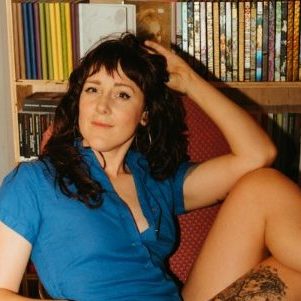
Author Laurel Radzieski

Throughout her collection, Radzieski offers up Ven Diagrams.  In “Woman Tree” (69), she encloses what these two entities have in common: branches, limbs, mistakes, leaves, organs, roots, flesh, rings, family, pain, and flowers.”  At least with this last word, she ends on hope.

Radzieski’s final poem in the collection, “Past Life Regression” (121) is a haiku:

Fallen walnut.  Such
a long way down, but then
soft idea of grass.

This seasonal form representing a walnut tree’s lifespan, culminates in a fruit-nut’s finality.  Not eaten, but allowed to cascade to an end-place.  Tranquility lands in grass.  Her bed, which begins again the tree’s lifecycle as the seed buries into soil knowing she will sprout once more. 

Laurel Radzieski won the Halycon Award from Middle Creek Publishing & Audio for this collection.  It is her second full collection of poetry.  Other poems have found a home in Rust + Moth, The New Your Quarterly, and Atlas.  She lives in Reading, Pennsylvania and is the Director of Grants at Alvernia University.
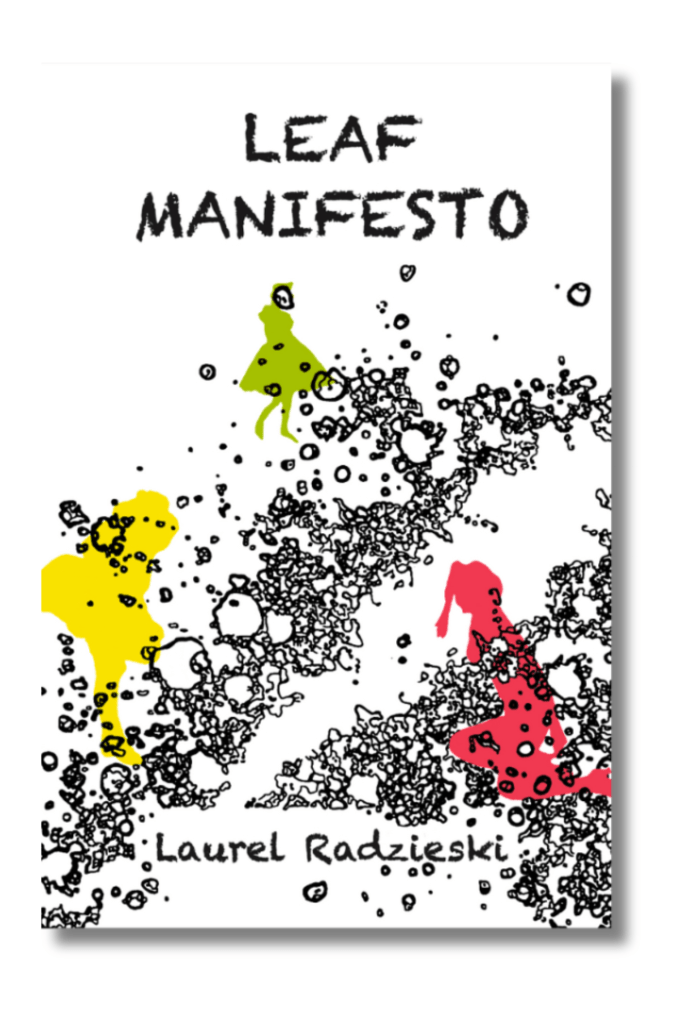
LEAF MANIFESTO

BY LAUREL RADZIESKI

AVAILABLE NOW!
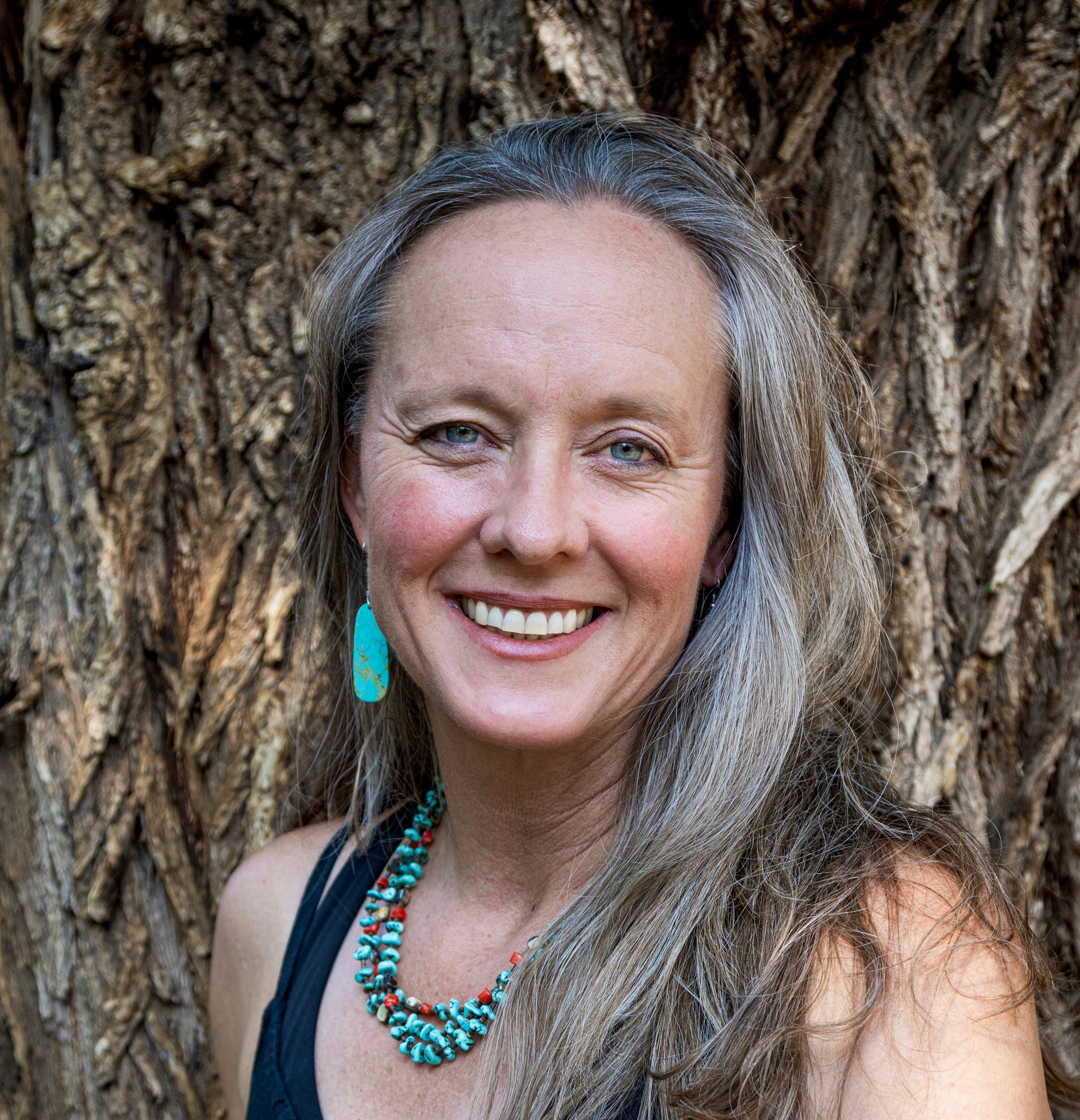
Shelli Rottschafer (she / her / ella) completed her doctorate from the University of New Mexico, Albuquerque (2005) in Latin American Contemporary Literature. From 2006 until 2023 Rottschafer taught at a small liberal arts college in Grand Rapids, Michigan as a Professor of Spanish. She also holds an MFA in Creative Writing with a concentration in Poetry and coursework in Nature Writing from Western Colorado University (2025).

Shelli’s home state is Michigan, yet her wanderlust turns her gaze toward her new querencia within the Mountain West where she lives, loves, and writes in Louisville, Colorado and El Prado, Nuevo México with her partner, photographer Daniel Combs and their Pyrenees-Border Collie Rescue. 

Discover more of Shelli’s work at: www.shellirottschaferauthor.com

Three Poems // Wheeler Light

Image: Louis K. Harlow

I DO NOT CARE IF YOU ARE ACROSS THE COUNTRY

BY WHEELER LIGHT

or down the country, or around the country.
The country, an exercise in understanding the space

of the country. I do not care if you are my friend
or my best friend or a collection of memories

I can talk to about the memories you are.
I do not care about meaning or anger

or hope or apocalypse when I care about laughter.
I do not care if it makes sense to call you

too many times in a day until you pick up
to tell you a joke you will like and laugh and laugh.

What I care about is distance as a measure
of effort to overcome said distance. If the distance

between us is the country, then the effort
is the world. You are a world away. I am

a world away. When I stare into the middle
of nowhere, you are there laughing at the joke

I traveled around the world to tell you.

THE BAD NEWS

BY WHEELER LIGHT

You wake up
knowing nothing.

The day, the shape
of a chrysanthemum

bell. Unraveling
is the start

of eventually hoping.
Oh, I too mistake

disaster
for salvation.

I take my medication
the same as anyone else,

staring at myself
in the bathroom mirror

to see what I recognize.
My actions reflected—

the bad news
is the actions.

The good news
is the reflecting.

Mistaking the self
for its consequences.

Mistaking the self
for anything at all.

The bad news
is the self.

The good news
is waiting at the end

of the illuminating
hallway of you.

SAWMILL RUN

BY WHEELER LIGHT

Writing about a mountain
because there is a mountain.

Photographs of the mountain
capture more than words

can carve out of enjambment’s
live edge. Oranges and reds

at the end of fall litter
my eyes with the image

I try to translate into imagery.
Can’t you see the green

peeking between naked birch
trees? The sun reflecting off

the fog blanketing everything?
A photograph is a headstone

which mourns the moment
it was taken. Up the road,

there is another overlook
and another. Different angles

to view the jagged document
of time, these peaks erupting

and softening over enough millennia,
their existence nearly makes you forget

dry brush, pipelines, controlled
burns, doe crossing the road doesn’t

make it. The present, a cloud of smoke
invisible behind the cliff in the distance.

Writing about the earth
because there is the earth

cracking its knuckles
and arching its back.

At the overlook, I get out of the car
and step on a pile of broken glass.

Wheeler Light received his MFA in creative writing from University of Virginia. His work has appeared or is forthcoming in Tupelo Quarterly, Barely South, and Allium, among other publications. You can find his poems at www.wheelerlight.net.

Mending Bones // Hillary Gonzalez

Image: Matt Artz

MENDING BONES

BY HILLARY GONZALEZ

In college, I sat in a room, painfully
lit by the overhead fluorescents,
at an uncomfortable desk meant
for someone much shorter than me,
listening to my Anthropology professor,
as he asked a room full of half-awake
students, what the first evidence of civilization was.
It was a test, which most people failed.
One intrepid student answered Egypt,
another offered the presence of agriculture,
others stared blankly–waiting for an answer.
It was a broken bone, he said.
Thousands of years ago,
a human broke their femur–
that long bone connecting hip to knee.
Had they been an animal,
they would have been left,
weakened and alone,
And as the day shortened
into the terrors of a wild night,
other animals would have crept in, no doubt,
circled around them, picking
them off as the weakest in the herd.
But this human was cared for.
Their bone was mended.
This was the pivotal sign that other humans
had wanted to care for them,
had perhaps thought of them as family,
had perhaps loved them.
Today, as I scroll on my phone,
I see video after video
of people begging to be seen as human,
of children whose limbs were blown off,
of people with no homes
holding up signs that say, “hungry,”
and I wonder if we can
still call ourselves a civilization?
Somewhere along the line,
perhaps when we traded
oral tradition for computer screens,
and living off what the earth
so readily wants to give to us,
for speedy factory convenience,
we forgot about the human
with the broken femur.
we forgot that deep down in our lineage,
we share the same tree roots.
now, I see signs in my city
as people march down the street,
saying “Jesus was a refugee,”
and I wonder if the people
yelling at the ones protesting
to protect our siblings,
would they even recognize
the face of their god,
if he were holding up a sign
in that same crowd,
demanding the deportations stop.
When did we lose our humanity?
What will it take for us
to see the value in mending
bones again–not for profit,
but because it’s what the spirit needs?

Hillary Gonzalez (she/they) is a Baltimore based queer, disabled, and AuDHD poet, whose work explores themes of eco-consciousness and reconnecting with the land, identity, and healing. They are the authors of Seasons and Wild Unfelt World, a collection of eco-poetry coming in 2026 from Gnashing Teeth Publishing. Their poems have been published by South Broadway Press, and in anthologies by Bi+ Book GangYellow Arrow Publishing, Loblolly Press’ zine: Understory, a fundraising anthology for the victims of Hurricane Helene, and In Praise of Despair, an anthology for disabled artists by Beyond the Veil Press.

SUN IN YOUR EYES // Azalea Aguilar

Image: Siora

SUN IN YOUR EYES

BY AZALEA AGUILAR

(Dad is wiping frantically at the windshield
condensation catching up
we are blind to the road ahead)

My therapist is wearing teal glasses today
When did this begin for you?
she lifts the wire frames
gently off the cushion of her cheek
pushing them closer to sight
was there a time before, I wonder
have I always been
meticulously watching
contemplating movement
sirens from school chairs
calculating distance
traveling closer or further
like counting seconds
between lightning and thunder
one one thousand
two one thousand
three one thousand
anticipating arrival
creak of a wooden floor
boots land heavy
do they shuffle or drag
are they staggered or constant
is he coming or going
slamming of a screen door
angry or rushed
in or out
her or him
idling in front of a fridge
hunger or thirst
boredom or pleasure
is it the beginning or the end
I tell her I can’t
remember
a time before

Azalea Aguilar is a Chicana poet from South Texas, gulf scents and childhood memories linger in her work. Her poetry delves into complexities of motherhood, echoes of trauma, and resilience found in spaces shaped by survival. Her work has appeared in Angel City Review, The Skinny Poetry Journal, and The Acentos Review.

Two of Cups // Erica Reid

Image: he zhu

TWO OF CUPS

BY ERICA REID
Even the  lions sprout  wings 
in a dream this desperate,
the one you begged for,
early bedtimes & lucid
machinations. Here, you
finally have it — if only in
a watery fog already
dissipating. For now it is
yours: harmony true as a
caduceus, clarity regular as
day. The dream’s central
art: your riven heart, the
other half given away.

Erica Reid is the author of Ghost Man on Second, winner of the Donald Justice Poetry Prize (Autumn House Press, 2024). Erica’s poems appear in Rattle, Cherry Tree, Colorado Review, and more. ericareidpoet.com

salmon run // Dara Goodale

Image: Ľudovít Varga

SALMON RUN

BY DARA GOODALE
every year     the air turns cold 
& trees catch fire—orange embers
glow backlit by pale
autumn sun
it is time to migrate

saltwater salmon go home
to the rivers of their youth
travel in leaps
of scales that shimmer
in afternoon light
the vice-grip of evolution
commands them to procreate
its primal hands tight
around slippery throats
most of them will not survive
the journey is high-risk
uphill battle they swim upstream
in the rush of current many are lost
there is no time to mourn

when they hit freshwater
salmon deny the need to eat
their bodies nothing but empty
vessels meant to sire new
offspring in sacred genesis
those who make it to the gravel beds
where they were born
lay their eggs & wait
for death—

pulled back
by invisible thread
salmon give up the free
expanse of ocean
where the world is boundless
for a wet grave—
they renounce the promise
of future & return to birthplace
where they die
martyrs
for their species
with no one left
to grieve them

Dara Goodale (they/she) is a Romanian-American lesbian, poet, and university student living in Lausanne, Switzerland. Their work has appeared or is forthcoming in the American Poetry Journal, Cleaver Magazine, Thimble Literary Magazine, Underbelly Press, The Passionfruit Review, and more.

Decomposure // Two Poems by Maple Scoresby

Image: Annie Spratt

A TRANS GIRL VISITS HER FAMILY

BY MAPLE SCORESBY
Hiding in the single stall men's room,
I try to reach out for help.
But there is no service
in this backwoods temple, and
the wifi is password protected.

With a sigh I leave the safety
of the small room and locked door
to wade into the sea of blood
relatives pouring into the pews,
and slide into my saved seat.

Standing at the podium,
the Elder gestures to the body
of my dead grandfather;
starting the eulogy
by praising the Church.
-
In two years my
grandmother will also be
eulogized by this same
Elder, who is her brother
by mother and by faith.

Just as bereft as the rest
of the congregation,
he will use her death
to accuse the left for
the downfall of our nation.

I won't attend in person
but my mother will send me
the recording and I will see
the world is ending
and I am the one to blame.
-
Here and now, the Elder invites
others to share, admitting
my grandfather had his flaws
and reminding us, it isn’t the time
to speak ill of the dead.

A long silence before
a Brother stands and speaks
on how active he was in the church,
these last months and weeks. Nods
of agreement flood the foyer.

At the social after the ceremony,
I trace footsteps of my past life;
as people who refuse to know me
give conditional condolences to
the person that I used to be.

CRAB APPLES

BY MAPLE SCORESBY

Unsupervised grandchildren gather
around a row of crab apple trees,
picking the bitter browning fruit off
the ground around the tree’s roots;
too young and small to grab the
pristine bright green apples, hanging
high in the branches of the tree.

The kids don’t mind though. They
know that if they root around enough
in the mush decomposing by their feet,
eventually they will find a crisp bite
of emerald, sour enough to make
their faces crinkle up just as
good as any high hanging fruit.

Maple Scoresby (she/her) is a Denver poet who tends to deposit her paychecks into the local claw machines instead of the bank. Her poetry tackles topics like gender identity, double standards, and pizza sauce. In her spare time, Maple likes to cry about how terrible she is at Street Fighter while drinking an obscene amount of eggnog.

When Siblings Visit // Leor Feldman

Image: Jessica Dismorr

WHEN SIBLINGS VISIT

BY LEOR FELDMAN
tighter than his own hands,
a familial hive claws his throat

prepped by tender olive
juice varnishes

the wood vinegar
against august trauma
now prepared for pickling

our railing indents the melancholy
splinters rise once again
and plead

to trace his face
connect the dots
of our generational trauma

born of the Mediterranean
feral freckles cut like diamonds

seeped in displacement and addiction

deep strawberry hair, darker in sea’s salt
feet like talons gripping sand

Leor Feldman (they/he) is a Jewish disabled writer who explores themes of culture, placemaking and the connection between our natural world and the chronically ill, genderqueer body. You can find their work in Humble Pie Lit Journal, South Broadway Press, Hey Alma and The Colorado Sun. Leor currently resides in Conifer, Colorado, yet is often found at community events in Denver.

Near the Rappahannock, Wellfleet Oysters // Jennifer Browne

Image: Beatrice Bright

NEAR THE RAPPAHANNOCK, WELLFLEET OYSTERS

BY JENNIFER BROWNE

The liquor in an oyster is the brine
of the water-body held at harvest.
This river drains the Blue Ridge,
meets the Chesapeake with a sigh,
leaves a sweetness in the locals,
but on the new planks of Wellfleet
Harbor, I tasted your salt. Beloved,
that one word in the day’s chalk
floods the room with light. Could
I ever choose another having known
your waiting nacre, your shucked,
gleam-soft interior along my tongue?

Jennifer Browne falls in love easily with other people’s dogs. She is the author of American Crow (Beltway Editions) and the poetry chapbooks Before: After; In a Period of Absence, a Lake; whisper song; and The Salt of the Geologic World. Find more of her work at linktr.ee/jenniferabrowne.

for what do we sing if not flowers // Ally Eden

Image: Soraya Silvestri

FOR WHAT DO WE SING IF NOT FLOWERS

BY ALLY EDEN
a bee slips and shifts over the face of water

tiny figures on the bridge beneath

lightning antlers watch the river

growing rouge


i like august except sometimes

when newly softened leaves flutter

dead by the rail-yard & earth’s last good leg

brings down the sky like a marble fish


we cling to what floats

wifi tattered boards pink sneakers

rising incense on an eerie blue morning

Ally Eden (Former Poet Laureate of Fort Collins, Colorado) writes poems that are vibrant, poignant & tender. Their work invites readers to conversations about current events while invoking reverence for humanity & nature. A Spanish interpreter by trade, Ally’s poetic ethos parallels her role as a linguist — bridging difference by way of words.