There is no such second place in the world where so many noteworthy moments have been saved. How many of your breaths flickered on the walls, how many of your tears soaked the floor, nobody knows. A part of your heart will stay here forever, no matter where the wings of fate take you. It’s a magic point, the mind remembers it as the heart longs for it, one and only—home.
Norbert Góra is a 32-year-old poet and writer from Poland. He is the author of more than 100 poems which have been published in poetry anthologies in USA, UK, India, Nigeria, Kenya and Australia.
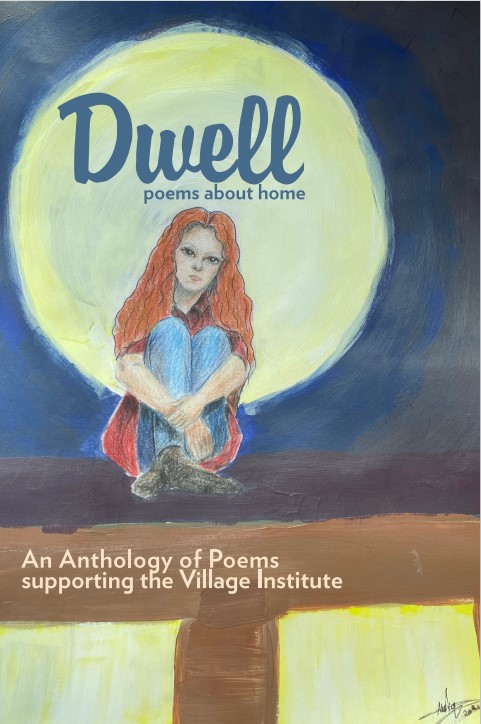
This poem is from South Broadway Press’ new anthology, Dwell: Poems About Home.Purchase here.
I’m airing out the house of my heart. All the cobwebbed corners, the shelves of knickknacks, are being dusted unmercifully. I’m opening the shutters letting the wind blow out the musty smell of disuse. I’m putting flowers in all the rooms. Even the basement, the attic ignored for so long are getting a going over. All that old junk has got to go. It’s just shelter for spiders that tap away when the lights come on.
I’m trying to put the house of my heart in order. “Smarten up,” I say, adjusting the bowties of my fears. “Stand up straight,” I say, brushing off the jackets of my doubts. “Everyone be on your best behavior,” I say to my wants and needs. “We have a guest coming.”
I am queer noir. The smoked clenched night. The dark alley, The pissed stained bathroom club floor. I am the slammed door of rejection. The constant rampant tapping to let me in. The hot palpitation of a night. The hookup line and sinker.
I am the low end speaker, the part of you that know’s something’s wrong.
I hold the light of morning inside my heart.
I am queer noir.
Cipriano Ortega (they/them) has been fortunate enough to have their work recognized and shown both nationally and internationally. Cipriano strives to create works of art that probe the mind and make people question what they perceive as the normative. Whether that is shown in music, theater, visual art or some sort of culmination of all of the above; Cipriano enjoys blending all creative forms of expression. As a sociological artist, Cipriano deconstructs the worlds around them and observes it under a nihilistic perspective. As an indigenous POC, they also have no choice but to deal with colonialism head on by making it a daily practice to see the divisions we as a society create and continue to make the ‘normative.’
I hadn’t seen the woman from Chicago in months though the guy still walked their hulking labrador.
But this was the city in sickness and in health, it wasn’t polite to impose.
Under what conditions might a sheet by the road not assume a body? The shroud
stained funereal so near to the point of some levied labor.
Is there a condition in which a ghost is not suspected?
Plastic bags trawl the landscape. Stone beds wait for us to seed.
The clementines congeal into the grapes shrink past sweetness and affix themselves
in the rot of last month’s spinach. Already dust settles in the bedroom and piss from a recalculating cat
shadows the tile in the study if you know where to look.
Last week I found a sand dollar with only a small hole left of center, I reminded myself
even the winged rats had to eat, had to play some part, so we’re told.
Even birds, requiring something solid to alight have been known to thread the nest with our disposal.
This morning I saw the black spot my left ovary a cavity
from which my ark had wrested in motion. But what about the body
that might or might not have been underneath the sheet?
The condition always the same:
Let me be some manner of ship or yes, again, a fish
suited to these streets
Abigail Chabitnoy, member of the Tangirnaq Native Village in Kodiak, is the author of How to Dress a Fish (Wesleyan 2019), shortlisted for the 2020 International Griffin Prize for Poetry and winner of the 2020 Colorado Book Award, and the linocut illustrated chapbook Converging Lines of Light (Flower Press 2021). Her poems have appeared in Hayden’s Ferry Review, Boston Review, Tin House, Gulf Coast, LitHub, and Red Ink, among others. She currently teaches at the Institute of American Indian Arts and Eastern Oregon University low-residency MFA programs as well as Lighthouse in Denver. Find her at salmonfisherpoet.com.
She tried to tell me that the past could be simply abandoned like unclaimed baggage at the airport or bus station,
or even, one day, with the closing of a door and the turning of a key—
left behind forever in the rear-view mirror like a house full of someone else’s belongings (not yours, not anymore) in a town full of strangers who never did you any favors.
But, I say the past can slip a microchip on you when you’re not looking;
I say the past always knows your current GPS location.
Jason Ryberg is the author of fourteen books of poetry, six screenplays, a few short stories, a box full of folders, notebooks and scraps of paper that could one day be (loosely) construed as a novel, and, a couple of angry letters to various magazine and newspaper editors. He is currently an artist-in-residence at both The Prospero Institute of Disquieted P/o/e/t/i/c/s and the Osage Arts Community, and is an editor and designer at Spartan Books. His latest collection of poems is Are You Sure Kerouac Done It This Way!? (co-authored with John Dorsey, and Victor Clevenger, OAC Books, 2021). He lives part-time in Kansas City, MO with a rooster named Little Red and a billygoat named Giuseppe and part-time somewhere in the Ozarks, near the Gasconade River, where there are also many strange and wonderful woodland critters.
This poem is from South Broadway Press’ new anthology, Dwell: Poems About Home.Purchase here.
Lack of a lover Lack of children Lack of pets Lack of flatmates Lack of arguments Starting out petty Lack of partitioned space Lack of visitors Unless they’re invited— Just me In my little house Two room Inner sanctum Where I could be Just me— A living Situation I seem Condemned to & somehow
Prefer—
Dee Allen is an African-Italian performance poet based in Oakland, California. Active on creative writing & Spoken Word since the early 1990s. Author of 7 books–Boneyard, Unwritten Law, Stormwater, Skeletal Black [ all from POOR Press ], Elohi Unitsi [ Conviction 2 Change Publishing ] and from February 2022, Rusty Gallows: Passages Against Hate [ Vagabond Books ] and Plans [ Nomadic Press ]–and 42 anthology appearances under his figurative belt so far.
This poem is from South Broadway Press’ new anthology, Dwell: Poems About Home.Purchase here.
My family grew corn in the heartland, but I’ve never seen it quite like this:
Angelic, husk-winged, guarding every shard of bone hidden in the soil.
How is it that I didn’t know I had thousands of angels? They were with me all the time.
I remember going out into the fields with my grandpa, crossing into the humid network, stalks sending out messages to each other across droplets of August air.
I could hear their choir, their low and incandescent hum, the sway of bass clef notes rocking me to sleep in the farmhouse.
Emily Dickenson advised us all to tell the truth slant, and I remember this is what hailstorms taught the fields. The slant truth seemed tragic, in a way, as if nothing stays upright or rooted for long. Not even cornstalks.
Not even families.
Not even farmhouses, burned to the ground long after they’ve become vacant, when the small town fire department needs a fire to practice on.
Something is always missing.
Maybe it’s just a three-hundred-sixty degree view, the ability to see that everything is overflowing,
all the time.
Cortney Collins lives on the Front Range of Colorado with her two beloved feline companions, Pablo (after Neruda) and Lida Rose (after a barbershop quartet song in The Music Man). She is the founder of the pandemic-era virtual poetry open mic, Zoem. Zoem produced an anthology of its poets’ work, Magpies: A Zoem Anthology, of which she is co-editor. Her work has been published by South Broadway Press, 24hr Neon Mag, Amethyst Magazine, Sheila-na-Gig, Back Patio Press, and others. Cortney considers herself a poet secondarily; her first calling is encouraging others’ beautiful words in community.
This poem is from South Broadway Press’ new anthology, Dwell: Poems About Home. Dwell will be available to purchase August 1st, 2022.
Terra Iverson is thrilled to be on the South Broadway Press editing team.
Originally a businesswoman, her passion has always been in the written word. Ink is an art form, painting your world in the minds of others. The meaning of a word, the structure of a stanza, the moment when you forget who you are because it is all so powerful. Terra loves those moments. She’s often found reading nearly everywhere she goes, even while walking, which she doesn’t recommend.
She has experience as an editor in publications such as Obscura. Terra has had her poetry and play scripts published in Project Yes and Obscura. Terra is also currently working towards publishing her collection of short stories, artwork, and poems. A Colorado native, she resides in a small mountain town with her husband and their two sons.
It’s so much easier to see the world in black and white. Gray? I don’t know what to do with gray.
Garrus Vakarian, Mass Effect 2
What does this quote mean to you?
The human mind tries so hard to fit everything into a category; to choose a side. Is this black, is it white? Does this fit into this box or that? It’s hard to do, but I want to see the gray, the opaque place where most of us truly dance. It’s difficult to walk through, even harder to write about, but when I hear or read something and it burrows its way into my soul, I want to honor it. Even if I don’t know what to do with it, even if it’s “gray”, I still want its company.
What books have made an important impact on you and why?
I’m not sure how I could possibly sum all the stories I’ve consumed into a simple list. I love adventure, I love conflict, romance, places, and characters. I feel like at the end of a good book I’ve made actual friends. I nearly weep when I’m finished, saying goodbye. I spent so much time with these stories, they influenced me, help build who I am. As a very young child, I slept every night with a book called Baby Dear. Where other children may have had a stuffed bear, I cuddled a book for comfort. Today, I read books to my children about dragons, wizards, dinosaurs, and blueberries. So perhaps these are the books that impact me the most, the ones that start myself and others down the path of discovering the worlds hidden between the pages.
What is the value of writing and art in the current state of the world?
Art is culture. Without it, society has no soul. Without art, would we truly be living? When humanity was stuck inside, faced with unsurmountable darkness, we turned to art. We turned to paint, to photos, to music, and to words. We latched onto our soul and held on for dear life.
How have writing and art helped to form the person you are today?
My art and writing gift me a way to share myself with others.
As a child, I was consumed by other peoples’ worlds. I lived in those worlds so I could walk through a broken home and many difficult and defining moments. I escaped into the imagination of others. It let me pause, breathe, and be someone else, if only for a moment.
As I grew, I started creating my own worlds, places where my mind could wander. Places where my feelings and my soul could be safe. I learned that through paint, photos, and writing I could explore that inner world and also share it with others. It’s so fascinating, so vulnerable, so beautiful, and so freeing.
What is something that matters to you?
Connections matter to me, the threads of emotion that bind people together as well as the commonality and differences we all share. There are so many people, places, and principles in this universe that have had a hand in shaping me into the person I am. My family, my husband, my kids, and my friends have all helped me to walk through this world with kindness, determination, love, joy, hope, and peace. I also value art, community, health, an adventurous spirit, and freedom.
Want to get to know our other editors? Read more Editor Interviews here.
Erin told me her face was falling. We sat on a motel bed in downtown Anaheim, each of us with stones inside our bodies where organs used to be. Hand to her face she placed her fingers at her jaw and said, it’s sagging. Like a landslide.
Our foundations were made from the gulfs created in the void of saltwater and sun; we were grown from the melting glaciers. Skeletons shaped from every piece of rock we had once picked up from the tongue of the shore because we thought it was pretty, replacing the bone until we were both ambling monuments.
In the motel in downtown Anaheim, we cracked geodes against one another with enough force to break them open to see if our guts were quartz. The same sort of rock scientists on playgrounds smashing stones to see if there were hidden crystals, only we were older, and our shared insides didn’t carry crystals…as we found out. Sharp fragments splintered and dented the cold bedcovers, rock people applying pressure as a kind of embrace.
And her face was falling like how Venice is sinking, and the world is impermanent, so we split our skin open to find anything secreted from the soft outsides. The shells of our exteriors thawed like those candles whose wax peels away to reveal tiny gems, but really, it’s just a trinket more like trash than treasure.
Structures like bones crease into putty like how memorials fall and become their own grave markers, and on a floral smoke-smelling comforter in a strip mall in Anaheim, I ease into the rock rain of my own face and the spring that found itself seeping out of the remains of my body. Our mingled landslide faces and surfaces liquified with only the memory of boulder bodies and gritted organs left in our wake.
Tomorrow we’d go back to carrying our stones.
Jane-Rebecca Cannarella (she/her) is a writer and editor living in Philadelphia. She is the editor of HOOT Review and Meow Meow Pow Pow Lit, and a former genre editor at Lunch Ticket. She’s the author of Better Bones and Marrow, both published by Thirty West Publishing House, The Guessing Game published by BA Press, and Thirst and Frost forthcoming from Vegetarian Alcoholic Press.
His name was Pietro Ludivicci, and he was in love with symmetry.
Those statues of his were carved with a delicate accuracy, angels and saints poised to bless or condemn, their pale faces set in expressions of aloof piety. That marble virgin of his was housed inside the chapel, the object of awe among the townspeople. For the sculptor had rendered the stone folds of her clothing as soft-looking as fabric.
The flawless beauty of Ludivicci’s creations was rivaled only by the appearance of the sculptor himself. With his tight curls, regal nose, cherubic lips, and mahogany eyes, it was as if he were the personification of the suppleness of youth. How lovely, this Pietro!
Of course, the young women of the town were hopelessly taken with him. Why, even the mayor’s wife fondly referred to him as her first love! A cacophony of tokens, flowers, letters, and gifts took up permanent residence outside his door. In the marketplace, women would tarry and stare, and those bold enough to proposition him always received the same answer: a curl of the lip, and a flat “I’d rather not”. You see, Ludivicci was a paramour of human beauty- and perfection his muse. How could he settle for anything else in a lover?
These harsh rejections were hard on the ladies of the town. Many would weep, and some would pull at their hair. Young Viola, who cleaned the sculptor’s apartment, witnessed countless of these spurnings. In the smoky bars, her father, the innkeeper, and the older townsmen would snidely remark that Ludivicci may as well wed one of his statues.
There came a day, as the harvest-season came round, that the sculptor unexpectedly stopped accepting commissions. For seventeen days on end, he vanished from the eyes of the community. Circulating whispers suggested illness, or even his death. Viola of course knew that the artist was not dead at all. He had thrown himself into his newest project.
Ludivicci the recluse remained shut up in his apartment, his door opening only to receive the bread and wine he paid Viola to purchase for him. During these visits, the girl caught glimpses of a form standing in the center of his room- a new statue, perhaps? Alas, she could never get a good enough look, as the sculptor would pay her what was owed and then slam the door with a force that made the frame creak.
The longer Pietro Ludivicci was in isolation, the more fanciful the rumors about him became. He had certainly lost his sanity, most agreed. Signora Columbo swore she had spotted him at the temple, worshipping the pagan gods! How could he have fallen so far? Poor Pietro! A red-cheeked and mortified Viola confessed to her sister as they lay in bed one night that she had caught the sculptor cradling what seemed to be the face of his passion project and kissing its lips!
Months passed before Ludivicci was spotted in public again. He looked certainly worse for wear, with dark shadows underneath his eyes, an unkempt beard, and his shoulder-length hair hanging in an unruly tangle.
His sculpting seemed to be abandoned as a thing of the past, as he had emerged from his isolation with nothing to show for it. If one would catch him walking about in town or marketplace and inquire about his work, he would stare back with haunted, glassy eyes and mutter something about having more important matters to pursue.
No one quite knew where the woman had come from. The way the innkeeper told it, she had knocked upon the inn’s door late one night (the night before Ludivicci returned to society) and requested residence. Said her name was Giana Aldi. She had paid him handsomely for room and board from a fine leather coin purse that hung from her waist. She was a painter, this woman, who wished to work undisturbed within the rooms. Why is it that this town is the place of so many fussy artists? The innkeeper bemoaned to his wife and daughters as they, dazed and recently roused from sleep, stumbled to prepare a room.
Soon enough, the town forgot their fascination with Ludivicci in favor of the mysterious Giana Aldi. It was if she had been carved from marble, as such flawlessness seemed unnatural. Smooth dark locks flowed down her back to her waist, and large black eyes were framed by heavy lashes. They seemed to see into one’s heart, and one couldn’t help but feel naked and exposed under her gaze.
She was stern and dedicated to her art with a borderline religious fervour. Her neighbors took notice, with news of her traveling within hours. Who was she? Perhaps she and Ludivicci would be the perfect match for one another. Two kindred spirits, parallel in looks and practice.
Evidently, Ludivicci was enthralled by her as well. Every evening, he would stand at her balcony, wildly waving bouquets of flowers, imploring her to come down and speak to him. No one ever saw Giana Aldi do so much as open her window. Late into the night, the sculptor would cry, shout, and even sing love poetry! Poor Ludivicci was in such a state of ruin by the seventh night, yet he persisted. Having enough of this, the innkeeper accosted him on the street, ordering him to give it up at once! Ludivicci, likely emboldened by the wine running through his body, declared that he would never stop his pursuit until he heard word from the lady herself.
It is said, and there have been several witnesses to this, that Giana Aldi appeared on the balcony then. Leaning over its edge, raven hair spilling over her shoulders, her disdainful shout could be heard by all:
“I’d rather not!”
Gracie Nordgren is a Creative Writing student at the University of Colorado Boulder. She enjoys daydreaming and pomegranates, and would very much like to travel to Venus. Her work has appeared in Kalopsia Literary Journal, The University of Colorado Boulder Honors Journal, and Cathartic Youth Literary Magazine, among others.









 south broadway press