two poems – kathy o’fallon

tomas-tuma-1139973-unsplash

Longing Still the Ruin of My Existence
                                                      for Tom

I always thought he’d come back
like this, wrapped in his youth,
spook to my banshee.
The thin man, I’d once teased—
huddled like an Einstein
crouched in the basement trying
to figure things out: aeronautics,
magic tricks, why
our family made no sense.
Bred in his lab
like little white spirits
or gods called by name,
rats nibbled crumbs from his lips,
staved his hunger,
but the lure of the airplane glue
proved too fragrant to resist,
formulas floating
clear out of reach, and then Boom!
a hole in the paneling closer
to the boiler than one cared to think.
Our father, who art not in hell,
didn’t like that too much, the trapped
pet rats now scurrying to get out,
racing against the poison-filled smoke.

I always thought he’d come back like this,
show me a smile could be sober
without losing its bliss.
Oh, how I’ve missed you, I said,
ten years of loss melting at my feet.

Umbilical Cord

The gravel granite path across
the cemetery crackles like rock candy.
What I’d give for a piece
to suck like a thumb,
weaned from the nipple.

I take off my shoes
so the stones can scar
something into submission.
I don’t mean to dissect the worm,
but I’m glad to, first-born of eight—
we craved the same nourishment.

I scrape fingernails along tree bark,
and its dust stains my skin.
She is here, reclaiming my body.
I kneel and cling to exposed roots,
can’t think       which one to follow.
They reach where I can’t so I pull,
but they break into little carcasses.

wolf_silhouette_png_clip_art_image (1)

With great assistance from her mentors, Kathy OFallon‘s poems and short stories have been published in numerous literary journals, magazines, and anthologies, as well as three chapbooks.  She is a psychologist living in Fallbrook, California, self-proclaimed avocado capital of the world.  Without poetry, OFallon asks, how would she know her own heart?

Photo: Tomas Tuma 

paper towel roll – jacob butlett

kaluci-145201-unsplash

“Gay males are thought to only represent 5% of the total male population but among males who have eating disorders, 42% identify as gay.” – National Eating Disorders Association


While the moon yawns outside the bedroom window,
I think of him as a white paper towel roll at a party:
In the beginning, a baby in the plastic-tight embrace

of his mother. Smooth, sensitive, plump,
he eyed others crowding around him, squeezing him,
soiling him with dirty hands of disappointment,

he believed. Holding me in the bed we used to own,
he once told me he hated himself for being himself,
for being the vanity’s prank upon the planet.

Since childhood, he’s thrown sheets of himself, papery
shreds of flesh, into the trashcan of life. Nothing remains
except a cold gauze of skin over his bones, the exposed

cardboard roll of his spine, which now I caress as he
falls asleep dreaming of what? Dreaming of food he’ll
never eat? Acceptance he’ll never accept?

I don’t want to compare him to a paper towel roll—
to any other object, for that matter—but as long as he retreats
into himself, refusing my help, how can I not see his body broken?

His spine’s a cracked telescope, fractured kaleidoscope,
revealing little in its lens, in its limited lightshow:
a glimpse of the brilliant borealis of his upbringing,

a glimpse of his future—colored slides in the light?
I imagine pressing an ear against his sunken chest,
a smashed treasure chest harboring, I hope, an ocean’s lullaby,

an ocean’s laughter. But now I hear him—
snores hoarse, whimpers raspy—begging to be more,
to be firm as muscles, firm as fat filling dead space.

Tomorrow we’ll talk. He and I will talk about this tomorrow,
before he fades forever like a breeze in the trees outside.
Until then, I close the curtains, tucking the moon into bed,

snuggle down under the covers, dark as an ossuary,
and dream of him—his smile wide as the crescent moon,
his once bulky body now protected in the warm plastic of my arms.


wolf_silhouette_png_clip_art_image (1)


Former poetry editor and longtime gay author Jacob Butlett (he/him) holds an A.A. in General Studies and a B.A. in Creative Writing. In 2012 he earned a Scholastic Art & Writing Awards Gold Key for his fiction, in 2017 he won the Bauerly-Roseliep Scholarship for literary excellence, and in 2018 he received a Pushcart Prize nomination for his poetry. Some of his work has been published in The MacGuffin, Panoply, Cacti Fur, Gone Lawn, Word Fountain, Ghost City Review, Lunch Ticket, Fterota Logia, Into the Void, and plain china.  

Photo: kaluci

what is this oblivion? – larry thacker

todd-downs-13325-unsplash


Returning to where we’re from,
to before waking into the question.
Fresh grass taken into the mouth, chewed, swallowed,
brought up, swallowed down to a blankness.
What was the child’s first words? Why me, mother?
A truth-flavored, empty dark scripted of dreamlessness.
Housedress pockets bulging, hanging,
with sleeping river rocks.
Ask anything into an abandoned house’s broken mirror.
Light from a dead star, roaming and waiting
to be seen and named by the fading eyes
a beast stuck by a vehicle
and resting on the roadside.
Empty well. Empty well. Empty well.
Knowing where all the bodies are buried.
An antique typewriter’s stuck, melting +/= key
on the eighty-seventh floor.
The one balloon, released.
Dust on a window brushed by a man’s black wool-
suited shoulder, glanced through
from inside by the retiring barista.
Cup of black coffee, evaporating on a picnic table.


Wolf_Silhouette_PNG_Clip_Art_Image


Larry D. Thacker’s poetry is in over one-hundred-and-fifty publications including SpillwayStill: The JournalValparaiso Poetry ReviewPoetry South, The Southern Poetry Anthology, The American Journal of Poetry, The Lake,Illuminations Literary Magazine, and Appalachian Heritage. His books include Mountain Mysteries, the full poetry collections Drifting in Awe and Grave Robber Confessional, the chapbooks Voice Hunting and Memory Train, and the forthcoming full collection, Feasts of Evasion. His MFA in poetry and fiction is earned from West Virginia Wesleyan College. Visit his website at: www.larrydthacker.com


Photo: Todd Downs

skim milk – jack orleans

skim

Marie met back with herself after quite a long hiatus. She was sitting in the den, reading the paper and letting tendrils of smoke vine up at her wrists. She met back with herself after she decided to take up gardening and collecting old National Geographic. She met back with herself after realizing that she wasn’t the one she needed to escape from. She met back with herself after she dumped all the pills in the toilet, and swore not to reach down and take them one-by-one, dry them off, and save them. She did that to two, swallowed one, felt half, and let the rest go.

She was reading NatGeo after stepping inside to make tea. The magazines looked like an attempt to get back to the land. In it there were glossed pictures of African women and Siberian native men, seemingly happy, seemingly without knowledge of more intimate pleasures. The most she’d seen is pictures of a few factory workers—some Soviet, some Chinese—stepping out for cigarettes, or drunk after hours. But even the cigarettes looked otherworldly. Between the fingers of people that weren’t her, and in a place she couldn’t be, the cigarettes looked healthy even. Like Chinese Coke, bitter and more bubbly, less sweet. Like Russian Kvass; healthful for fun. As for the tribal folks, the most there was a shaman taking the strange brew, which looked less like fun and more like duty.

Marie thought of what a mistake it may have been to throw out the pills. How, they swam down the pipes and tubes in a moment of peace, and how she might wish she wouldn’t when times became less easygoing. And in some ways she was right to sense that she in the future would be scolding of her in the present. That thought alone brought some tension, some punctuations in ease. She tried to lose herself from it, hiding between the glossy pages, under people who knew better, and beside them as close as possible without kidding herself. She put down the magazine to grab a beer from the fridge. The cigarette in her hand had fizzled out, but it was burnt enough to even think about relighting it. She came back to the magazine with a pint glass of stout, watching the black middle get sandwiched between two shades of foam.

She took small bird-like sips of it, now cautious of anything that feels good. A substitution couldn’t be on its way already. Anything that feels good; enemy. But she kept sipping it and tumbling through the rest of the pages, looking for an answer after having found the camaraderie. She put the issue away and grabbed another from the magazine holster beside the armchair she sat in. This time, the ‘67 issue. It felt heavy, and a bit too holy to not have a few more sips of beer and a cigarette beforehand. She wanted to read it, but wanted to enjoy herself, so she huffed the cigarette until the ember was longer than the ash and took one huge chug of stout. She took a deep breath and opened to the contents. In it was an article: Skim Milk. The title reeked of incredulity. Invitation by title alone compared to the others that started with ‘how’ or ‘when.’ It described the end of the Civil War one-hundred years later.

When soldiers returned from battle, they also returned with morphine addiction. Those who’d survived survived with a slow illness, rather than quick ones. Even if they’d not been killed or severely maimed, they still returned for carvings for the good stuff. To which, they were either put in asylums, or slowly died from the addiction. A doctor treating them had grown infamous for his advice: “to treat morphine dependence, the afflicted should make in their regimen a cup or two daily of skim milk.” Meanwhile, people who went to him still had the disease. The skim milk didn’t save anyone. In fact, drinking skim milk doesn’t even cure calcium deficiency. But they drank the skim milk, still used morphine until death or cold-turkey.

She looked through the myriad of pictures of soldiers trying to stand still. They did a good job, but the slump rest just beneath their eyes. Their pupils were the size of pin-pricks, and for good reason. Eyes like that make the light dim. They maintained their rowdiness in candid shots. Gathering around a small table playing dice, drinking, smoking on pipes. They were distant, unseen, clouded in sepia and scuff marks on the thin glass panes that served as film. They looked like they did, everything normal, just with the weight of morphine resting on them. Everything they did or could do, they would have done. But they hunched over, going about the day-to-day, but weighed.
They didn’t stop drinking skim milk. Even though it didn’t do anything, they didn’t stop drinking the skim milk. They may have died from overdose or stress, but earlier that day they most likely drank a heaping cupful of skim milk. And they didn’t ask themselves why. It didn’t help, but it didn’t hurt. Her interest grew into it, looking glued to the article. She finished her cigarette so she could read more, and the beer was making her woozy. So she clasped the magazine in both hands and tried to dive in.

She couldn’t understand how a doctor—someone who’s in the business of help—could suggest something so bizarre. She couldn’t understand the logic. It wasn’t perfect but they had methods for every other thing. It wasn’t perfect but it was better than years before. It can’t be perfect but it’s always better. She thought that that sort of advice would’ve been outgrown by then, after the war, after most of history. She couldn’t understand it, but also didn’t mind going for a glass of skim milk.

hourglass

Jack Orleans is a Denver writer whose work has been featured in Birdy Magazine (‘Nobody Leaves,’), SUNY Hopewell’s literary journal, The Finger (‘Edward III’), and Suspect Press (‘Orchid’). He has also published a photo-essay in Stain’d Magazine (‘Paris Syndrome’), and an essay is forthcoming in Litro. Jack can’t seem to fall asleep. He takes the bus late to have coffee. While taking the bus, he’s happy until someone fucks up on the bus. After, he’s happy but with caveats. He knows that he’d be awake regardless of having had coffee. He prefers to be awake and alert over awake and tired. He just doesn’t know what he wants, but it better involve lots of undeserved perks or skymiles. 

Photo/Ceramics: Tom Crew

hungry ghosts – chris moore

hungry ghosts

How to Woo a Married Woman:

• Converse on a wide variety of topics
• Share music she’s never heard before but likes
• Be physically close
• Challenge her, without conflict
• Have similar outdoor interests
• Love nature
• Notice rocks
• Be quick-witted
• Be offbeat
• Keep your mind open
• Be intelligent
• Care about things
• Give
• Have patience with her children
• Be the keeper of more than one talent
• Be thoughtful
• Be intuitive (to a fault)
• Be sensual
• Make her laugh
• Have bright eyes

hourglass

August 2010: They say that the brain doesn’t stop developing until mid-twenties, even early thirties. Guess that means I meet her at a crucial point. Twenty-four. I tell her twenty-five; my birthday just around the corner. She’s eleven years my senior and a lesson in forced autonomy. I have her and I don’t. She asks if I see my future full of options and I say yes: multiple paths yet unknown. To be settled down is her dream and I lose myself in it.


Lately everything is a little bit more than it seems.  Lost in a book of a back-mountain man who builds his stasis from the wood of trees much like the ones that are burning to the ground as I speak. Maybe it’s a little bit timely, maybe it’s a little bit telling: the winds that raged that Labor Day when we trailed behind a group in the woods, crossing paths with children hunkered down under backpacks, on our way to an inlet that led you and I to our private rocks of contemplation. And tonight, we can’t even talk over the winds so I hold her against me, against the porch pillar, letting passersby revel in our puzzle pieces.


hourglass


Dear T,

I know I gave birth to you. You wilted with your wife and said you revived my body, the way Maria did mine. But I have seen how when a body is resurrected, a war can begin inside. These disorienting dilemmas have a way of upending lives. Your former life was a carefully set table overturned in rage. I knew our life together might meet the same end. Nevertheless, I persisted.


hourglass


The thought just barely creeps in. It says, we can make it outside my dreams. Her eyes are reckless windows that lead directly to her soul without passing ‘go,’ without collecting two hundred dollars; precisely why I always look away. Our very separate bodies ached together, woman who oh-so-frankly called me out on the speed with which I fell. Tempted to say: told you so or oh, how the tables have turned.


Valentine’s Day, 2011: I rent us a room at a quaint bed and breakfast in a mountain town, fill it to overflowing with candles, lie my guitar across the bed like a naked woman. After we have dinner I bring her there. I am shy. I sing and play for her every song that has shaken us. We consume one another the rest of the night. Blood everywhere. It’s either love or death to the housekeep in the morning. Surprised they don’t call the police. The next day, she vanishes.

hourglass

Dear T,

Who are our first lovers if not our mothers? Your disappearing act was familiar to me. You were familiar to me. You were my home insofar as you were like my mother.

Baby Duck Syndrome:

  • Absence on loop.
  • A scratched compact disc.
  • Unable to advance.
  • Insane in love.
  • Insane in war.


Maybe the possibility that we could heal our respective mommy-traumas is what held us together for so long. In the meantime, we loved the outdoors and creating things with our four hands.


hourglass


December 21, 2011: We live together now. I promised her before I moved in that I wouldn’t drink.

She strands me at a billiards bar in a suburban strip mall. She rents herself a room, over an hour into the mountains and makes her angry getaway. Her disappearing act is familiar to me. I fill my bloodstream to overflowing with beer by midnight, take a taxi home, find her reservation in her email inbox. I decide to chase her down, guitar in my backseat, and serenade her back into my arms.

A couple close calls: my passenger door and the guardrail, my sideview mirror and the median. A couple of empties thrown through my open window into the dark. A couple hundred shards of glass on the snowy highway. A couple of good samaritans. A couple 911 calls. A couple of cop cars. A couple of blows: a couple tenths of a milligram per deciliter away from a coma. A couple of hands in handcuffs. A couple of mugshots. A couple hours sobbing. A couple hours sleeping. A couple hot showers in between the couple hours of sleeping. A couple of other women cry aloud in the beds around mine. A couple bus tokens the next morning. A couple miles to walk back to our home without my socks, short-sleeved in a couple feet of snow. A couple days until Christmas, a couple dissolving.

hourglass


Dear T,

Thank you, oh and fuck you, for letting me back in a few months later. I became the third or fourth mother to your children for a second time. You’ve really gotta work on your boundaries. We were a five year love affair. Drama all the time. Maybe we were caught up in the passion we had lost. We fought about something everysingleday for two years. A zucchini flower. A credit card. Any snide remark. Any crooked look. The childrens’ bedtime. What to have for dinner. Who will cook dinner. Who appreciates who less. That thing I did two years ago. Which therapist we should hire.


hourglass


January 1, 2015: She says get your shit and get the fuck out by 8pm or I will call the police. My blood turns to battery acid and my eye levees burst. I get out. Downtown, center of the city, my friend Chad helps me across his street, up the stairs, into and out from the elevator, down the hall, into his open-air spare bedroom, and back again about fifteen times. I am moving out, maybe moving on, but my identity is still T and the kids. They’re everything. People often ask why a battered wife won’t leave her abuser. I understand now. It becomes the only thing of everything you know. Probably of everything you’ve known since you were a child. Familiar may not be healthy but it’s expected. Ani Difranco sings privilege is a headache that you don’t know you don’t have. Read that again. Let it sink in. I guess in my case it’s: abuse is a headache you have always had and so you didn’t know you could exist without it. And I won’t know for another two years.

hourglass

Dear T,

Fuck you for begging me back nearly six months later. And what of the in-between? The only true thing you ever said of me: you didn’t want a lover, you wanted a mother. I think you knew my weakness. Maybe you didn’t want to disassemble another household. I almost said family, you didn’t want to disassemble another family, but you’d put me on a par with your children and when one sibling moves away, the family itself doesn’t dissolve. But the household changes. Your household changed, drastically, the third time in five years. I demanded couples therapy if I were to set foot back in your house. You told me you’d do anything to make this work. Why then, in our therapist’s office, did his nearly-gaping mouth betray his neutrality? I sat tight  against the armrest, swollen eyes staring off at some object in the room. He coached you through what it would sound like to validate another human’s feelings. You kept up the questions about whether or not my particular feeling really had validity. That’s not the point. It’s not about right or wrong, feelings aren’t right or wrong. All feelings are valid because they are just that: feelings.’


val·i·date /ˈvaləˌdāt/ (verb):

  1. check or prove the validity or accuracy of (something).
  2. demonstrate or support the truth or value of.
    • synonyms: prove, give proof of, show to be true, give substance to; uphold, support, back up, bear out, justify, vindicate, substantiate, corroborate, verify, demonstrate, authenticate, confirm, endorse, give credence to, lend weight to; vouch for, attest to, testify to, stand by, bear witness to


It’s as though you thought that to say I hear you, meant you’d convict yourself. Of what, though? It’s the only time I ever walked out of a therapy session in my life.

hourglass

My anger is so thick I can’t cry. I go through the house reclaiming all of my belongings, again – if it fits in my car, it’s going with me. I slam the hatchback so hard on this part of my life that it echoes through the cul-de-sacs. I slam my car door just as hard. The dead bird in the bush comes back to life, my hampered voice fills my mouth again, the first time since thirteen. This is it: the moment where I take up all of my pain and resentment. Like so many knick-knacks from my past, I hurl the abandonment and invisibility into my literal and metaphorical car and get the fuck out because dammit I deserve better.

hourglass


Chris Moore is an elementary school teacher and poet-turned-essayist, residing in the Denver Metro area. She is currently completing her MFA in Creative Nonfiction in the Mile High MFA Program at Regis University. Her work has been featured in the 2018 Punch Drunk Press Anthology, Naropa’s 2019 Vagina Monologues Zine, and Allegory Ridge Magazine.

acheron – robert boucheron

acheron.jpg

At five o’clock, Arthur Lothbury put on a gray felt fedora, inserted a fresh white handkerchief in the breast pocket of his jacket, and stepped out the front door for his daily stroll.

The town was a cluster of brick and frame dwellings of the 1800s. Located in a hollow, on a railroad line that was no longer active, it had three churches, a dozen shops, a post office, a school repurposed as a senior center, and a white-columned filling station with a porte cochère. At the center, where two main streets crossed, the town hall boasted a mansard roof and a clock tower. The tallest structure in town, with a face on all four sides, the clock tower rose above the trees like a sentinel.

Arthur kept the clock tower in view, though he was unlikely to get lost in the town where he was born. He generally walked for exercise, but this afternoon he dawdled. His gaze wandered left and right. It was early spring, still bleak but mild. Buds swelled on the trees. Cold weather had delayed them. Slanting rays of the sun lit the quiet streets. No one else was about, which was odd for the end of a weekday.

He stopped to examine a flowering shrub that overhung a picket fence, as though eager to escape. The yard was unkempt, in a town that was proud of its gardens. How could such a thing happen? Who lived in this house? He knew many neighbors, but not all. In retirement, he was losing track of changes in the population.

This house must have a tenant, someone who did not care for the place. A deflated ball and a broken toy lay on the weedy lawn. Rolled newspapers littered the porch, dusty and yellowed. Maybe no one lived here.

Arthur moved on. It was an effort to put one foot in front of the other. Yet the day had passed in idleness—light housekeeping, some reading, an hour at his desk paying bills, a letter to a relative. What had he done to be worn out?

A single man with many friends and few responsibilities, he ought to enjoy this stage of life, an endless stretch of leisure. But contentment was elusive. He urged himself to walk faster. Chin up and eyes peeled! At any moment, a friend or stranger was likely to cross his path. He would need to say something cheerful, a word of greeting. But the town was deserted, as if Arthur had missed an order to evacuate. He looked straight ahead and spurred his flank. But his feet dragged.

Coming to an alley, he stopped to peer down its length. He seldom walked in this part of town. He knew it like the back of his hand but not this alley. It bordered the railroad track—that was the trouble. The sun trembled on the horizon. The alley was already in shade. Lined by sheds and fences, it promised things of interest—an old wagon, a gnarled tree, a forgotten bicycle like a sketch of lines and circles.

Arthur strolled down the middle, over gravel and grass. The alley was long—he could not see the end—and growing dark. He tried not to scuff his shoes. He hoped he would not step in a puddle. Not a living creature met his eye, not so much as a sparrow. Then a small shape shifted. A cat crouched a few feet ahead.

Cats lurked all over town. Some allowed him to pet them, some rolled at his feet, and some fled. This one stared coldly. Whoever said that cats were curious? Another step, and the cat disappeared, perhaps through a hole in a fence.

Dusk came on. Was it so late? Arthur looked around and did not see the clock tower. How long had he been walking? He had left his watch at home. Was this a blind alley? To turn around would be an admission of defeat. Despite fatigue, he pressed on.

The alley ended at last in a building with a passage through its ground floor. It was now night. At the far end of the unlit passage was a gate, with open space visible through the bars. Should he enter? What if the gate was locked? He was too tired to retrace his steps. Go forward and hope for the best.

The passage was empty. Beyond the gate was a street. He grasped the gate and pulled. In the hollow space of the vaulted passage, the rusty hinges groaned. Arthur flinched at what sounded like a voice, the drawn-out syllable “woe.” Arthur stepped through the arch, and the gate clicked shut. On impulse, he tried it. Locked.

The street was built up on one side. The other was open to the railroad. Arthur had not been here for years. Shops were closed or boarded up. The pavement was cracked and littered. He wanted to sit, but where? A short distance away stood the old train station, abandoned. A light burned inside, the only light in this gloomy wasteland. He trudged toward it.

A low rumble made itself known. The earth shook. The rumble grew and grew to a roar, until it was unmistakable. A train! Arthur reached the platform as the train arrived. In a stupor of exhaustion, he watched it slow. It looked like an excursion train from the century before, an antique restored to service for a single run. It screeched to a stop, a door opened, and a stair dropped at his feet. Where was the conductor? The side of the coach bore a name: “Acheron.”

Was that the destination? Arthur grasped the metal railing and climbed aboard.

hourglass

Robert Boucheron grew up in Syracuse and Schenectady, New York. He worked as an architect in New York and Charlottesville, Virginia, where he has lived since 1987. His short stories and essays appear in Bellingham Review, Fiction International, London Journal of Fiction, Porridge Magazine, Saturday Evening Post, and other magazines.

Photo: Adam Bixby

glossolalia – cortney collins

glossolalia

This refuses to be written. It’s the pistachio
stuck in the shell
that won’t crack open.
I spread out my collages on the living room floor—
the ones made in secret, midnights, gluesticks and jazz—
chose the holiest one, with seahorses and clocks
and pieces of words from a language I didn’t realize
I was fluent in until you understood;
put it in your hands for you to take home
and prop up on your kitchen counter.
I annotate this poem with my incoherence,
and erase the footnotes.
I stole my collage back
while you were passed out on the couch
and locked it up with everything else,
the life-force bleached out. It was
a casket of bones lowered into the ground,
never looked at again.
A famous folks singer said in an interview that musicians
these days, they don’t know where the music
is coming from. I don’t know
where anything I speak these days is coming from.
Consonants spliced together form
burial mounds. Vowels, a train moving artifacts
along a distant track.
The impact of stone
on a taut surface of water shattered
the stone, not the water.
I am inchoate fissures now,
uttering fragments of
our native tongue.

cropped-dead-bird-clip-art.jpg

Cortney Collins is a poet living on the Eastern Plains of Colorado, in Eaton. She is equal parts metropolitan bustle and unincorporated railroad town, prairie and ocean, kale and Cheetos. She co-facilitates a weekly creative writing workshop for persons on probation in conjunction with SpeakOut!. This is her first published poem.

Photo: Patrick Tomasso

womb in purgatory – ingrid calderon

fullsizeoutput_1ff7 (1).jpeg

(a spin-off of Eggs in Purgatory)

Ingredients

1 tablespoon of extra-virgin sacrosanct
½ medium ego, chopped
1 cup of depression
1 clove of laughter, minced
¼ teaspoon of anger
1 teaspoon suicide
½ teaspoon freshly ground prayers
¼ cup fresh cemetery dirt, finely chopped
4 large wombs
¼ cup grated afterlife

Instructions

Drizzle sacrosanct into skillet set over medium heat.

Once it begins to shimmer, add in the ego and cook until tender, about 3 minutes.

Stir in the anger, minced laughter, and depression.

Sprinkle the teaspoon of suicidal ideation and allow the mixture to thicken, about 5 minutes.

Break a womb into a small bowl and using a large spoon, make an indention in the angry mixture. Repeat with the remaining wombs.

Top with grated afterlife and prayers.

Cover skillet and cook until the wombs set and are cooked to the desired level of doneness.

Remove skillet from the heat.

Sprinkle with remaining cemetery dirt and serve.

cropped-dead-bird-clip-art.jpg

Ingrid is a Salvadoran poet & refugee residing in Los Angeles. She’s published in OCCULUM, Electric Cereal, Dryland, Seafom Mag, Memoirmixtapes, Punch Drunk Press, Moonchild Magazine, Anti-Heroin Chic, Bad Pony Mag, L’Éphémère Review amongst others etc… Guilty of four full-length poetry books entitled ‘Things Outside’, ‘Wayward’ ‘Zenith’ & ‘Ablution.’ She invites you to stalk her on Twitter at @BrujaLamatepec and to read her rants at notesofadirtyyoungwoman.com

Photo: “Tidy notes led me astray”, also by Ingrid Calderon

RATTY or the errands end – meredith counts

counts

An homage to Edward Gorey.

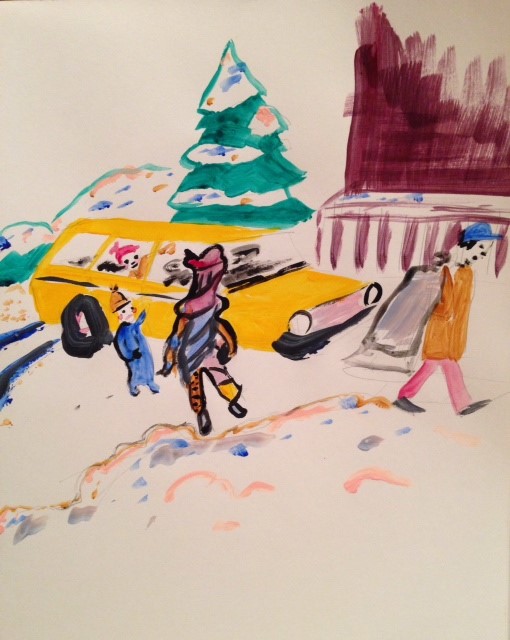
Their dad was running errands in town and insisted that the kids come along. They had been to the dry cleaner to drop off Wraddey’s dragon suit to see what could be done about the ink stains. They’d been to the butcher for sausage, the hardware for tacks, and the place that sold glow-in-the-dark soda. It wasn’t that their dad wanted their company, Wraddey thought, so much as that he remembered what a mess they’d made last time they’d stayed home unattended. Weeks later their father complained he still found marshmallow in crevices about the house, and he wasn’t happy that Wraddey had pasted over every reachable inch of her room with the funnies.

In the backseat of the station wagon, Wraddey felt so bored that she might disappear into the seat, that’s how sick of things she was. Her big brother Egor elbowed her to get her attention. As she reeled back to sock him for touching her she saw the stranger wading through the high piles of snow. Wraddey liked to fight her brother, but it had been a long and relentlessly dull winter. Both children were so hungry for something out of the ordinary to happen that the fight melted away.

“Do you see…?” Wraddey started to say.

“But who…?” Egor asked.

Wraddey shushed him.

Teetering through the dirty snow on the side of the road, whoever-it-was wasn’t wearing a coat or boots, but was cocooned in yards and yards of fabric. Every bit of the person was wrapped up, and except for a purplish brown velvet, most of the wrappings were clashing patterns. No nose or wrist or eyeball, no feature to be seen. As the car passed, the kids turned to keep looking.

“Huh,” Egor said.

“Wow,” Wraddey said.

“Huh?” said their father from the driver’s seat.

The person grew smaller through their wide rear window. Then they turned into a parking lot and the strange person was out of sight.

Their dad ran in to check on a watch he was having fixed. The kids waited in the car, admiring the neon line drawings of jewels in the window of the tiny shop, and listened to the radio. From her seat in the back, Wraddey put her feet up on the center console. Egor kicked Wraddey’s boot and started to scold her.

“Dad wouldn’t let you–“

“Shut up. Look!.”

“I’ll tell him you’re putting your – “

“Shut up and look, Eeg. Who is that?”

The stiff figure crossed the jeweler’s parking lot. Wraddey wondered out loud if they were walking backwards, the way she did when it was windy at the bus stop. Maybe that’s why they were going so slowly, why their knees didn’t bend.

She waved but the figure didn’t respond. It wasn’t possible for Wraddey to tell if she was unseen or being ignored. But you know how being ignored can stoke your interest.
Their dad returned, satisfied and whistling. He was old-fashioned even as far as fathers went – he wore a watch, their car didn’t drive itself, he whistled to an actual FM radio station. Then he whistled a song that wasn’t the song on the radio, then he whistled through the people asking for donations to the radio station. At one point Egor started whistling, then Wraddey tried too though she’d never quite got the knack of whistling (she was only eight) and their father told them to cut out all that racket.

They passed the strange person up ahead one last time. Even from a distance, the scraps and scarves and sheets covering the covered up person didn’t look homeless. From elsewhere, maybe, but not weathered.

Then their always steady, never-impulsive father was in such a good mood that he impulsively swerved over to the side of the road, rolled down the window, and offered that fascinating bundled-up person a lift.

The person was tall, and bent sideways to peer into the open window. The head, scarves on top and scarves on bottom sandwiching huge blue blocker sunglasses in between, seemed to nod. Their father leaned across the passenger seat, opening the door from the inside so the person could climb in.

They lived near a prison and never picked up hitchhikers, let alone wobbly mysterious persons wrapped up like fragile treasure with no single centimeter of skin to be seen.
The figure sat tall in the passenger seat, head skimming the roof, looking forward. Winter air flooded the car, for the person hadn’t closed the door after climbing in. Dad stared at the person. The person stared ahead, making no moves toward the door or otherwise.

“Um, allow me, I guess,” their father said, exiting and going around to close the door.
Wraddey giggled. Her brother belted her for it, but their father’s guest didn’t seem to notice.

The car filled up with the smell of an apple orchard past its season and also of mothballs like at their aunts’ house and wet wool and something like cheap warm cheese.
Dad asked “So where can we drop you off?” but the person only looked forward, so Dad filled the car with chit chat.

“Cold enough for ya?”

“Been a hell of a winter.”

It was a chattering sort of aimless talk, their dad was filling silence and gaining no answers. The children kept a very close eye on the stranger, but they offered no response. Not a word.

“Yes, sir-ee.”

“Where’d you say you’re headed?”

Nothing.

Their father was unsettled. He couldn’t tell if the person was stupid or deaf or dangerous, or scariest of all – silently judging him to be not worth a response.

“Are we, uh, headed in the right direction for ya?”

From the backseat, Wraddey thought she heard a faint scratching sound.

“Well, uh, say, we’re close to home. We can drop you off there, or, uh…” He paused for a moment, then finally said “Would you like to come in and warm up?”

The person’s head fell violently downward. The one harsh nod sent a puff of that rotten apple smell into the cold air of the backseat.

Impressive! Wraddey thought. By ignoring their father, the stranger had bullied him into an invitation inside. They hardly ever had a visitor. If someone did come over, it was in sensible parkas and those visitors had faces.

In the driveway the person sat stone still again, so that father told Egor to go around and open the passenger side door and let “their friend” out.

“I can do it!” Wraddey yelled.

She was closest, but moreover she wanted to be the one to do it.

While father went ahead with the dry cleaning bags to unlock the door, Wraddey opened the passenger side door to let the stranger out. Both feet swung out together like the tines of a tuning fork, then they found purchase on the snowy drive and the whole body lurched up and out. Wraddey said “follow them,” pointing to the guys, followed, watching closely. Wraddey followed the tiny footprints in the snow that looked more like a deer’s than a person’s.

In the house, the stranger clomped over to the davenport and sat, imperiously, down.

“Make yourself at home,” father said with some sarcasm.

The stranger didn’t even look at him.

“Maybe I’ll, uh, put a snack together then?”

The figure nodded that violent nod.

Feeling he was being had, the children’s father disappeared into the kitchen, searching for some unstale crackers for their silent guest. Wraddey thought that she was going to try the stranger’s approach the next time she wanted something.

Egor stood shuffling by the door in his thick winter socks.

Wraddey sat down on the couch next to their guest.

“Hello,” she said, in her soft voice.

It was only when she reached out and laid a hand on its leg that the figure jerked around and pointed its head at her. When it raised its arm, Egor knew it was going to pull his sister’s brain out through her nose, but the arm stopped short. It didn’t strike Wraddey but hung in front of her, inviting a shake.

She accepted, taking the end of the arm in her own hand. Around where a wrist should be, she felt a tassel. She felt it between her thumb and forefinger. She couldn’t help it. She pulled.

It was the end of a scarf, which came off the stranger’s arm in a great spiral, like the curly paper wrapper of a China marker. Under the scarf was a folded blanket, which Wraddey unfolded, the stranger oddly kicking one leg out but not moving the rest of its body at all as its arm was revealed to be not an arm really but two thumb-thick sticks stabbed into a withered apple where an elbow would be. When Wraddey peeled off another layer, leading to the abdomen, the smell of rotten apple grew stronger.
Then when she pulled a hank of Pendleton plaid from under the collarbones, two shocking things happened. First, the head, still pointed at her, tipped clean off and landed on the floor with a thump. At the neck was a pair of broken sticks, and when she wrenched one out it uncovered the chest.

There sat a large rat, in a wicker sort of ribcage, concentrating hard and pulling at the levers of its failing body with all four feet and tail.

“Oh!” Egor yelled in disgust, for he was becoming adult enough to be wary of rats.

“Oh!” Wraddey repeated, in a different way, because she was a lover of animals and it wasn’t the ugliest rat ever, not really, and it was so clever.

“Oh?” Their father said, coming from the kitchen with a platter of finger foods. Then he bellowed, and dropped his cargo, dehydrated apricots and wheels of sliced summer sausage bouncing on the heirloom carpet.

“Tssss!” Shrieked the rat, pointing his ratty face this way and that.

Then it leaped out of its seat in the rib cage, neatly landing on its hind legs.
Another ancient apple fell out of the body, landing with a muffled plop in the piles of shed fabrics.

The rat looked directly into Wraddey’s eyes. It cocked its pointy head toward the door, and Wraddey nodded.

Wraddey took the rat by the paw, helping it out of its wrecked body. She slipped her feet into her boots, grabbed her coat, opened the door and vanished with him out into the cold bright day.

Her family watched from the big picture window, the girl and the large rat, running through the high snow, past the station wagon, down the driveway, down the road, never to return. Over their years together Wraddey and the Rat travelled and saw amazing things. They rebuilt it’s human body better than ever, using common kitchen implements Wraddey was able to produce a more convincing gait and her fingers could tie much sturdier knots that an animal could. What the rat lacked in terms of getting its protegee into college it made up for with adventure. With it’s keen sense of smell the two never went hungry, and after a year of trust building the rat would give up its wrappings on cold nights so that Wraddey could use the fabric as blankets and the rat would cozy up into her chest, it’s fast rodent heart beating twice for every single beat of hers.
cropped-dead-bird-clip-art.jpg

Meredith Counts has an MFA from the Fiction Writing Department at Columbia College Chicago. Now she’s studying archives at the University of Michigan. She’s had work in Traverse, Portage Magazine and Quail Bell Magazine. Her story on poet Jim Gustafson and Detroit Tigers baseball, originally published in the Detroit Metro Times, was named notable by Best American Sports Writing 2018. She’s always loved Edward Gorey.

Artwork: also by Meredith Counts
more than one way to be a gravedigger – divya

gravedigger

i bet your hands taste like honey. put a finger in my mouth
….& let me dream it. i watch you roll cigarettes –
i know you memorized my number when we were in eighth grade
i know you think of me when you can’t sleep at night

the ghost of me lingers these corridors in your house,
counts your pennies, fucks with your linen. oh baby,
you listen to songs to kill time, you dance in empty houses
and i think of the last boy i loved
& how he set fire to everything

me too, i think. i’ll have that fag, thanks. i am a fag, thanks.
i blow smoke out like a fairy godmother. who am i
if not this broken glass bundle of queer? i have always been
pretty face, ugly existence. the fire alarm, the dynamo.
the girl of your dreams, the girl with tree-branch fingers
typing out obituaries in the cold dampness of 3AM thursdays.

cropped-dead-bird-clip-art.jpg

Divya is a writer and dreamer whose hobbies include reading poetry, drawing pictures of flowers in their sociology study notes, romanticizing make-believe worlds and occasionally ignoring the rules of grammar in the name of art. They have posted their work on various online platforms since 2016. They believe in the healing powers of nature, art, music, sunsets and in the overall goodness and resilience of people. They currently live in the southern half of the Indian subcontinent, but can be found online in various places, most notably @divwhine on twitter and @cyanidesunflowers on WordPress.  Their work has been previously published in The Brown Orient and Rose Quartz Magazine.