Grace Gardiner is a British-American non-binary poet and burgeoning intermedia installation artist. They are currently pursuing their PhD in Creative Writing at the University of Missouri, Columbia, where they live with their partner and one too many brown recluses. Find them online at pearlsthatwere.tumblr.com.
The hands that caught me as I entered
the world were the same hands that examined
me at sixteen, back flattened against a white sheet.
There was no discussion of sexual activity,
birth control, or even menstruation.
This man revered by my mother,
told me I could lose weight, told me
to diet, that in his country people are hungry.
My own hands clutched the fabric,
tried to not cry the instant
tears that would come hot in the car.
My place in the world
welled inside me like the ghost
of a boulder, great and silent.
Sarah Lilius is the author of four chapbooks, including GIRL (dancing girl press, 2017), and Thirsty Bones (Blood Pudding Press, 2017). Her work has appeared in the Denver Quarterly, Pithead Chapel, Entropy, and Fourteen Hills. She lives in Virginia with her husband and sons. Her website is sarahlilius.com.
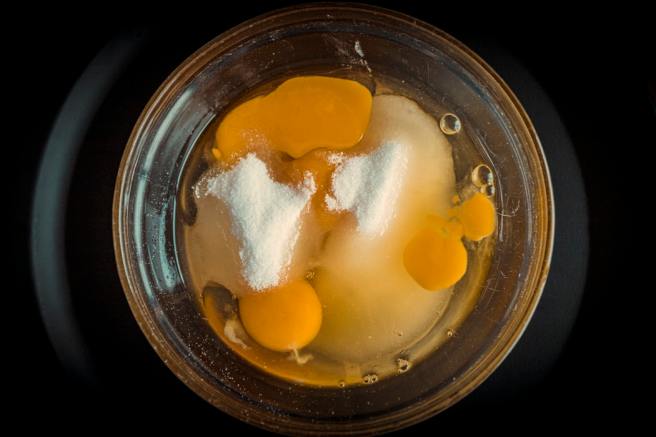
When I was five years old, I said to my mother, I want to be a frittata when I grow up.
No. she said. No, no baby. You can’t be a frittata. Why not? I asked. I love frittatas. I love cracking eggs, I love shredded cheese, and I love the little green bits that you mix into the bowl. Why can’t I be a frittata? Because you’re a Jew, baby. Jews can’t go in the oven, not ever again. Not a toaster oven? No. Not an easy bake oven? No. You can never think about being a frittata, nor write about being a frittata. If you dream about being a frittata, you must wake up and make yourself have new dreams. As Jews, we don’t use the oven. We don’t think about the oven. We can’t look at the oven. The oven is locked in a box, buried underground, and guarded by a man who swallowed the keys nearly a century ago. Those keys are never coming out. My mother put her arm around me and said, Just remember baby. The oven is buried so deep, no one can touch it again. You’ll never become a frittata.
I forgot about wanting to become a frittata. I thought about lots of things I could become instead. I was afraid of the oven, and I did not go near one for many years.
One day, I sat in my office and read that a man in a uniform rammed his truck into a protester’s leg and broke it. Before I could read it again, it was gone, his internal bleeding replaced with clickbait articles, the ambulance ride overridden by ten facts about a topic I could not remember. Four other protestors hit by the truck. An ad for a jacket to cover myself. Pepper spray to their eyes. An op-ed with comments that burned. The man’s uniform said: I-C-E. The protestor’s sign said: Never Again Para Nadie.
I opened my mouth, perched on the ledge of something I wanted to say. Before I could speak, eggs began pouring out. The yolk, wet and warm, dribbled down my lips. I collected them in my lap, and sat, waiting. I wanted an opening to grow in my computer screen, a hot gap I could crawl into. It just had to be large enough that someone else could climb into my body, sit swaying in my office chair, and I could become a frittata.
With each egg from my lips, I thought about a book I saw at my boyfriend’s house called Eggs and Cheese. It showed all the ways you could make eggs and cheese. An omelette, a souffle, a quiche, or a frittata.
My boyfriend did not have a book called Protesters and Cars, which showed all the ways protesters and cars could interact. A protester could ride in a car to a protest, or convince a car to honk in support. You could also hit a protester with a car, stop, then pump the gas pedal and drive through a line of protesters sitting cross-legged on the ground. These are all recipes in a book that has not yet been written.
There is no recipe for a protest. Just like my grandmother said, It’s all guesswork to decide which spices get simmered into the dish midway through. I have never read instructions about who gets to lock eyes with a Rhode Island license plate drawing close and fast.
My computer screen finally cracked open, and I found my grandmother sitting there like a settled stack of dishes. She said, Look up, there you are. She said,
If you want to use the oven then by the grace of God, use it. She said,
Before the existence of ovens, someone baked on hot stones outside and before there were hot stones, there was the sun on your back. She said,
When I bake, I don’t think about Jews and eggs and whether you’re allowed to crack open the ground and dig up boxes with keys in men’s stomachs. She said,
It runs down the back of your neck and trickles down your spine into new generations, then it spreads and sprouts on untouched ground. She said,
Your grandfather only eats cold cereal with milk because he is afraid of the oven. She said,
Breakfast is just news left unopened. She said, If you crawl in here with me you will find out that hiding from the oven is the same as hiding in the oven. The oven is made to be used.
I sat spitting eggs for three more hours, then I turned off my computer and made myself a frittata in my kitchen. I waited for my mother to get home.
Shoshana Lovett-Graff (she/her) is a white, Jewish queer writer originally from New Haven, Connecticut. Her work has been published in Pittsburgh Poetry Journal, The Flexible Persona (nominated for a Pushcart Prize), Atlas + Alice, Poetica, Blink-Ink, and more.
Lining them up against the brick wall,
there is nothing for the sun to bleach.
Tinny, tenacious shrieks
pierce the air and emit an aria.
Metallic, it leaves a poor taste on the tongue,
the kind of putrid fur no scraper can peel.
The sound of bones primordial
against a backdrop of bold, fuzzy shells
hangs over human heads,
calculating, ruminating, no other than a bored specter.
One person struggles to find meaning,
but is left with the other cradling the saw.
Trapped within the jungle’s fury,
even the bones are not themselves.
Morgan Ventura is a writer and folklorist from the Midwest. Her poetry has appeared in The Raven’s Perch, Really Serious Literature, Ghost City Review and is forthcoming in Clockwise Cat, while her essays have been featured in Jadaliyya and Folklore Thursday. When she is not interviewing archaeologists, she enjoys podcasts, experimental film, and exploring ruins. She splits her time between Oaxaca, Chicago, and the forests of Connecticut.
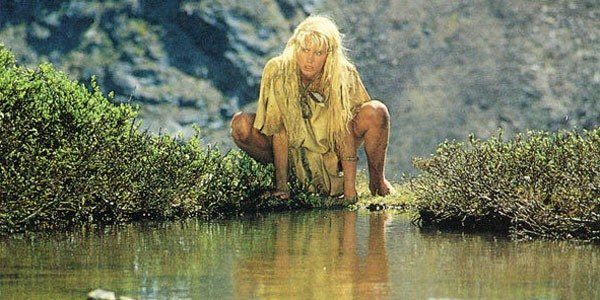
My father had a VHS tape of Clan of the Cave Bear. It had that same patina of heroism of the Kipling poems I memorized bouncing on his knee, my fee for the most dependable kind of love I got as a kid: that look in his eyes at my ability to memorize his idols. But in this movie, the hero was a woman. A Cro-Magnon girl, who can learn and adapt, unlike the Neanderthals who adopt her after the rest of her clan dies. Her ability to evolve and be different is seen as a threat, and one of the things she learns that a woman just idn’t supposed to know is how to hunt. She uses this hunting sling and she’s better at it than any of the men and for 1986, I guess this was a pretty big feminist move even though she slings it wearing an off-the-shoulder wolf skin that bares more than it covers.
She’s played by Daryl Hannah who my Daddy loved with his penchant for leggy blondes, but she’s hated by her adoptive clan for her blue eyes and light hair. She’s also raped more than once by the one who hates her most at age 10; she gives birth to his son at age 11. His spawn’s big ole Neanderthal head almost kills her coming out. I don’t know if Dad knew the book it was based on was written by a woman, who at the age of 40 felt like she’d hit her glass ceiling and was pissed, but I know he was in it for the action more than the proto-feminist dystopian themes.
It had this moment, see, this moment where the woman is holding a baby. They’re being stalked by a cave lion, and she knows if the baby dudn’t quiet down, they’ll both be eaten, so she tries to hush the baby, keep them hid and she hushes that baby alright, she hushes it dead. And yet another moment comes just like this one later on in the film. Though it seems unlikely, this I get. This I get now that I lived long enough to know that moments and people, whatever we can’t swallow, really, repeats on us. She gets this moment with another baby, not her baby, but a baby and another big animal trying to eat ‘em both and the baby starts crying and she starts hushin’ and she flashes back to that other baby and you can feel her change her mind. You can feel that spark light like when she invents fire in another part of the movie and they’re standing by a fire this time and you can just about feel her think, “awh, HELL no, hell no, man, I ain’t gonna hush this one to death, too.” So she holds that baby up like it was Simba. She waves that baby in a circle like saying come on and just you try and take us down. Make all the noise you want, baby, be as loud as you can. We’ll make a wall outta sound. She tucks that baby onto one hip with one hand and she puts some fire on a stave with the other and she goes absolutely berserk. All her squallin’ ain’t for nothing; she scares lion-death away acting crazy like that.
And I guess that film left its impression, and I mean more than just for the images I can’t unsee of women hunched over joyless taking it doggy style from the men. I mean I figured as a kid, there’s two options: you lay down, ball up, get real quiet and take it or you bawl til your voice drags you up and out with it, til your voice barrels 12-gauge dead-on, deafening, whatever’s comin’ for you.
Stina French has featured in many venues in Denver and Boulder, Co., and her work has appeared in Heavy Feather Review, Punch Drunk Press, and on the podcast Witchcraftsy. She is scratching at the window of her body, writing poems like passwords to get back in. To get forgived. To get at something like the truth. To get it to go down easy, or at all. She wears welts from the Bible Belt, her mother’s eyes in the red fall. She’s gone, hypergraphic. Writes on mirrors, car windows, shower walls. Buy her a drink or an expo marker. She’s seeking a home for her manuscript, Also Arc, Also Offering, a Southern-queerdo, coming-of-age memoir, in flash non-fiction and verse. She leads somatic (body-based) writing workshops and retreats focused on empowerment through exploring archetype and unearthing the body’s hidden stories.
I ask my sons about dogs. Today, dogs in paintings: why a dark tail curls out beneath the monk’s robe as he strangles a dog. My sons don’t eyeroll, even the living one. They look at me the way dogs do, wet and directly.
My live son asks what’s inside a dog and my dead son says shit. No one nods because we’re now in a sculpture room. The dog’s pelt grabs little spaces. Maybe he’s a going-to-sea-dog: his nails scratch at a saint’s knees, shellish pelt wrinkling. My dead son asks for a spear and I say no violence. I lift an apple again or a pomegranate but it doesn’t go anywhere because stones aren’t hungry.
Outside in the city someone’s posed between wings –this time blue for the endangered scrub jay. They’ve stopped in the kitsch, shoulder-high thin spot. My live son says this is stupid but he’d do it for his child. My dead son says well that’s it for the bloodline. I stitch blue to each boy whenever the paint flecks.
Little mouths in a river tingle or twitch. Back in the origin myth I nearly fall down the same step. Someone asks why even go to term with an accident/ stormstrike/ deathray/ baby, but it’s always too soon to ask art.
I ask my dead son if he’s feral now. Because even cities get lost, even a toddler saint’s head except for one lone stone curl caught in St. Isabel’s dress. My live son knows about cutting because he’s needed transfusions. My dead son knows other things. Someone with a nosebleed leaves 6 votive kleenex.
The devil asks why he wants to be loved by boot on his belly or hand on his neck so much. Moonfaced and sad as he chokes? Call flat dog. Gut-wrenched around another stone boot? Try tide-coming-in dog. My sons hang “gone fishing” signs though one’s really out scoring weed. What’s up, asks a stair. This is the elimination round, scrub jays, so whistle whistle into the last blue city.
Terri Witek is the author of 6 books of poems, most recently The Rape Kit, winner of the 2017 Slope Editions Prize judgedby Dawn Lundy Martin. Her poetry often traces the breakages between words and images, and has been included in American Poetry Review, Lana Turner, Poetry, Slate, Poesia Visual, Versal, and many other journals and anthologies. She has collaborated with Brazilian visual artist Cyriaco Lopes (cyriacolopes.com) since 2005–their works together include museum and gallery shows, performance and site-specific projects featured internationally in Valencia, New York, Seoul, Miami, Lisbon, and Rio de Janeiro. Collaborations with digital artist Matt Roberts (mattroberts.com) use augmented reality technology for smart phones to poetically map cities and have been featured in Manizales (Colombia), Glasgow, Vancouver, Lisbon, Miami, Santa Fe and Orlando. Witek directs Stetson’s undergraduate creative program and with Lopes teaches Poetry in the Expanded Field in Stetson University’s low-residency MFA of the Americas. terriwitek.com
C.C. Russell has been published here and there across the web and in print. You can find his words in such places as The Meadow, The Colorado Review, Cimarron Review, and the anthology Blood, Water, Wind, and Stone. He has been nominated for Best of the Net, Best Small Fictions, and the Pushcart Prize. He currently resides in Wyoming where he stares at the mountains too much. You can find more of his work at ccrussell.net
Fate arrives in her mailbox. And with its arrival, a decision. Fate is a red matte lipstick, a special order that arrived for Nicole Masterton, the person who lived in 12A before Allie. Allie has lived in 12A for five months, and she still receives Nicole Masterton’s mail. Sometimes Allie takes the mail to the post office and leaves it. Sometimes she throws it away. The magazines and catalogs she keeps. She guesses Nicole must be a fashionable young woman with a formidable shoe collection.
She doesn’t generally open Nicole’s mail, except for she did open the heavy envelope, embossed, that turned out to be a wedding invitation. Allie doesn’t get invited to many weddings. The fancy envelope has been sitting on her end table for three weeks, the gilded RSVP card askew as if the person who opened the invitation to the nuptials of Sarah Jane Laux and Jeffrey George Bolingbroke couldn’t be bothered to hurry an answer.
Allie imagines Nicole waiting for a wedding invitation, wondering if she had been forgotten, if she should call and inquire, if she should just show up as if the invitation had arrived as expected. Or if she should be hurt, or angry. Allie has considered bundling it all back into the torn envelope – why hadn’t she used a letter opener? surely such an envelope warranted a letter opener? – and taking it to the post office with a murmured apology. Instead, the envelope sits there, silver-foiled and pretty.
And now Fate has arrived. Allie doesn’t think of herself as a red lipstick type of girl. But when Fate is delivered to your door, oughtn’t you to accept it? The lipstick is a good match for Allie. It complements her complexion. She wonders what Nicole looks like, if Fate looks as good on her.
Allie wears Fate on her lips and goes to Nordstrom’s. She walks through the women’s section, aimlessly trailing her fingers over the sale racks and she sees it, a dress red as Fate. A dress in her size, on sale so ridiculously low she’d be a fool not to buy it.
For two days the dress lays over the back of a chair, waiting, like the wedding invitation. But Allie has known since she held Fate in her hand that she was going to the wedding. She wants to see it, to see this wedding announced with such an elaborate invitation, sent to a woman with a chilly name like Nicole Masterton who buys a lipstick called Fate.
Inside the church it’s all flowers and tulle and crystal and candles. Extravagent. Allie doesn’t sit all the way in the back as she’d planned. Women with Fate on their smiles don’t sit all the way in the back. She sits on the groom’s side, looking on the bride’s side for someone who might be Nicole Masterton who surely came, who isn’t at home sad and angry, whose friends told Sarah Jane Laux about the lost invitation and she surely was sent another.
The ceremony is beautiful, of course. The bride could grace the pages of Vogue and maybe she does. Allie dabs her eyes, caught up in the couple’s first married kiss. She finds herself in the receiving line, and she hugs the bride, who glows with happiness, and she hugs the groom who says, “It’s so good to see you again, it’s been so long.” It has, she agrees, but he doesn’t really know her. She leaves a touch of Fate on his cheek. It’s ok, she brought Fate with her in the tiny purse she dug out of her closet from prom years ago (from prom! seriously!) and she’ll keep Fate with her all night.
Because of course she attends the reception. The tables are set with name holders. There are two tables for those who have not RSVP’d. Allie wonders if she’ll be seated near Nicole Masterton. She doesn’t catch all the names as introductions are made, but Nicole is not one of them. She gives her own name as Tiffany Smith and hopes she remembers it later, if necessary. When she’s asked how she knows the bride, she says she knows the groom, but it’s been a very long time, not since they were quite young and the blush that warms her cheeks at the lie makes her wonder if people will assume they were lovers. She imagines what it would be like to have been his first love. Someone clinks a glass and the happy couple kiss. Allie smiles with her Fate lips. The table she is at is far from the wedding table, this table reserved for those without reservations.
Allie leaves a mark of Fate on the cloth napkin, reapplies in the Ladies where every moment she expects to run into Nicole Masterton, whose invitation she usurped. Allie smiles at the mirror. Fate looks good on her. So does the dress of the same hue, the only one like it she owns.
She watches the couple’s first dance. She leaves traces of Fate on more than one champagne glass. It’s past 11 when she decides to leave. The reception shows no sign of slowing down, and Allie wonders if it will end at midnight or continue until the sun rises.
Allie walks past the cloak room, past the bathrooms on her way out the door. The groom emerges from the men’s room. “Wait,” he says to her. “Don’t leave yet. I’ve wanted to talk to you all night.”
Allie turns, smiling with Fate on her lips.
Epiphany Ferrell lives and writes on the edge of the Shawnee Forest in Southern Illinois. Her stories appear in New Flash Fiction Review, Third Point Press, Newfound and other places. She recently received a Pushcart nomination, and has a story forthcoming in Best Microfiction 2020. She blogs intermittently for Ghost Parachute and is a fiction reader for Mojave River Review.
Gregory was the only male in the Hadrick Women’s Mental Institute. He was a burly nurse of about six foot six, heaving several bowling balls worth of excess weight around his stomach, and in his fifteen years as a professional carer he had committed many crimes.
It was a normal day at the asylum. Gregory padded up the shiny white floors – so clean they were sticky – and he entered Gina’s room. She was in bed, duvet wrapped around her bare feet, cheek squished against an exposed mattress spring. Gregory poked her nose with his plimsoll. She sat upright and rubbed her eyes with her fists. She received the milk, the buttered toast and double the number of pills she’d been prescribed.
‘I can’t remember anything,’ Gina moaned. ‘Not even yesterday. Gregory, do me a solid, tell me what happened to me last night or, God damn it, I’ll end it all. Life’s not worth living if you can’t remember last night’s Yorkshire pudding.’
Gregory sniffed and shrugged.
‘What if I just stopped taking the pills Gregory?’’
‘That would just be stupid.’
‘Wild stupid. My vagina feels weird.’
‘I don’t… Need to…’
‘Something’s not right. Something’s been in it, I’m pretty sure. I need to know.’
‘Um? Forget about it?’
‘I’ve got a vibe, man, and I can’t let this one slide!’
Gregory decided not to indulge Gina any further and finished off the rest of his rounds. The other girls were maudlin, grey and placid. They ate the food that made them fat, and the overdose of pills that made them pliable. They didn’t struggle.
Visiting hours came, and Gina met with Jackie, someone she’d befriended in Hadrick a year ago. They sat by the expansive window, far away from reception, as Gregory was there analysing their every move, chewing on a soggy pencil rubber.
‘I broke into Gregory’s home. He has mother issues,’ Jackie whispered, ‘serious mother issues. He has shrines to her, pictures everywhere, dresses laid out on chairs and beds. He sleeps next to her ashes. He’s an acid freak too. That’s how we get him.’
An hour later, Jackie skirted around Gregory, eyes locked to the floor, and exited the building. Gregory turned his gaze to Gina, who was chugging on a cigarette in the smoking cage, peeking out of the corner of her eyes, sussing Gregory up, hatching a plan.
That night Gina felt the thick velvet fog descend upon her – the consequence of the obscene amount of pills she’d been swallowing. But tonight would be different. Jackie had slipped her some poppers and the pungent effulgent rocked her mind enough to stay alert through the night – with the added bonus of making her bowels a little more carefree.
At the strike of two in the morning Gina heard the squeaking of trainers on linoleum. In the light from the lamp by reception, Gina watched as Gregory bore down upon her singing ‘The Yellow Submarine’ and smelling of pork scratchings.
Gregory flung Gina’s duvet off her and drooled. He began to undress her.
‘Come to Matka, lovely baby boy,’ Gina said.
‘Matka?’ Gregory said, dumbstruck. ‘Mamma?’
‘Yes baby, don’t look at me, what we are about to do is shameful but nevertheless – we must. Our love shall be anointed.’’
Gregory stepped back and covered his eyes with his arm.
‘I want to mamma, so have I missed you. But I’m afraid. Can this really be true? No, it can’t be. Maybe I’m losing my mind. I am on a helluva lot of acid.’
‘If you can’t please your mother then who can you please?’
‘Please Matka, I’m very confused.’
‘Make love to me now, or may Beelzebub eat your soul!’
Gregory began to cry and, keeping his eyes shielded, stumbled out of Gina’s room.
The next day Nurse Fold gathered the girls by the sofas next to the TV and told them Gregory would be absent for a short while and she would now be in charge.
As Nurse Fold started to dole out the day’s pills, Gina made a beeline for her and smashed the tablets out of their containers causing them to scatter to the floor.
‘I dare you to pick them up,’ Gina said. ‘I dare you. From now on I’m in charge, otherwise I’ll expose you for letting Gregory get away with what he did to us.’
Days passed and the girls still refused their pills. They tuned into MTV and danced on the sofas. They smoked joints in the dining room and stubbed their roaches out in their mashed potatoes. Gina was high as hell and jumped onto her friend’s back like a footballer who’d scored a goal, and shouted, ‘You can’t stop us, we’ve got too much spunk in our veins! Knock us down, we’ll just come back for more!’
And then things turned religious. Many of the girls recited babbling scripture – making the sign of the cross after every sentence they spoke. A week off the pills and the fights broke out. Girls made weapons from toothbrushes and plastic spoons. They picked sides.
Then time stopped.
One of the girls killed a nurse. She slit her throat with a shiv. The nurse had refused to bow down to the girl who claimed to be the new messiah. In the hours that followed, before security bulldozed their way through the doors – blocked by chairs and beds -everyone, including Gina, quickly sobered and saw things clearly. They were nobodies. They had nothing, never did. Who could blame them for thinking they were gods, who could blame them for wanting to live large for once in their lives?
As Gina was tackled to the ground by security, she saw light sweeping through the hospital hallways – a kingdom of light. She’d never felt so alive and she knew life would never be so wondrous again. She was ready to go back on the pills.
Tim Frank specialises in the comic, the dark and the surreal. He has written a semi-autobiographical novel, Devil in my Veins, and is currently writing a sci-fi thriller novel.








 Terri Witek is the author of 6 books of poems, most recently The Rape Kit, winner of the 2017 Slope Editions Prize judgedby Dawn Lundy Martin. Her poetry often traces the breakages between words and images, and has been included in American Poetry Review, Lana Turner, Poetry, Slate, Poesia Visual, Versal, and many other journals and anthologies. She has collaborated with Brazilian visual artist Cyriaco Lopes (




 south broadway press