INTERVIEW: LAUREN CAMP

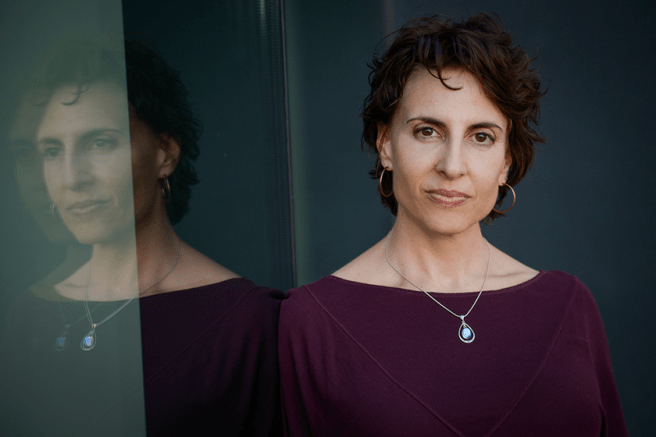
Lauren Camp is an Arab-American poet.  She is a first-generation daughter of a Jewish-Iraqi immigrant.  Often, she writes about the immigrant diasporic experience and how that personally has influenced her.  Lauren grew up in New York, attended Cornell University ‘88, and now calls Santa Fe, New Mexico home. Before she dedicated herself to writing and being  an educator, she worked as a visual artist in fabric and thread, and was a radio producer and host. During 2022-2025 Lauren was the Poet Laureate of New Mexico. Is Is Enough (2026) is her ninth poetry collection.

Poet, author, and frequent reviewer for the South Broadway Press journal, Shelli Rottschafer, recently sat down to interview Lauren.

SLR: Lauren, thank you for this interview.  I have been excited to ask you questions ever since Is Is Enough was released this past March.

Is Is Enough considers your relationship with your father.  Like so many of us, we have interesting relationships with our parents.  In this case, your dad struggled with dementia.  

In some way, does your poetic verse try to recuperate memory before it is lost?

LMC: Thank you for making time for my new book! This isn’t the first book I’ve written that focuses on my dad. In my earlier book, One Hundred Hungers (Tupelo Press, 2016), which imagines and tracks my father’s childhood in Iraq, I was definitely trying to gather and unfold memories long hidden and had been possibly already lost. 

Alzheimer’s Disease can’t support more than the immediate now. For Is Is Enough, I wasn’t probing memory; instead, my attention was on dealing with a present moment and whatever was happening in my father’s mind. 

Though it was difficult in my father’s last years to “daughter”—to watch what was disappearing, and in more action-oriented ways, to take care of his wellbeing, his finances, and his worries—it was a joy to craft these poems. I got to step to the side of responsibility and simply notice, and find language for, what was occurring. 

SLR: Many writers have the quandary of “do I write about family, or should I not?”  

How did you come to terms with that internal wonder? How would you encourage others to overcome that doubt?

LMC: I never question whether I should write something; I only question whether I should publish it. I wrote these poems for myself. I wasn’t writing for a reader. I didn’t know that some of the 100+ poems I wrote about this time would become a book. I hardly even know they were poems. For a long time, they were only notes—things I wanted to hold onto because they were my father’s behaviors, and charming or devastating. I wanted to tack down and keep what wouldn’t exist the next time I saw him. 

Families and relationships are complicated. I might write something in an early draft that expresses anger or hurt. But by the time I get through the revision process (which could last months or even years, with long stretches of waiting in between drafts), hopefully that emotion has tempered. While still being honest, I can look at any imbalance in my thinking and be more fair in my assessment and presentation of anyone else.

SLR: “Original Hope” was in particular very moving to me.  It seems to consider your father at his final moments.  Family is gathered and remembers.  What is interesting is that certain memories, especially those captured in family pictures, mean one thing to one person and symbolize something much different to another.  Each has their own perspective, their own interpretation.  

Can you speak about this poem for the South Broadway Press audience?

LMC: Surprisingly, I have no other drafts of this poem. I usually revise (quite happily), but this poem was fully formed when I got to the page. By using the impersonal pronoun “one,” the poem could be speaking to or for any reader. The perspective was not specific to the author, or any specific family member. That choice made “Original Hope” feel aphoristic or proverbial to me, and I liked that. When I write about or into a subject repeatedly, I leave behind approaches I’ve exhausted and begin to look for new language or angles to come at the topic. I love this effort and find it revelatory. By the time I get to the 20th or 80th poem I’ve written about something, things get wilder or shift in some other significant way.

SLR: Lauren, your writing has taken you to many interesting places.  Your collection, In Old Sky (2024) was written in conversation with your time spent at Grand Canyon National Park as the Astronomer-in-Residence. While there you worked alongside park rangers and witnessed the Dark Skies.  

Can you tell us a bit about your residency?

LMC: In 2022, I was invited to spend a month at the South Rim. Each of those nights I investigated the shifting darkness that surrounds the canyon, trying to figure out how it felt. My goal was to write for readers who might not know what pristine darkness is like, perhaps readers who live in an urban environment where light pollutes their skies too much to see anything above—and certainly not the Milky Way.  I found the darkness at the Canyon safe and enveloping. I couldn’t get enough of it. I watched as it dropped down and gradually closed off my ability to see. In fact, as that sense shut down, I began considering what was happening with my other senses. What could I hear? What was the texture of the air? 

I wrote a book worth of poems that month, which Grand Canyon Conservancy made into In Old Sky. A surprise gift, that collection. The experience changed my interpretation of self and culture. I now regularly have a perspective of our time and deep time, and I consider/re-consider my place in each. 

SLR:  In the poem, “Bluest” you ask questions of the stars.  

You look upon their sparkle, millions of light years away, and wonder:

How will I greet you when I am back,
the spectrum not yet diminished in me?

This liminality of time, a transcendence of one point in time to infinity, it makes us humans question our time on earth and what we do with that precious time.  

Is the answer ‘open ended’?  Or is the answer ‘be creative with that time’?

LMC: When I left the Canyon, I was challenged by how to shift from a place of endless, deep wonder to a place of ordinary goodness (my home). Whenever I leave a place I’ve loved, whether from a brief vacation or a significant immersion, I want to keep a bit of it for as long as possible, to incorporate it, somehow, into my daily existence. 

At the Canyon, I was reminded of the benefit of focus. Our lives are so full of multi-tasking. In the dark, I would do a single thing: sit on a giant boulder looking into a nearly invisible canyon, or walk, watching only the slight circle the red headlight offered in front of me. 

There’s a generosity in that.

SLR: As Poet Laureate of New Mexico, your project was “The New Mexico Epic Poem Project” and its intention was to visit all 33 counties within the state of New Mexico and to write in place with collaborative pieces from each audience you worked with.  I witnessed this in action myself as I attended your workshop at the Taos Center for the Arts.  

What was it like for you to lead others to write collaboratively?

LMC: I had done something similar while at the Grand Canyon, inviting park visitors to respond to prompts and statements about darkness. It can be scary and off-putting to ask someone to write a poem, but with this approach, individuals are instead encouraged to contribute a few elements to a greater whole. I adopted a similar approach for the New Mexico Epic Poem Project, giving residents a chance to write about the community they call home. Once I had those responses, I worked as an architect, building the poem from the scaffolds and details people contributed. The result presents a chorus of voices. 

SLR: As a result of this three-year project, which of all the many workshops you led, were you most surprised by?

LMC: Oh, such an unfair question! I couldn’t possibly pick. Each town or rural village—and the libraries, arts centers, coffee shops and other venues that hosted our gatherings—offered something wonderful. Some individuals showed up not knowing anything about poetry, but were receptive. Some showed up to figure out whether what they were doing in secret might qualify as poetry. And others had good experience with the art form already. Because of the format, I gained as much as (I hope) the participants did. I had the chance to learn more about each location through its people. 

SLR: Having had a career in Marketing and as a Visual Artist, how did that prior experience help you promote yourself once you dedicated to write full-time?

LMC: I have learned that full-time creative work is a bit of a myth. If you want to reach an audience, you need to either hire help or do the marketing yourself. When I worked as a professional artist, I understood that I needed to spend nearly half of my time on elements of the job that weren’t artmaking. Everything from correspondence and contracts to exhibit organization and other details; those all take time. 

From marketing classes in grad school, I learned the rule of 7—that it takes that many exposures before someone will register what you’re offering. It can be awfully hard to promote something even once, much less seven times. But this reminds me that there’s no shame in sharing something at least once (and maybe more, if I can stand it). 

SLR: If you could have a conversation with your younger self and knowing where you are now, and the knowledge you have gained as a writer, what would you remind young Lauren?

LMC: From the time I was small, I always knew creativity as my partner. I never veered from that, though the medium I worked in has changed a few times. I’d like to remind the me now that the “making” is always the revelation. The audience’s response is sometimes a side benefit, but the process is the true triumph.

SLR: Many readers of South Broadway Press also are creatives and appreciate a nudge.  

What are you working on now that you plan to incorporate into a writing workshop? Do you have a prompt or advice for our audience?

LMC:  Right now, I’m working poem to poem, focused mainly on poems that originate from a place and its facets. 

Advice? Remember to keep the “making” close to you. Make your poems for yourself, not for an outside audience. There is no formula, no correct way, no need to ever follow any other path than your own. That’s where the answers and excitement are. But also… embrace revision. I believe that’s where the magic is. I believe you (and I) can push a draft further from its start than we ever thought possible. Challenge yourself in some way with each poem. Don’t worry; 

it will right itself eventually. New amazing things come out of that process and the patience to wait for it. 

SLR: Thank you so much Lauren for answering these questions in support of creativity and the creative life.

READ:
SHELLI ROTTSCHAFER’S REVIEW OF LAUREN CAMP’S IS IS ENOUGH
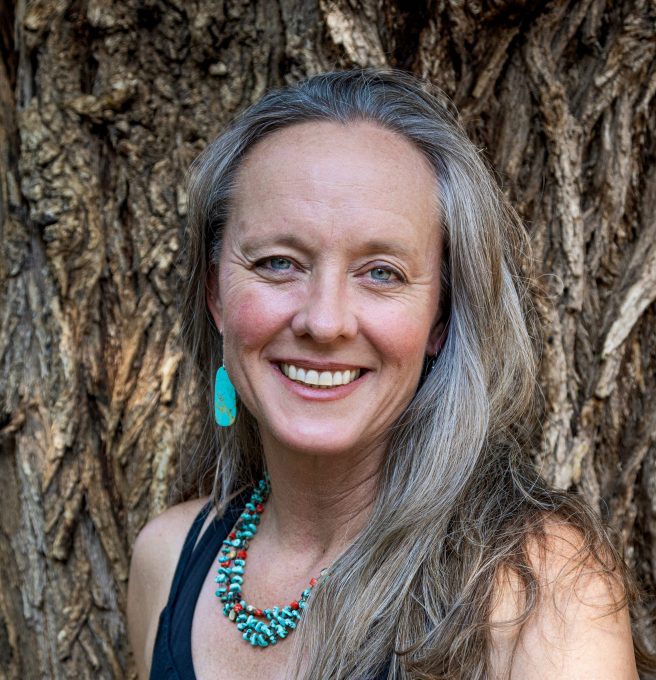
Shelli Rottschafer (she / her / ella) completed her doctorate from the University of New Mexico, Albuquerque (2005) in Latin American Contemporary Literature. From 2006 until 2023 Rottschafer taught at a small liberal arts college in Grand Rapids, Michigan as a Professor of Spanish. She also holds an MFA in Creative Writing with a concentration in Poetry and coursework in Nature Writing from Western Colorado University (2025).

Shelli’s home state is Michigan, yet her wanderlust turns her gaze toward her new querencia within the Mountain West where she lives, loves, and writes in Louisville, Colorado and El Prado, Nuevo México with her partner, photographer Daniel Combs and their Pyrenees-Border Collie Rescue. 

Discover more of Shelli’s work at: www.shellirottschaferauthor.com

Artist Feature: Rachel Mulder

ARTIST STATEMENT

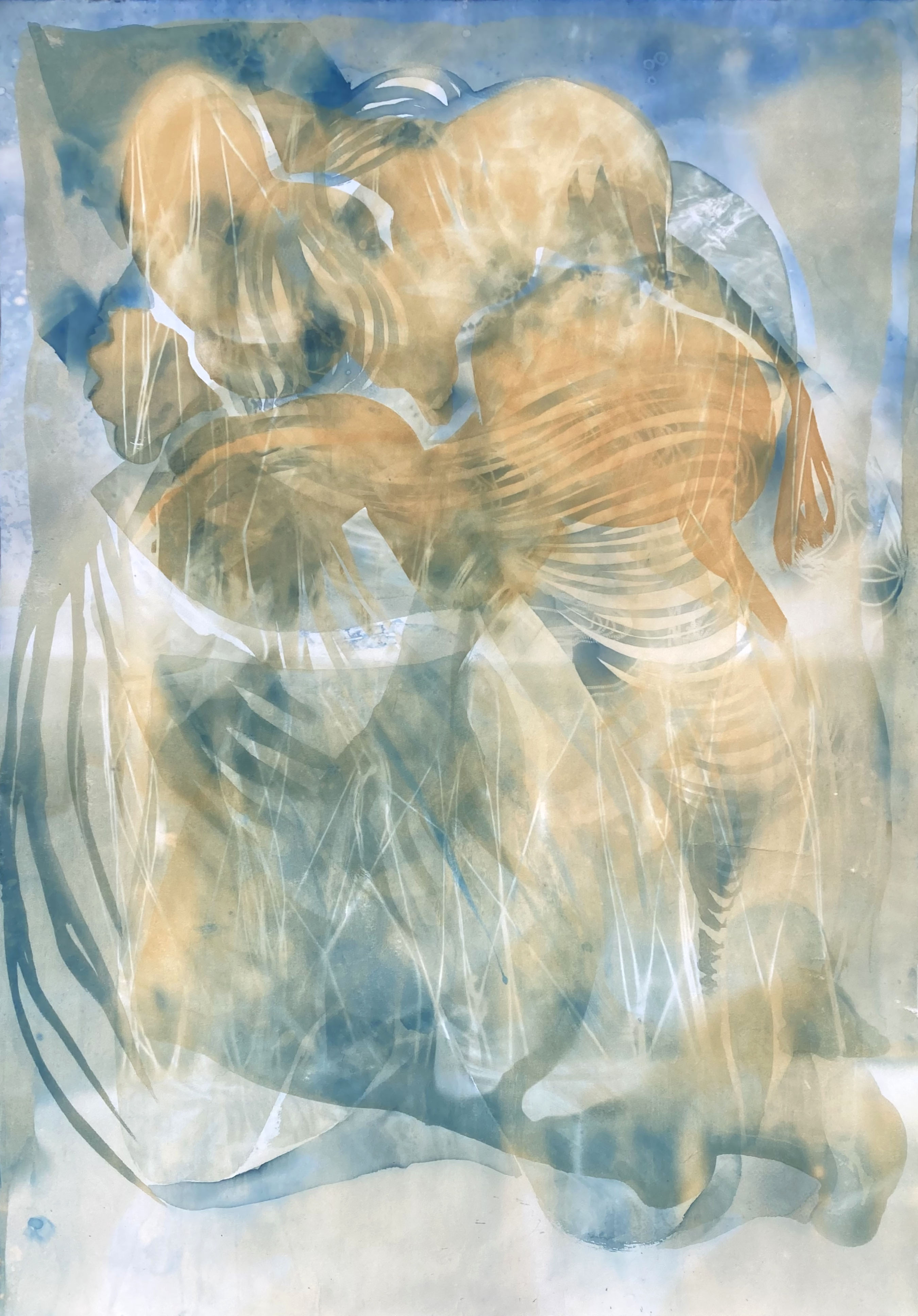
My work is a swirling devotion to process and surrender.

Since 2019, cyanotype has taught me subversive techniques via states of play, acceptance and transformation. This alternative photographic process uses light-sensitive chemicals which are applied to a surface like paper or fabric, exposed to UV light, and developed with water to create brilliant blue and white images. Additional processes like bleaching and toning (with everyday kitchen witchery like baking soda or tea!) make for additional color possibilities using the same old chemistry.

Both imagery and process are relational, with my work often revealing my own emotions to me before I’m even aware of their presence. I often explore this terrain by painting shapes with the chemistry, placing objects onto the surface to resist the light, rinsing and repeating this process in multiple layers. The paper holds the memory of each new layer, dodging destruction while creating space for possibility. 

Conversely, there are also magical moments where the image snaps into place in one exposure, as if by a flick of the wrist. The simplicity can be electrifying. The paradoxical nature and generative inertia of making these painterly cyanotypes continually invites me to learn and my work to transform.

INTERVIEW

South Broadway Press asks Rachel Mulder a few questions to get to know this artist a bit better.

SBP: WHERE ARE YOU FINDING INSPIRATION AS OF LATE?

RM: As a leo (sun, mercury and mars), I feel really grateful that a major part of my practice is actually worshipping the sun! Cyanotype is such a whirling dervish of magic, it’s really easy to be endlessly captivated by the process itself. I also enjoy listening to podcasts while I work, including Dean Spade’s Love in a F*cked up World (named after his most recent book, which I haven’t read yet) and Margaret Killjoy’s Cool People Who Did Cool Stuff (especially the four-parter on how the Surrealists were even cooler than we thought!)

WHAT DO YOU HOPE TO ACCOMPLISH, IF ANYTHING, WITH YOUR ARTWORK?

Currently, I feel like I’m at a kind of journeyperson stage with cyanotype; I have a lot of confidence and trust with the chemistry and timing but I feel as though I’ve barely begun deepening the secondary processes available to me, like toning or adjacent methods like anthotype or Solarfast (the latter offers lots of different colors outside of the traditional blue!). I’m also passionate about sharing this magical process with others, and am on the lookout for an ideal, accessible location where I can continue to offer more masks-required cyanotype workshops for people of all ages and abilities here in Portland.

SBP: WHAT IS BRINGING YOU JOY RIGHT NOW?

I’ve been spending a lot of time in parks lately, and I feel really lucky and grateful when a dog or baby locks eyes with me and demands to become my friend. Like, when a dog you just met gives you The Lean or crouches beneath your legs like you’re its protector, that’s like the highest compliment. 

SBP: ANY UPCOMING EVENTS?

My solo show SUNWORK will be on view at Elbow Room in Portland, Oregon next month! The opening reception is on Sunday, October 26 from 3:00 – 6:00 pm and will be up through November 27. I’m also part of a little co-op called Grover’s Curiosity Shop where I sling prints, stickers, cards and more, and we host sweet and weird events there. My website is rchlmldr.com and there you can easily sign up for my newsletter or find my online shop. I offer a selection of prints where 25% of my sales are shared with Palestinians and mutual aid efforts in Gaza, like the anticapitalist mutual aid fund Bridge of Solidarity. Last, I have a Patreon where at the $5 tier or higher you get monthly postcards in the mail as well as behind the scenes process stuff, discounts in my shop and more.

Rachel Mulder (she/they) lives in Portland, Oregon, with her two cats, Opal and Tomasina. She was born in rural Wisconsin and when she was small she spent a lot of time sitting in the grass staring, obsessing about animals, watching cartoons and peeling her skin off. Now she makes drawings using a variety of media that often yield printmakerly textures – residual effects from earning her BFA in Printmaking at Milwaukee Institute of Art & Design in 2007. A process-oriented artist, her work vacillates back and forth between the meticulous and obsessive to playful experimentation and experientiality. Whether it’s drawing with human hair, mud, cyanotype, gel pen or graphite, her imagery explores human connection, expression, and the strangeness of existing in a body. Encouraging others (and herself) to create/exist sincerely is a parallel passion of hers that braids itself into her visual work.

Sinew // Three Poems by KD Hack

Image: David Young
EDITOR’S NOTE: THESE POEMS ARE BEST READ
ON TEXT OR HORIZONTALLY ON A MOBILE DEVICE.

LAGNIAPPE

BY KD HACK

I could’ve held you / the whole night / through / the wilderness / of my body-mind / asks /
too many questions / but I am parched / & prefer / too many answers / meet me / at every
river bank / along the Mississippi / your name / a prayer / my name / a promise / your kiss / a
wish / it’s good medicine / it’s my command / teach me / something sweet / something
mother-father-auntie-grandma / tongue / I want / the knowledge / to blacken on / my tongue
/ I want / the taste / to linger / the lagniappe / of a love / freshwater / & somehow / still
molten / I molted / here / on these rocks / slippery / but not too heavy / to hold /  I will bring
them / back / to you / like precious stones / like something / we might build with / the levees
won’t break / there / the gumbo will be / glorious / & the bowls / never empty / bring your
spoons / bring your lover’s lover / bring your appetite / bottomless / as the river / where we
sent up Hail Marys / like shooting stars / fletting but full / of feeling / a feast / we won’t soon
forget.

DIOSCOREA POLYSTACHYA

BY KD HACK
Fairy 
as in
frolick
as in
lick
my faggity ass
while you’re at it
we’re all wild
here
& freer
than
they want us
to think
when the water
grew
too frigid to dip
a toe into
my friend
fluorescent
in the finger-smudged
mirror made
a man
out of mascara
& might
& I might not be
convincing anyone
but myself
but you
can kiss
my faggity ass
& even my lips
while you’re at it
I promise
I won’t bite
unless you ask
nightly
I wish
for whiskers
I whisper
in their ear
let me
come
nearer
let me
come
closer
to the fairy prince
I promised
to be
in the woods
where we dug
our faggity fingers
in the soil
in the seams
making streams
across our bodies
I’d dig a grave
in the space
between
your breasts
& your belly
my legs melt
into jelly
when you lick me
hard
enough
this is not
a metaphor
this is not
a death wish
this is
a grave
I’m digging
down where
the fairy potatoes
grow I am not
asking
you to
die
but to be
reborn
beneath the soil
I’ll meet you
down there
soon.

BLOOD MOON

BY KD HACK

KD Hack is a Queer/Trans writer, Death Doula & land steward. Their artistic practices were nourished across the Northwoods of Wisconsin, & reside in the spaces between fingers in the soil & pencils on the page. His work is featured in Peach Fuzz, Fruitslice, Querencia Press, Transfix, Tence, & Volume One, among others.

Genesis – Philip Matthews

NC048 © D. Johnson, courtesy of the Colorado Photographic Arts Center

Flutter at no wide open mind.

I did not think like an individual eyelash. 

I did not move in the hourglass house, 

perpetuating itself of flashes of quicksilver of fish-knives. My parents. 

When the sermon was streamed in the old South, it was creamy, a small amount amounting. 

Whatever I thought of / against me, little queer hook, I was writing on my centurial skull. 

Until something ovarian. A tucked testicle. I felt her tapping, almost at full plank: Petal.


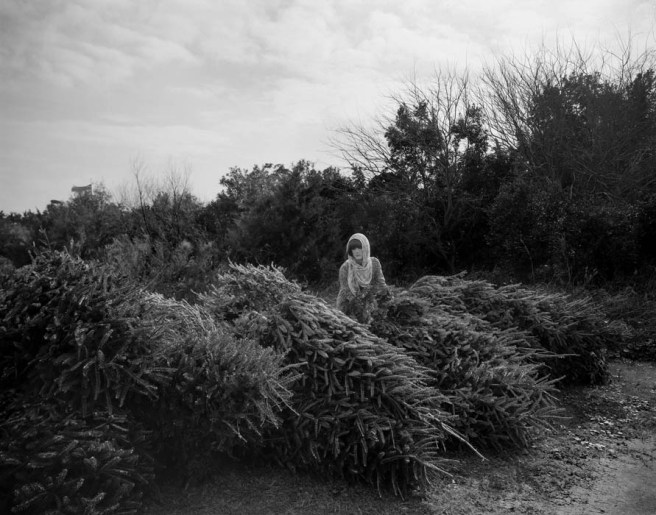
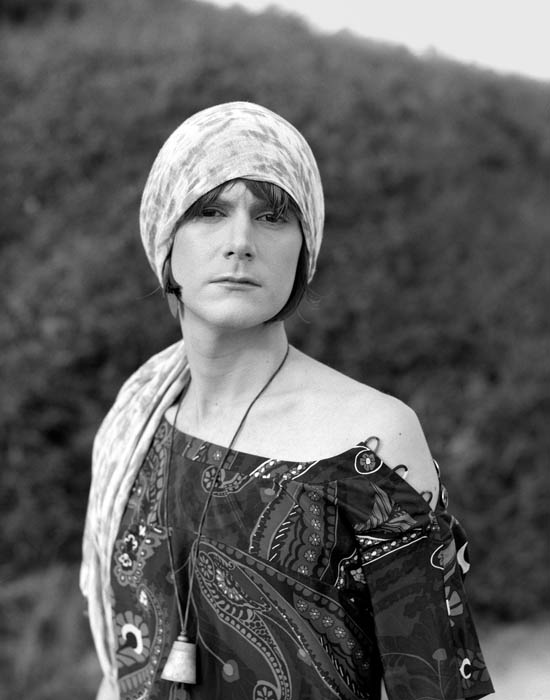
Philip Matthews is the author of “Witch” (Alice James Books, 2020) and “Wig Heavier Than a Boot” (Kris Graves Projects, 2019), a collaboration with David Johnson. A poet from eastern North Carolina, he currently resides in Sauk County, Wisconsin where he is Director of Programs at Wormfarm Institute. Up to this point, his practice has anchored in site-specific meditation and performance: he is curious about what happens next. philipandpetal.com / @philipandpetal

The Colorado Photographic Arts Center has an exhibition Aug 14- Sept 23, 2020. The Space Between explores issues of queer identity, sexuality, and relationships through the works of three contemporary artists, including two photographers and a poet.  In “Through the Lens of Desire,” Kris Sanford uses vintage photography from the 1920s – 1950s to explore an imagined queer history. “Wig Heavier Than a Boot,” is a collaboration of poetry and images that reveals Petal, a persona whom Philip Matthews manifests to write about and David Johnson photographs. 

In Our Own Small Bodies — Violet Mitchell

sad rainbowphoto: Dewang Gupta

your breasts hang in a fog & you can no longer see the ceiling or clouds & can no longer
feel your (   ) you do not know where they are

his jeans ripped at the knee showed hair (   ) & dried scraps he says unreasons says hair says bodies says sweat says it won’t matter once it’s done

a pear split so that you could dig out the seed to see what you’ve always wanted to rid (         )

hexagon breath turning like a wheel up your throat clunky like (          it was man-made          ) the air was yellow & glittering sharp a fast sun was it always so full-bodied

until then you had always loved yellow

it was like a side stitch after running too far it pierced that you looked to the stars & ran to find thread sew sew sew it tighter

your opening is gone it is red & songblue it wasn’t firework it wasn’t a redred balloon it was a dried puddle

set of drawers with kids’ clothing the shade of moths’ wings holes absorbing the mahogany grief this is the morning you decide your new outfit

it was late late light loose hair clinging to plastic rose petals       quiet & dry

(       ) you kept wanting to close the shades to stop the light to just know the lick of darkness to just be in it & not be talked at about pointed stars & wishes they made

if you are caught in quicksand you have to lay down flat spread your limbs hold your weight in your chest you must face palms up & open like the sky you watch who is blue & counting ( close) your eyes (think) of water (think) of the year the flood came & swept your home away

he said he found a ring it was diamonds cut from earth just like you how you were born he slipped it over your ankles, thighs, hips (   *   ) & when he reached your stomach rock after rock fell out of you & became the ring became a gift of the earth’s ground


Violet Mitchell is a Denver-based writer and artist. She earned a B.A S. in cognitive literary studies and is completing an MFA degree in creative writing poetry, both from Regis University. Her work has been published in Heavy Feather Review, The Blue Route, Sixfold, Word for Word, ANGLES, Furrow Magazine, and several other journals. She received the Robert A. O’Sullivan, S.J. Memorial Award for Excellence in Writing in 2019.

violet

cropped-imageedit_3_3022794780.png  

Standing at the Edge of the World — Alyssa Jordan

kyle-ryan-jtSO-EnyqjY-unsplash
Photo: Kyle Ryan

i. In the garden, Jena thrives.

Loneliness has transformed into electric-green cacti and short, spiny plants. Anxiety raises flowers that look vibrant and oily in the daylight. Restlessness enriches the earth, coloring flora with a spill of magenta, a blaze of orange.

In the end, fear evaporates entirely under the sun. It turns into the soil caked under her nails, the wet clumps that stick to her thighs and the back of her knees.

This garden takes terrible things and puts them to good use.

At least, that’s what she tells herself.


ii. When Jena is eight, her father picks her up from school and drives for two days straight.

He tells her it’s for the best.

Sometimes, he says, running is the only thing a person can do.

The farther they drive, the quieter she becomes. Tears dry to salt on her skin. Beneath their feet, the thunderous rhythm has become something dangerous.

In her mind, she disappears.

Jena feels safe amongst the shrubs. She can easily envision this sanctuary, and so she builds it. Trees and plants and birds sprout from the ground. They start as feathery buds with paper-thin roots. As their bodies take shape, her father’s voice thins into the breeze, his face hardens to bedrock.

Every time fear creeps in, her hands form fists. With the garden she can outrun it, outmatch it, and she barely has to wait before it subsides in the grass.


iii. Jena doesn’t know it yet, but theirs will be a life on the move.

It will start with a string of motels. Each one will be indistinguishable from the next, with their jelly-lit signs, the soap slivers that cut her skin. They will turn into a monochromatic blur of vending machines and scratchy sheets and stained walls.

Soon, she won’t be able to fall asleep without barks of laughter, or the drone of a generator. It will feel unnatural to sit outside the cramped design of a car. Most of her spare time will be spent in a garden that never changes.

Years will pass before she is home again, standing in a room that no longer feels like her own.


Processed with VSCO with g1 preset

Alyssa Jordan is a writer living in the United States. She pens literary horoscopes for F(r)iction Series. Her stories can be found or are forthcoming in The Sunlight PressX–R-A-Y Literary MagazineReflex Fiction, and more. When she’s not writing, she’s hanging out with her partner or watching too many movies. You can find her on Twitter @ajordan901 and Instagram @ajordanwriter.