BOOK REVIEW:
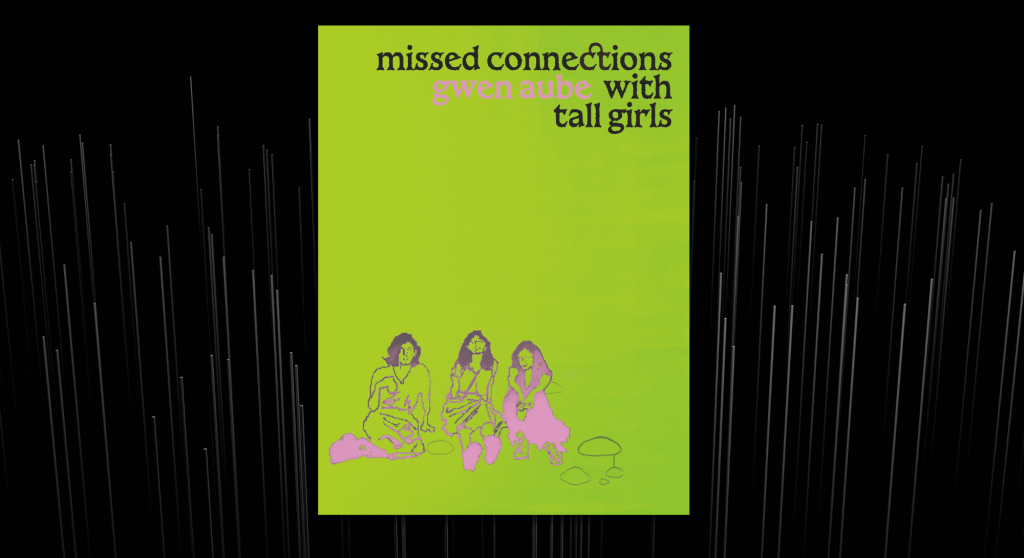
missed connections with tall girls
BY GWEN AUBE
A BOOK REVIEW BY EDEN HEFFRON-HANSON
It’s the poet’s right, according to the Russian Futurists, to use “arbitrary and derivative words”. For Myakovsky, in fact, it was a “social command”, a requirement to translate colloquial speech onto the page following increases in literacy after the Revolution. Similarly, as trans presses do away with the market-oriented eyes of cis editors, beautiful phrases lurch out of Omegle chat rooms in knee-high socks and cat ears. We are blessed with language that is not only geared towards trans audiences, but would hopefully piss off, confuse, and be unintelligible to most cis ones.
Gwen Aube’s missed connections with tall girls is a book that spoils us with such language. A collection of vignettes of “oddball trannies”, it is filled to the brim with bawdy colloquialisms, manifestos, and general debauchery of every kind. It has “girldick”, HSTS vs AGP kandi, traps, “kkkanada”, and blood pacts. It is the sounds of dolls awkwardly crowding into bars, Montreal train yards, and half-bird girls smuggling away hamburgers. It is a book that is warm, and loud, and will make you cackle so heinously your roommate asks what you are choking on.
The poetry is funny, and carries so much character, that it is hard to realize how earnest it is. Aube brings the poetic voice of a self-identified “flop-house bitch”, yearning after eponymous “missed connections” of a cast of stragglers, vagabonds, and cast-off trans women. The politics of the poetry throughout are a working-class evangelical trannyism, with shade reserved for those that would scorn solidarity for the sake of upward mobility i.e., girls on their snobby stealth or true transexual bullshit.
The first section holds stories of rebuffs and missed connections underscored by class or social anxiety, but transitions to a second interspersed with a chorus of all-caps stanzas laying out the voice of “AN OLD GENDER CRITICAL FRIEND”. Aube’s double ventriloquism satirizes the far-right conspiracy theorist while simultaneously proclaiming the warmth of T4T collectivism:
COME YE NEEDY AND BROKEN
GIRLS—BRAID TOGETHER YE
WEARY BODIES— BATHE INTHE GIGGLING COVENANT—
Aube explores the part Western transsexuality plays in the imperial project. When a group that relies on solidarity for its survival finds state legitimization, what purpose could it serve? The poet reflects on the infamous but mythological “Lockheed girl”, on the CIA-backed PEN International giving Aube a literary award, and on the fact that western queer claiming of the Greek Galli opens Mount Ida for Canadian mining interests. Among this horror, the poet longs for pre-legitimization, to be declared a “freak unfit for labor” outside the tools of the Western project. Yet, the voice proselytizes this is the place we stand once again, amid an apocalyptic “HETEROGENOUS REJECTION” which leaves “PURSES CUT, OUR TEMPLES DESTROYED, OUR CHILDREN SLAUGHTERED”. But this is rarely a poetry collection settling into despair, and it is here, in this post-Revelations world, that bourgeois trans life rediscovers its fetishized “underground”, reapproaching the place where “LOVE WINS” is more than a bumper sticker.
However, Aube’s poetic voice is too compassionate to assert that a direct confrontation with fascism will be a net positive if it creates class love among trans women. The third section is, among other things, a guide on mogging the welfare office. In the different presentations Aube’s narrator has in the chapter, wearing a fur coat to the welfare office, getting stared at for the holes in her shoes by “the state itself”, or living off arts grants “before I even had a book out”, we see the poet leveraging what is meant to be a static class/caste system. Combined with For Herma, the longer ekphrastic poem making up the last section of the book, it becomes clear that, for the poet, love already overwhelmingly exists in trans life when it is separated from capitalist values. The poet works to reckon with “tranny wiping poopy ass—tranny attending the PTA meeting—tranny pushing the stroller” but is easily able to resolve to “find some boy in an alley and groom him to be my daughter”. For Herma makes connections to family in all its forms, it is the poet’s reckoning with growing into an elder through queer or conventional motherhood. A deep love orbits the vignettes and portraits of the book, for all the girls that she fails to connect with, for Nevada, casey, syb, and for the traps and dolls that populate the book’s pages. It becomes clear that uncoupled from institutional validation, bourgeois aspiration, and the nuclear family love is still intertwined with survival. However, it is a love that is subject to state indifference, if not violence, and generally deserves the downfall of the West to prosper.
It is an important book for anyone interested in what trans poetics can do. If the goal is to repudiate fishy girls that run away with boys, or the ones that tell you to fuck off in doctor’s offices, if it’s to support the spirit of grooming as a beautiful plot to increase the warmth of the trans project, then it succeeds. It’s a book I felt too bougie, too Statesian, and a little too young to fully get. Aube’s hilarious writing is a layered satire, using joy and irony to explore transness and class at multiple levels. If it stumbles anywhere, it’s that the written poetry can’t match the energy of Aube’s readings, existing between page and voice to demand gathering. It is a book inline with Bambara’s irresistible revolution, proselytizing love in the corners where the state can’t or won’t reach, a collection that dreams pretty, audacious, blasphemous dreams. Dreams that are summed up best in some of the final lines of the book:
“let no woman be without sister…
let rains bless the women
which have made themselves women
for the kingdom of heaven’s sake”
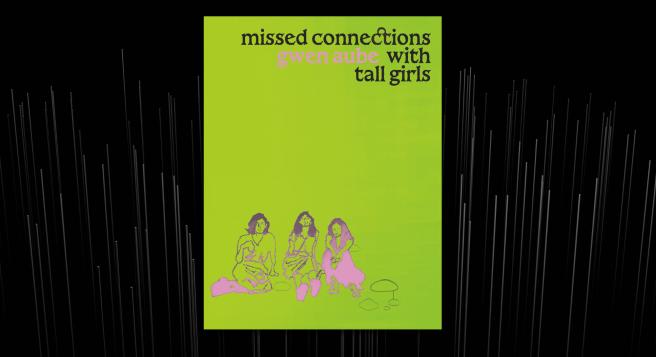
MISSED CONNECTIONS WITH TALL GIRLS
BY GWEN AUBE
AVAILABLE THROUGH LITTLE PUSS PRESS
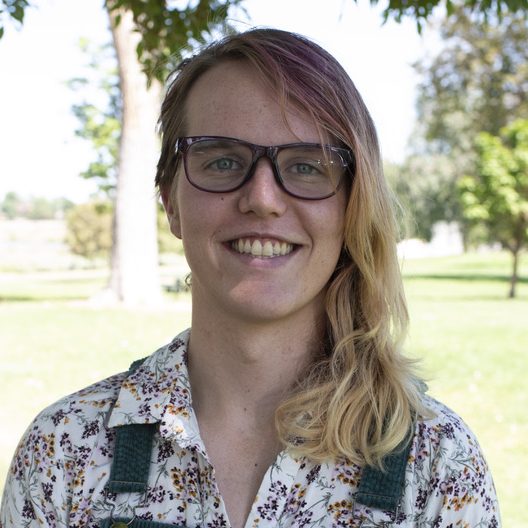
Eden Heffron-Hanson is a writer and poet living in Queens, New York. She traditionally writes love poems but in her down time would looooove to review your work (edenheffha@gmail.com or @edenheffha on Instagram). She has been published in Beyond the Veil Press, South Broadway Press, and Trans Mag.









 south broadway press