hopper house – james h duncan

steeple

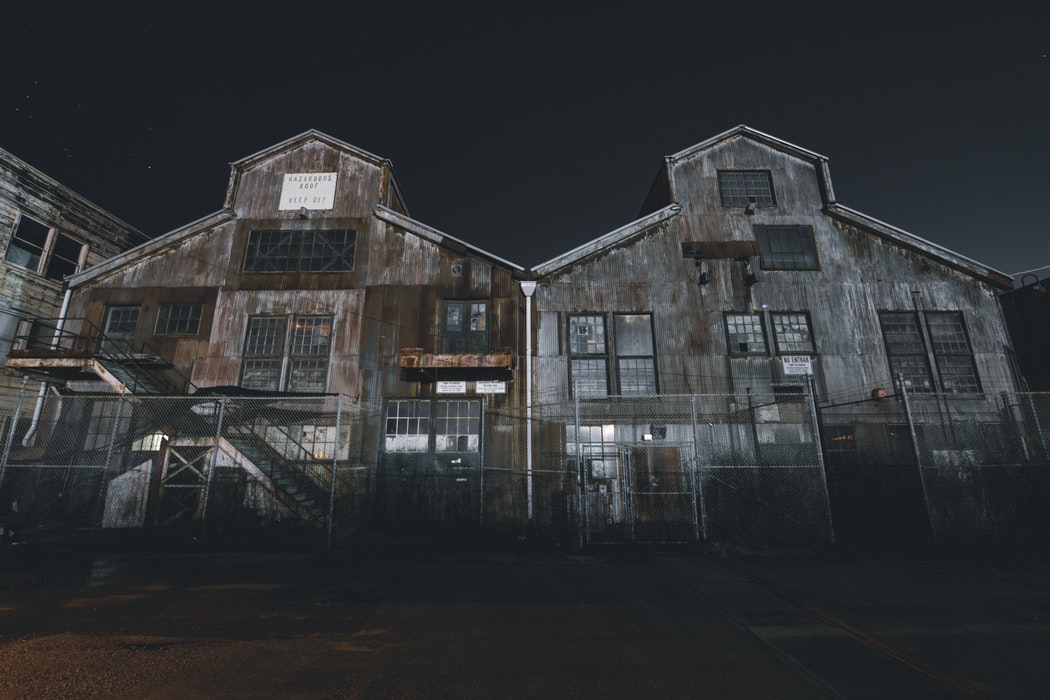
Down the hill stood a house beside a set of railroad tracks, a house I always called the Hopper House because it reminded me of those Edward Hopper small town scenes he would paint, quiet and windswept, forlorn. Shades of chipped emerald and hunter green paint, scalloped awnings, spire staircase, slanted chimneys. This house stood on Orient Avenue with dirt for macadam and a green-striped folding chair on the front porch, a radio playing in the window and a dog barking somewhere deep inside, but no one ever sat in the chair or came out when I walked by every day.

I was in a bad way, unemployed aside from some very fortunate writing jobs or some small checks coming in for poetry, $10.00, $5.00, even a few for $2.00. I would walk to the bank and cash them and then take Orient Avenue and a short-cut through the grounds of a dilapidated trolley station to a small tavern by a rock-strewn river where I’d eat an inexpensive meal or just blow the whole shot on two-dollar bottles of beer.

I often stopped at the Hopper House and looked up, wondering what it must have been like to live there during its heyday. All three stories were gorgeous and ornate, though falling apart from years of neglect and agoraphobic hibernation. Save for the dog and the radio I would have called it abandoned. Even haunted maybe, and that green folding chair always gave me an odd feeling like someone I couldn’t see watched from within, waiting for me to leave.

All that summer I wrote letters to a woman in Germany about the house. She wrote back and told me of a similar manse near her father’s summer home outside Bremen. Her haunted mansion was not green but yellow, bleached by the sun and empty, and stood back from the road on a small rise, its black hollow eyes watching their car drive by whenever they went back into town from their seaside cottage. She asked if I named my green house, and I said yes. I told her of Edward Hopper. She knew him and adored his work, most especially Automat.

One afternoon someone at the end of the bar said a car went off the road and had rammed into the house and some of us got up and half-walked, half-ran up the street to the Hopper House. A white Subaru had crumpled into the front porch and paramedics, police officers, and firemen surrounded the car and were climbing onto the porch. We watched for a while but no one came outside, no one sat on the curb with head in hand, not even the driver, who apparently ran off. The dog didn’t even bark.

Soon we all walked back to the bar, but for weeks afterward blue tarpaulins covered the broken portions of the porch and stairs, with no dog, no radio, no green folding chair. I wrote a letter to Germany and told her what happened at the house, and two weeks later her reply said I should avoid it. My story gave her a bad dream, a bad feeling. It was haunted, she said, and a magnet for bad luck. I believed her. I always believed her. She signed her letters Yours, so I did too.

I avoided the house after that, as she specified, but I had dreams of the house as well. I had them then and long after I moved away. In the dream I walked up those porch steps and put my hand on the doorknob. A fear filled my chest about what waited inside, about going up the stairs to the second floor, the third floor, the attic, and then I was there, in that attic space. I heard the radio far below me, the dog barking somewhere. I closed my eyes and a claustrophobic warning in my heart told me that what if I opened my eyes again I’d discover something unbearable. In the dream I would run, painfully slow, and leave the front door open behind me, the green folding chair sideways, the dirt driveway littered with bottle caps and gravel as I raced for the horizon, for that wildfire sky.

And then I’d wake up—somewhere else, far away. But the dream was hard to shake and I wrote to Germany about it, but after three letters with no reply, I stopped writing. Now there is only the dream, wherever I go.

sbgs cowskull

James H Duncan is the editor of Hobo Camp Review and author of such books as Nights Without Rain, What Lies In Wait, and Dead City Jazz, among other collections of fiction and poetry. For more, visit www.jameshduncan.com.
submit to south broadway ghost society.

the pilgrimage – bare ly

pilgrimage - bare ly

for three days
I walked to the town where
the monks translated winter
for seven years,
their work crumbled like bricks
even in obscurity –
truths fall
(plucked from the eyes
of our lords)

sbgs cowskull

Bare Ly is the tender gender-fuck your parents never warned you about. They make sad music (Double A Dollar) and host an experimental podcast series called A Soft Mess

Photo: Also by Bare Ly, @dear_bare

candlemas – maria berardi

light

The aspen stand like a cemetery,
upright, gray as ice, bark furred
with white velvet, and their sad
hieroglyphic eyes witness, witness.

The aspen stand straight as the deer
they camouflage, trunks bars
of invisibility. This little stand
is a house of ghosts.

Their twigs stick like fairy-tale fingers.
All their bones are showing,
it is a magic defense. And in each tip,
tight as a heartbeat,

the bud, the knowledge compressed to potency
in each of these desolate soldiers, these angels:
like a sex dream
spring surges in darkness.

sbgs cowskull

Maria Berardi’s work has appeared in local and national magazines and online (13 Magazine, Voca Femina, Mothering, The Opiate, getborn and most recently Twyckenham Notes, Luna Luna, and 8th street publishing guild). Her first collection, Cassandra Gifts, was published in 2013 by Turkey Buzzard Press, and she is currently at work on her second (a chapbook, or perhaps not, entitled Pagan). She lives in the Front Range foothills west of Denver at precisely 8,888 feet above sea level .

Her process is one of listening for transmissions from the cosmic radio and trying to catch them on paper before they dissipate: the glimpse, the complicated knowledge.

She may be reached at mariarazberardi@gmail.com.

she said she dreamt – ace boggess

hat

She Said She Dreamt

we were prisoners together,
standing to the side
while hard men fought battles,
their arterial spray like trajectories
of missiles on computer maps.

I climbed inside her head into the dream &
sniffed permanent bathroom stench
mixed with faux-bleach & burning tissue-
paper smoke off makeshift cigarettes.

It wasn’t real, but as she told her story,
I heard the desk guard shouting, “Lock down!”
I watched the goon squad roll in,
cans of mace for target practice.

I wonder if in the dream I squeezed her hand,
said, “Hold your breath. Forget,”
or if she knew how lucky she was
to dream herself into a place like that,

whereas I, in my age of atrocities,
spent eighteen hundred nights alone
trying in vain to dream myself back out.

sbgs cowskull

Ace Boggess is author of four books of poetry, most recently I Have
Lost the Art of Dreaming It So (Unsolicited Press, 2018) and Ultra
Deep Field (Brick Road Poetry Press, 2017). His poetry has appeared in
North Dakota Quarterly, River Styx, cream city review, and American
Literary Review, among others. He received a fellowship from the West
Virginia Commission on the Arts and spent five years in a West
Virginia prison. He lives in Charleston, West Virginia.

submit to south broadway ghost society.

teenaged shell – bare ly

desertLook closely—
part of this poem was written
20-some miles from his home
at a bus-stop in Santa Barbara.

He doesn’t know how
to give voice
to his ambitions,
so he writes half-poems
on napkins
on State Street
and pretends that
stolen toilet paper rolls
are tiny scrolls
and he is a scribe
with nothing to write
but gold.

sbgs cowskull

Bare Ly is the tender gender-fuck your parents never warned you about. They make sad music (Double A Dollar) and host an experimental podcast series called A Soft Mess

submit to south broadway ghost society.

you’re really something – bruce mcrae

railroad

I’m the unpronounceable something
that lives behind the garden wall.
Something that begins with the letter something.
The something from something for nothing.

I’m really something, or I’m something else –
we can debate the various uncertainties.
We can discuss our purpose, divine a plan.
‘A thing unspecified, a thing unknown’,
the dictionary patiently explains.
‘An amount being stated that isn’t exact’.
Like ‘I love you something terrible’.
Could you ever love me in return?

sbgs cowskull

Bruce McRae, a Canadian musician currently residing on Salt Spring Island BC, is a multiple Pushcart nominee with well over a thousand poems published internationally in magazines such as Poetry, Rattle and the North American Review. His books are ‘The So-Called Sonnets (Silenced Press), ‘An Unbecoming Fit Of Frenzy’ (Cawing Crow Press) and ‘Like As If” (Pskis Porch), Hearsay (The Poet’s Haven).

submit to south broadway ghost society.

put me on a dog leash and make me eat taco bell off the floor – nathaniel kennon perkins

taco bell

You keep thinking you will grow accustomed to a feeling of worthlessness, but you never do.

Your goal was to pay off your debt by the end of the year. Your credit card. Your overdrafted checking account. The last three thousand or so dollars of your student loans. The payments on the van you bought but that your ex-wife sold to get the money to buy herself a truck.

You are just making payments on her truck, basically.

You’ve been working, but you realize it isn’t going to happen. This is not the year that you pay off your debt. Even on days you have off from your regular job, you go to work for your friend Gruber to make extra money.

He owns a landscaping company. You meet at his house in the morning and go together in his truck to a client’s yard, where you pull weeds.

After a while, Gruber says, “That’s good enough.”

He says, “That’s the good thing about trying to go for a quote-unquote natural look. When I’m sick of pulling weeds, I just stop pulling weeds. It’s natural.”

Time for a break. You go with him to the coffee shop where he used to work before he started his own company. The baristas there are cute. They are excited to see him. When he realizes that he has forgotten his wallet, they make jokes about scanning his retinas. He giggles and puts his face over the cash register, as if it might be accepting a payment from an account linked to his eyeballs.

One of the baristas grabs the back of his head and slams his face into the cash register and laughs.

It looks like it hurt.

“Sorry,” says the other barista, addressing you. “I know that seemed violent, but we all love each other. We love Gruber so much.”

You can’t think of anything clever to say.

You are thinking about all the times that you have wanted to grab your friend by the hair and smash his face into something, but you feel like you probably shouldn’t mention that.

You pull some crumpled bills out of the pocket of your work pants and pay for the espresso.

You wish someone would grab you by the hair and smash your face into something.

You don’t think you deserve it, but you’ve been wrong before. You probably do deserve it.

It’s a safe bet.

Maybe that’s how you could make some money.

Frustrated service industry workers could take out their rage and frustration by paying you to let them smash your face into something.

It could be donation-based.

You don’t want to be classist.

You could print up flyers and pass them out:

“Smash my face into something! Suggested donation: $5 – $10. No one will be turned away!”

Back to work, sort of. You drive with Gruber to a plant nursery almost an hour away.

On the way there, you listen to the college radio station and think about how you recently got laid.

You certainly didn’t see it coming. Why would you?

So, even though you knew that you were going out on a date, you did nothing to prepare.

She came back to your house, and when you opened the door to your bedroom you said, “Sorry. It looks like a depressed person lives here.”

You thought about saying something similar about your neglected, untrimmed pubic hair, but you didn’t want to call any more attention to the complex ecosystem of chaos in which you seem to live.

Does any of this make you an asshole?

Probably not.

If anyone ever calls themselves an asshole, you should probably believe them.

You make a resolution to believe every self-declared asshole.

And then let them smash your face into something.

But you’re not an asshole.

You’re just a loser in a mountain town populated with extremely rich people.

They know some secret that you don’t.

This is because you are dumb.

You and your best friends are a bunch of dumb drunks who will never pay their debts.

Like Paul, who lives out of his car.

And Jimbo, who pours shitty whiskey into a Maker’s Mark bottle that he carries around in his backpack.

And Avagyan, who is dating a 21-year old.

Though, when you think about it, dating a 21-year old actually doesn’t seem like such a loser thing to do.

Seems pretty cool.

This creepy guy at some hot springs once told you, “You’re only as old as the woman you’re holding.”

You imagine dating a 97-year old woman.

About letting her smash your face into the hood of a Lincoln Continental.

About fading into the sweet peaceful caress of the universal void together.

No, you’re not a loser, you decide.

And neither are any of your friends.

How could you think such horrible things about your best friends?

You dumb dick.

You asshole.

You really do deserve to have your face smashed into something.

And you’ll get rich from it.

You’ll finally pay off your ex-wife’s truck.

sbgs cowskull

Nathaniel Kennon Perkins is the author of Cactus. He lives in Boulder, CO, where he works as a bookseller and publisher at Trident Press. His creative work has appeared in Triquarterly, The Philadelphia Secret Admirer, Keep This Bag Away From Children, decomP magazinE, Maudlin House, Timber Journal, and others. He is the recipient of the High Country News’s 2014 Bell Prize. 

submit to south broadway ghost society.

marks for perseverance – patricia walsh

barnyards

Exiled to a lonely corner, wanting more than letting on
something is wrong with the state of myself,
love as transaction, flowing freely of course
being silently watched, no effort at a smile.

Making the world go round, insolent situation
cutting hands and feet to ribbons in protest,
I don’t care about you anymore, if I ever did
rolling one’s own jelly babies not really my problem.

Serial butterflies galvanise the rotten core,
protected in instances of eventual delivery
home-grown opportunity not a mortal sin
just the run of the day, everything is special.

Principles aside, nothing at a loss.
Breaking through ranks, ass being grass
and me being the lawnmower, catch you out
mutual benefit never hurt anybody.

Instant messages, never mind the duress
the tawdry ambition ascending for the kill
bleeping phones on a constant adventures
transmitting turn-ons, a glorious guilt.

Streetscape for want of a better life,
the passer-by muscles by a hearty congratulations
knowing less than required, plugged-in cartoons
advertising psychosis hidden in a purpose.

sbgs cowskull

Patricia Walsh was born and raised in the parish of Mourneabbey, Co Cork, Ireland. To date, she has published one novel, titled The Quest for Lost Eire, in 2014, and has published one collection of poetry, titled Continuity Errors, with Lapwing Publications in 2010. She has since been published in a variety of print and online journals. These include: The Lake; Seventh Quarry Press; Marble Journal; New Binary Press; Stanzas; Crossways; Ygdrasil; Seventh Quarry; The Fractured Nuance; Revival Magazine; Ink Sweat and Tears; Drunk Monkeys; Hesterglock Press; Linnet’s Wing, Narrator International, The Galway Review; Poethead and The Evening Echo.