RATTY or the errands end – meredith counts

counts

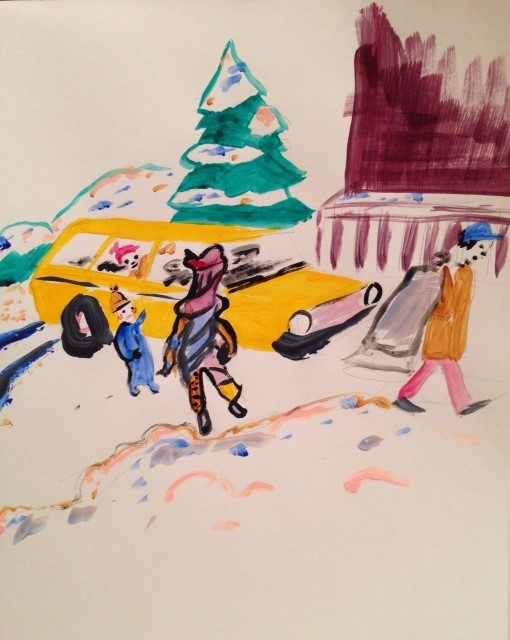
An homage to Edward Gorey.

Their dad was running errands in town and insisted that the kids come along. They had been to the dry cleaner to drop off Wraddey’s dragon suit to see what could be done about the ink stains. They’d been to the butcher for sausage, the hardware for tacks, and the place that sold glow-in-the-dark soda. It wasn’t that their dad wanted their company, Wraddey thought, so much as that he remembered what a mess they’d made last time they’d stayed home unattended. Weeks later their father complained he still found marshmallow in crevices about the house, and he wasn’t happy that Wraddey had pasted over every reachable inch of her room with the funnies.

In the backseat of the station wagon, Wraddey felt so bored that she might disappear into the seat, that’s how sick of things she was. Her big brother Egor elbowed her to get her attention. As she reeled back to sock him for touching her she saw the stranger wading through the high piles of snow. Wraddey liked to fight her brother, but it had been a long and relentlessly dull winter. Both children were so hungry for something out of the ordinary to happen that the fight melted away.

“Do you see…?” Wraddey started to say.

“But who…?” Egor asked.

Wraddey shushed him.

Teetering through the dirty snow on the side of the road, whoever-it-was wasn’t wearing a coat or boots, but was cocooned in yards and yards of fabric. Every bit of the person was wrapped up, and except for a purplish brown velvet, most of the wrappings were clashing patterns. No nose or wrist or eyeball, no feature to be seen. As the car passed, the kids turned to keep looking.

“Huh,” Egor said.

“Wow,” Wraddey said.

“Huh?” said their father from the driver’s seat.

The person grew smaller through their wide rear window. Then they turned into a parking lot and the strange person was out of sight.

Their dad ran in to check on a watch he was having fixed. The kids waited in the car, admiring the neon line drawings of jewels in the window of the tiny shop, and listened to the radio. From her seat in the back, Wraddey put her feet up on the center console. Egor kicked Wraddey’s boot and started to scold her.

“Dad wouldn’t let you–“

“Shut up. Look!.”

“I’ll tell him you’re putting your – “

“Shut up and look, Eeg. Who is that?”

The stiff figure crossed the jeweler’s parking lot. Wraddey wondered out loud if they were walking backwards, the way she did when it was windy at the bus stop. Maybe that’s why they were going so slowly, why their knees didn’t bend.

She waved but the figure didn’t respond. It wasn’t possible for Wraddey to tell if she was unseen or being ignored. But you know how being ignored can stoke your interest.
Their dad returned, satisfied and whistling. He was old-fashioned even as far as fathers went – he wore a watch, their car didn’t drive itself, he whistled to an actual FM radio station. Then he whistled a song that wasn’t the song on the radio, then he whistled through the people asking for donations to the radio station. At one point Egor started whistling, then Wraddey tried too though she’d never quite got the knack of whistling (she was only eight) and their father told them to cut out all that racket.

They passed the strange person up ahead one last time. Even from a distance, the scraps and scarves and sheets covering the covered up person didn’t look homeless. From elsewhere, maybe, but not weathered.

Then their always steady, never-impulsive father was in such a good mood that he impulsively swerved over to the side of the road, rolled down the window, and offered that fascinating bundled-up person a lift.

The person was tall, and bent sideways to peer into the open window. The head, scarves on top and scarves on bottom sandwiching huge blue blocker sunglasses in between, seemed to nod. Their father leaned across the passenger seat, opening the door from the inside so the person could climb in.

They lived near a prison and never picked up hitchhikers, let alone wobbly mysterious persons wrapped up like fragile treasure with no single centimeter of skin to be seen.
The figure sat tall in the passenger seat, head skimming the roof, looking forward. Winter air flooded the car, for the person hadn’t closed the door after climbing in. Dad stared at the person. The person stared ahead, making no moves toward the door or otherwise.

“Um, allow me, I guess,” their father said, exiting and going around to close the door.
Wraddey giggled. Her brother belted her for it, but their father’s guest didn’t seem to notice.

The car filled up with the smell of an apple orchard past its season and also of mothballs like at their aunts’ house and wet wool and something like cheap warm cheese.
Dad asked “So where can we drop you off?” but the person only looked forward, so Dad filled the car with chit chat.

“Cold enough for ya?”

“Been a hell of a winter.”

It was a chattering sort of aimless talk, their dad was filling silence and gaining no answers. The children kept a very close eye on the stranger, but they offered no response. Not a word.

“Yes, sir-ee.”

“Where’d you say you’re headed?”

Nothing.

Their father was unsettled. He couldn’t tell if the person was stupid or deaf or dangerous, or scariest of all – silently judging him to be not worth a response.

“Are we, uh, headed in the right direction for ya?”

From the backseat, Wraddey thought she heard a faint scratching sound.

“Well, uh, say, we’re close to home. We can drop you off there, or, uh…” He paused for a moment, then finally said “Would you like to come in and warm up?”

The person’s head fell violently downward. The one harsh nod sent a puff of that rotten apple smell into the cold air of the backseat.

Impressive! Wraddey thought. By ignoring their father, the stranger had bullied him into an invitation inside. They hardly ever had a visitor. If someone did come over, it was in sensible parkas and those visitors had faces.

In the driveway the person sat stone still again, so that father told Egor to go around and open the passenger side door and let “their friend” out.

“I can do it!” Wraddey yelled.

She was closest, but moreover she wanted to be the one to do it.

While father went ahead with the dry cleaning bags to unlock the door, Wraddey opened the passenger side door to let the stranger out. Both feet swung out together like the tines of a tuning fork, then they found purchase on the snowy drive and the whole body lurched up and out. Wraddey said “follow them,” pointing to the guys, followed, watching closely. Wraddey followed the tiny footprints in the snow that looked more like a deer’s than a person’s.

In the house, the stranger clomped over to the davenport and sat, imperiously, down.

“Make yourself at home,” father said with some sarcasm.

The stranger didn’t even look at him.

“Maybe I’ll, uh, put a snack together then?”

The figure nodded that violent nod.

Feeling he was being had, the children’s father disappeared into the kitchen, searching for some unstale crackers for their silent guest. Wraddey thought that she was going to try the stranger’s approach the next time she wanted something.

Egor stood shuffling by the door in his thick winter socks.

Wraddey sat down on the couch next to their guest.

“Hello,” she said, in her soft voice.

It was only when she reached out and laid a hand on its leg that the figure jerked around and pointed its head at her. When it raised its arm, Egor knew it was going to pull his sister’s brain out through her nose, but the arm stopped short. It didn’t strike Wraddey but hung in front of her, inviting a shake.

She accepted, taking the end of the arm in her own hand. Around where a wrist should be, she felt a tassel. She felt it between her thumb and forefinger. She couldn’t help it. She pulled.

It was the end of a scarf, which came off the stranger’s arm in a great spiral, like the curly paper wrapper of a China marker. Under the scarf was a folded blanket, which Wraddey unfolded, the stranger oddly kicking one leg out but not moving the rest of its body at all as its arm was revealed to be not an arm really but two thumb-thick sticks stabbed into a withered apple where an elbow would be. When Wraddey peeled off another layer, leading to the abdomen, the smell of rotten apple grew stronger.
Then when she pulled a hank of Pendleton plaid from under the collarbones, two shocking things happened. First, the head, still pointed at her, tipped clean off and landed on the floor with a thump. At the neck was a pair of broken sticks, and when she wrenched one out it uncovered the chest.

There sat a large rat, in a wicker sort of ribcage, concentrating hard and pulling at the levers of its failing body with all four feet and tail.

“Oh!” Egor yelled in disgust, for he was becoming adult enough to be wary of rats.

“Oh!” Wraddey repeated, in a different way, because she was a lover of animals and it wasn’t the ugliest rat ever, not really, and it was so clever.

“Oh?” Their father said, coming from the kitchen with a platter of finger foods. Then he bellowed, and dropped his cargo, dehydrated apricots and wheels of sliced summer sausage bouncing on the heirloom carpet.

“Tssss!” Shrieked the rat, pointing his ratty face this way and that.

Then it leaped out of its seat in the rib cage, neatly landing on its hind legs.
Another ancient apple fell out of the body, landing with a muffled plop in the piles of shed fabrics.

The rat looked directly into Wraddey’s eyes. It cocked its pointy head toward the door, and Wraddey nodded.

Wraddey took the rat by the paw, helping it out of its wrecked body. She slipped her feet into her boots, grabbed her coat, opened the door and vanished with him out into the cold bright day.

Her family watched from the big picture window, the girl and the large rat, running through the high snow, past the station wagon, down the driveway, down the road, never to return. Over their years together Wraddey and the Rat travelled and saw amazing things. They rebuilt it’s human body better than ever, using common kitchen implements Wraddey was able to produce a more convincing gait and her fingers could tie much sturdier knots that an animal could. What the rat lacked in terms of getting its protegee into college it made up for with adventure. With it’s keen sense of smell the two never went hungry, and after a year of trust building the rat would give up its wrappings on cold nights so that Wraddey could use the fabric as blankets and the rat would cozy up into her chest, it’s fast rodent heart beating twice for every single beat of hers.

cropped-dead-bird-clip-art.jpg

Meredith Counts has an MFA from the Fiction Writing Department at Columbia College Chicago. Now she’s studying archives at the University of Michigan. She’s had work in Traverse, Portage Magazine and Quail Bell Magazine. Her story on poet Jim Gustafson and Detroit Tigers baseball, originally published in the Detroit Metro Times, was named notable by Best American Sports Writing 2018. She’s always loved Edward Gorey.

Artwork: also by Meredith Counts
more than one way to be a gravedigger – divya

gravedigger

i bet your hands taste like honey. put a finger in my mouth
….& let me dream it. i watch you roll cigarettes –
i know you memorized my number when we were in eighth grade
i know you think of me when you can’t sleep at night

the ghost of me lingers these corridors in your house,
counts your pennies, fucks with your linen. oh baby,
you listen to songs to kill time, you dance in empty houses
and i think of the last boy i loved
& how he set fire to everything

me too, i think. i’ll have that fag, thanks. i am a fag, thanks.
i blow smoke out like a fairy godmother. who am i
if not this broken glass bundle of queer? i have always been
pretty face, ugly existence. the fire alarm, the dynamo.
the girl of your dreams, the girl with tree-branch fingers
typing out obituaries in the cold dampness of 3AM thursdays.

cropped-dead-bird-clip-art.jpg

Divya is a writer and dreamer whose hobbies include reading poetry, drawing pictures of flowers in their sociology study notes, romanticizing make-believe worlds and occasionally ignoring the rules of grammar in the name of art. They have posted their work on various online platforms since 2016. They believe in the healing powers of nature, art, music, sunsets and in the overall goodness and resilience of people. They currently live in the southern half of the Indian subcontinent, but can be found online in various places, most notably @divwhine on twitter and @cyanidesunflowers on WordPress.  Their work has been previously published in The Brown Orient and Rose Quartz Magazine.

the monk’s succulents – j. miller

monkulents

What kills you doesn’t make you stronger, as if every reason happens for a thing. I spent weeks trying to figure out how to keep the succulents alive. Patiently listening to classical music, and sufferingly waiting to hear back from my botanist-friend. Gregor Mendel waits as the plumule and cotyledons spread to the sunshine, to live without shame and to massage the ground as a 马杀鸡, accept the shame and stains of the ascetic life. A horticulturist who loves their houseplants will lose them; A horticulturist who hates their houseplants will need to water them even after death.

The matter of the fact is death creeps towards the houseplants. Now I remember if time passes by me, the magnolias will outlive me. Now I remember these sheets of time. Each layer found in a newspaper or magazine. The monk as a botanist advises that sunlight accelerates growth.

Growth. A bush beats around the dead houseplants. 上a Chinese word for up, pronounced shàng shàng shàng shàng shàng shàngshàngshàngshàng shàng shàng shàng shàng shàng shàng shàngshàngshàng. Can the shrub withdrawal into the moonlight, and still watch the birds fly from their holes in the sky? Those aren’t birds.

You were a bird in a previous life, said my monk-friend, as we walked towards the delicatessen on 84th. A previous life, a forgotten sheet, sediment un-dredged, left to fall through the hole in the sky and rain that creates holes in the smoke, and holes in the sea, and sea in the holes. I am a houseguest here. Resultant from the monk’s prediction, all the houseplants died on 84th street. Or it could have resulted from an ancient Chinese proverb.

All gardens know better than their gardeners. My houseplant smirks at me. The houseplants know that I am its houseguest. Bonsai sprouts legs and waters me in my sleep, my pillow stained with sweat. All sheets uncanny, my potted plant and I use the same bathroom.

cropped-dead-bird-clip-art.jpg

J. Miller is a writer currently living in Central China. He teaches literature to a city that is often referred to as a furnace, and in winter he lives shrouded in a white curtain. Instagram @yawn_sea

Photo: Viktor Talashuk

miscarriage in train car #4 – lauren napier

letoh

The salt of embryo and ocean
The grounding of the shoreline and rubber tread
Here is where true nature is seen
Here is where fleshly goodbyes are said

Parallel lines in a hotel room
A parallel universe unfolding within a surreal frame
Enfolded in two familiar arms
Embracing again for the first time
Renewal – the act of letting go

cropped-dead-bird-clip-art.jpg

Inspired by all forms of energy and art, lauren.napier takes comfort in the written word and in creative performance. She lives within a lush realm of bittersweet melodies and phrases alongside her black feline, her guitar, and typewriter. Wherever lauren might be, her work may be found online at punkrockdoll.com or followed upon instagram.

Photo: Jonathan Pielmayer

two poems – sandra santos

santos

have you ever asked a butterfly
if flying once transformed is hard
and how much weight is lost meanwhile
the wasteful creaking of the world’s skin
the copious slash on a piece of blow
pushing your smile through the night
— you belated hour end a cycle
music is the dawn
you trace in my way of surrendering to sleep
the remembrance that fills my heart with a sudden longing
to have you here someday
lightly
unveiling the beauty
of our flight
that heads to silence.

nunca perguntaste a uma borboleta
se lhe custa voar quando transformada
qual o peso largado no voo
e é custoso o ranger de pele do mundo
o corte copioso sobre um pedaço de sopro
movendo o teu sorriso pela noite
— ó hora tardia que findas um ciclo
a música é a aurora
que traças no modo de me abrir ao sono
a lembrança que traz ao peito um súbito desejo
de te ter aqui um dia
já leve
desvendando a beleza
do nosso voo
rumo ao silêncio.

if I were a dagger
I would drop
the blade
every day
on the wet grass
until it came back
in blossom.

se eu fosse um punhal
deixaria cair
a lâmina
todos os dias
na erva molhada
até ela regressar
em flor.

cropped-dead-bird-clip-art.jpg

Sandra Santos is a poet, teacher, writer, and translator from Portugal born in 1994. She holds a B.A. in Languages and International Relations from University of Porto and got her Master’s degree in Editorial Studies at the University of Aveiro. As a translator, she has published her work in Portugal, Spain, and Latin America, working back and forth in Portuguese, Spanish, and English. Her own poetic work can be found online at: http://sandrasantos-ss.blogspot.pt/.

Prepared and translated by Nicolás Barbosa López

Photo: Claire Brear


two of pentacles – robert beveridge

two of pentacles

The table sits in the corner. It
is brown. The fixture over
the table holds four lights. One
is burnt out. One is missing.
The other two are low watt
bulbs. The walls on two sides
of the table are beige. Chairs,
mismatched, face the table
on the other two sides.

The table is empty save a single
sheet of paper. It bends upwards
at the edges as if it had been
folded into thirds, placed
in an envelope. If there was
an envelope, it is not there.
It has been moved from the table.

A thread dangles from between
the two expansion leaves. It is
attached to the body of a spider.
The spider catches every draft,
drifts in the wind on the end
of the silk. The spider cannot
read, does not know what
the paper says. The Russian
Blue who lives in the house
jumps up, bats at the paper,
knocks it from the table.

cropped-dead-bird-clip-art.jpg

November 2018 marked Robert Beveridge’s thirtieth anniversary as a publishing poet. When not writing, he makes noise (xterminal.bandcamp.com) in Akron, OH. Recent/upcoming appearances in Pink Litter, Triadæ, and Welter, among others. 

three poems – rebecca kokitus

deer

sagittarius

the music of his teeth grinding
isn’t enough to lull me to sleep

there is a draft in the room, there is
a freedom in letting yourself shiver

I think your ghost would be a fever
leaving dew on my flesh

I keep picturing your parents
finding you

the guilt flickers on my eyelids
you told me you were so tired

I told you sleep
I told you sleep

I pray to whichever deity will
have me

pray to the goddesses you favor
to hold you to their breast

on Sylvia’s birthday you chose
rope over the kitchen stove

but your throat refused to collapse,
your neck contorted

like a waist
in a corset

your sigh pushed through
like fire, like dragon breath


die clean

I woke up this morning and
weighed one thirty-one (point seven)

I stand in the mirror, hair creeps
from the sides of my underwear

like ivy through a window,
cobwebbed skin

like a bruise you were
just starting to forget

blue veins spider-step
over hips and breast, threadbare

dead girl, no rigor mortis
I am still so, so soft

and pockmarked like a
plush moon in a picture book

she tells me “you’re beautiful
but you should probably eat something”

I say let this body feed on the
broad shoulders, spineless back

I know I’m normal, I know
I’m like everyone else—

I wash my mouth out in the mornings
and forget to at night

cut anyone open and find
only one heart, find yesterday’s shame

I am not an animal, I am
not otherworldly

I will repeat this until
it is true


future plans

I consider my future
the way a deer
considers the hunter

I’m so afraid of dying
that I’ll throw myself
through a windshield

cropped-dead-bird-clip-art.jpg

Rebecca Kokitus is a poet residing in the Philadelphia area. She has had poetry and prose published in various journals and was nominated for a Pushcart Prize in 2018. Her poetry chapbook, Blue Bucolic is forthcoming from Thirty West Publishing House in 2019. You can find her on Twitter and Instagram at @rxbxcca_anna, and you can read more of her writing on her website: https://rebeccakokitus.wixsite.com/rebeccakokitus.

Photo: Sebastian Grochowicz

“die clean” is in reference to Thinner, a novel by Stephen King.

the psychoaffective realm // kesi augustine

window

the psychoaffective realm

BY KESI AUGUSTINE

“The first thing which the native learns is to stay in his place, and not to go beyond certain limits. This is why the dreams of the native are always of muscular prowess; his dreams are of action and aggression. I dream I am jumping, swimming, running, climbing; I dream that I burst out laughing, that I span a river in one stride, or that I am followed by a flood of motorcars which never catch up with me.”

Now
Bedstuy, NYC, 2016

He lays alone in his cramped apartment. Tipsy cars are his soundscape. The yellow of a streetlight hits his dark skin like the promise of rainbows to come.

In bed, one of his legs dangles outside of his covers. The other cradles underneath. An army of sweat marches down his spine.

When he finally falls asleep, his face is a frown.

In Dream, he is walking down an alley. Blunt in mouth. Not knowing from where he came, or to where he goes, he walks.

Suddenly, he hears a familiar crescendo of footsteps behind him. The rattling of nuts and bolts.
He spins around on his heels, briefly seeing the world as a blur of pink and purple.

He stops.

The creature crouched in front of him is part flesh, part metal. Its boxy muscles are boulders. Black voids of eyes. Its chest heaves in and out with each calculated breath.

This creature is an old program, but a stubborn one. The newest creatures can morph into the subconscious. Embody the beliefs that roam in the shadows of the colonial subject. A model citizen at terrorizing Black people.

But this old technology still patrols Dream streets. For many, its physical ugliness cannot be stomached. It can catch and cradle them in their choking itches of fear. Suck the optimism from their hearts. Render them worthless.

“We meet again,” the creature howls, its voice a synthetic sound bite of virus. Its teeth, digital chips. The tone, a caustic, racist disgust. “Motherfucker.”
This time, man and creature draw their weapons. He manifests a sword. The creature, a laser gun. Something of a different dimension. The gun fades in and out of materiality.

It shoots.

In a split second, he makes himself jump. He wields his sword and brings it slashing through the fleshy part of the creature’s neck. Just as he has practiced. Night after night.

The creature drops dead.

He clutches his stomach, feeling warm blood spurt into his hands.

He laughs viciously like the thunders of a torrential downpour.

“There are maleficent spirits which intervene every time a step is taken in the wrong
direction, leopard-men, serpent-men, six-legged dogs, zombies—a whole series of tiny
animals or giants which create around the native a world of prohibitions, of barriers and
of inhibitions far more terrifying than the world of the settler.”

Then
Montgomery, Alabama, 1964

He lies restless in bed, both legs under the covers. Surrounded by an army of toys. A GI Joe. Cars. Even a teddy bear, still.

There are protests outside of his window.

“Mama,” he cries. Shaking. Still seeing the shadows of ghouls pressed against his eyelids. Still hearing their demonic squeals of joy. Still feeling the bony fingers pressed around his throat. The sensation of waking up with a choke.

She comes in.

“Again?” she asks. Weary.

“They’re everywhere,” he says. “I can feel them in my sheets.”

She places glass of water on his nightstand. To swallow the spirits. Then, a hand on his forehead. To soothe the imagination.

“Make it stop,” he cries. “Please, Mama. I’m scared.”

She sighs, seeing a white bubble of light surrounding his black body. Whispers a protective prayer. Feels his body for knots. Soothes the mysterious scratches.

She says, “It’s not real.”

“It feels real!”

She sits on the edge of his bed. Wipes the sweat from his brow.

“Stay centered, baby.”

Shouts seep into the room from between the drapes.

“Someday, you’ll know how to push those fears away,” she whispers. “You’ll learn how to fight back.”

“During the period of colonization, the native never stops achieving his freedom from
nine in the evening until six in the morning.”

Quotes are from from Franz Fanon’s “On Violence” in The Wretched of the Earth (1961).

cropped-dead-bird-clip-art.jpg

Kesi is a writer and a teacher of literature and creative writing for teenagers and adults. Her writing has appeared in Winter Tangerine, USA TODAY, on the New York City Subway, and in collections like haiku narrativo and ancient futures. Kesi received her Ph.D. from NYU in 2018 and wrote her dissertation on Black writers who are working to correct the lack of diversity in children’s literature. She lives in Queens, New York. You can find her at kesiaugustine.com

Photo: Teddy Kelley

affection/affliction – andrea dreiling

x-ray_of_paratype_of_paedophryne_amauensis_(lsumz_95002)

She sat on the torn sofa and finally glued the last bone in place.  She would write on the black, cardstock backing with white gel pen when she labeled the different bones.  Just like in 5th grade, when her whole class received owl pellets, each containing a single mouse-skeleton to reassemble.  After everything she had been through over the last year, it felt good to pin down what was left of it and label it in clear, scientific terms.  Who knew, maybe as time passed, she would grow fond of the display.  Maybe she would hang it on her wall and imagine flesh for it.  She had a memory attached to each bone, a story to write for them…


Innominate


In a split second they become so obvious, the two things that I realize.  The first is that I’m pregnant, the second is that I don’t know how it happened.  I hook up with the same couple of people sporadically and I hadn’t been with anyone for a long time.  Through the bathroom window the sky bares its teeth at me. Loneliness calcifies.  I could tell someone else but I’m not sure I can pretend to be happy about it, or if I even have to.  I remind myself that my body is well equipped to handle this.  I thank my wide hips.  What if I never love it?  What if it’s not even mine?  When you try to find answers where there are none, the nature of the task drives you mad.  You know you will lose even before you know that you will never stop trying.  I become a caged animal.  I try to escape because I knew I can’t.     


Sternum 


I grew up Catholic and left the church without regret.  I imagine the people I knew as a teenager and what they would say if they knew me now.  I imagine the way they would touch the rose gold crosses hanging around their necks, as if to remind themselves that they are not like me. I would ask them, Couldn’t there be a second Mary Magdalene to usher in the second coming?  I would ask them, Do you think you can have an immaculate conception even if you’re not a virgin? Why not? Besides, those celibate preachers had us touching the lean skin between our breasts while we murmured the son during every mass.  What could they teach about a woman’s body?


Mandible


All food has become tinny and dry.  I struggle to take care of myself, I couldn’t feel less maternal.  I call my friend Atticus, the King of Last Night.  We get drunk together.  It is horrible and necessary.  I play the pinball machine at the back of the bar where my face becomes a distortion rolling on the surface of the silver marble.  I remember how my mother ate so much liver when Oli, my baby sister, was born.  So much liver, I can feel its grain between my teeth now.  I clench them to crush the sensation away and wake up in one of my nightmares.  The one where my teeth are crumbling with such violence that they are choking me, making it impossible to tell my mom, who’s on the phone, that my teeth are crumbling.  My teeth are crumbling, and it’s all blood and bone falling into the bathroom sink.  One of the fragments becomes lodged in the bar of soap.


Metacarpals


In my inertia I stay in my tiny apartment, forgetting that my future child will take up space.  If I could, I would scratch a new home for myself in the face of the Earth.  I would wear my fingers down, leaving all ten fingernails inside the tunnels I create, burrowing.  The overripe drip of the summer sun will go on without me.  The flowers, rooting far above my reach.  When the bathroom door is open, I can see every corner of my apartment from the couch in the living room.  In the winter, when the window’s always shut, the dust moves in accordance with my breath, my movements; I like it that way.  If I ever left, I would crawl to the center of the Earth, as far away from heaven as I could be.


Sacrum


The lonely pregnancy is an anchor dragging me to the bottom of the ocean.  In the silence every word is amplified, every interaction a raggedly inhaled breath.  I visit Anne, a friend from college.  She will have kids someday soon, it is written in her five-year plan.   I sit on her couch gingerly, worried that the leaden weight of my body could break it; like I could crash, tailbone first, into her cellar.  If I relax for even a second, I could come undone.


Metatarsals


When men stub their toes they howl like baby wolves.  They revert to childhood somehow, or pull their yelps from some layer of their ego that exists without expectations.  They forget that they have to be tough.  It makes me feel closer to them when I witness it.   I also have toes that are often stubbed, and I don’t howl, but I pinch up my face, and sit on the floor and take a moment to revel in self-pity.  If someone is in the room with me, I expect them to ask if I’m ok, even though we both know that a stubbed toe is both ok and not ok at the same time.  At any rate, there is no cure for a stubbed toe. But there is a remedy, which is to momentarily lose yourself in the pain, to howl, or pinch up your face, to sit on the ground and be asked if you’re ok. I stub my toe on Anne’s coffee table when I stand up from her couch, preparing to leave.  She does not ask if I’m ok this time, she is too worried about the other parts of me.  A toe is just a toe.


Vertebrae


I try to go to a yoga class for the first time in my life, a special one, just for pregnant women.  Compared to the other expecting mothers, I am made of ash.  I do not glow.  I follow along during meditation, trying to roll a ball of light up and down my spine.  It should float gently, a paper boat on a placid lake, but it does not work this way.  Instead, I feel my ball of light swirling violently down towards my abdomen.  My bulbous belly wants to capture the light and snuff it out.  The last of my hope drains through an umbilical cord, I leave the class quickly, before anyone can ask me when I’m due.


Ribs


Starla lives in a world populated by possibilities.  I don’t know where I met her, I pulled her from the twilight.  I’m endlessly thankful for her company.  Starla’s the only one I can stand to be around as I head into the seventh month of my pregnancy.  We smoke herbal cigarettes and contemplate the possibility that I am carrying a baby pterodactyl.  At times I could believe it, because whatever is in my womb seems intent on pressing against my ribcage, winging its way up into my chest cavity as though my belly is not enough for it.  I suspect that what I have to give will never be enough for it.


Skull


The contractions come on all at once, as though someone is wringing my guts out like a sponge.  Something is wrong and I know it right away. I call no one but a taxi.  At intake I give all the wrong answers. They just started? And they’re how close together?  It’s like the nurses want me to make sense of it for them.  Finally, I’m taken to a hospital room with horrible yellow wallpaper- the color hurts my eyes.  I feel everything, including something beating against my pelvic wall.  The small fists turn to claws and it is pulling apart my flesh- burrowing its way out.  My screams are disembodied and go unanswered by the nurses.  My distended belly button opens-a new eye.  Finally, some doctors rush in, but they freeze when I rip back my sheet and show them the hole in my stomach that is opening up.  Inside I’m just black, no blood.  Whatever is pushing out of me is doing so without the benefit any natural lubrication.  It’s dryness scrapes through every inch of my insides and I pass out- missing my pillow and banging the back of my head against the wall.


Humerus


I’m dragged from my sleep by a blood pressure cuff squeezing my upper arm.  The nurse that is taking my vitals will not acknowledge my consciousness.  Hey… I begin but she cuts me off, The doctor will be with you shortly.  An IV drip runs into my other arm, just above the elbow, I bend my arm to feel the catheter burrowed into my vein.  I realize now, that I should be cradling a baby, and for the first time I really want it.  I want to look into its filmy eyes and rest it’s clenched up fist against my chest.  Hey, I want to see my… The nurse whisks out of the room before I can finish my sentence.


Scapula


I arrive at my apartment with the bundle of dead matter that the doctor forced into my arms.  No one had an explanation to offer, the only thing they would tell me was that my health was stable, that I could go home.  I toss the prescription for Valium that the doctor gave me into the trash. The fear and anger and confusion is a rubber band stretched to breaking point between my shoulder blades. I can’t breathe or sit. I try to take a hot bath but I sink to the bottom like a petrified piece of wood. I finally unravel the blankets to look at the dusty heap inside: a ball of yarn made from human refuse, hair, teeth, nails and bones.  I sink my fingers into the repulsive mass and begin separating the bones from the hair.


Wishbone


As I complete the gruesome task, I find myself hoping that there is a wishbone amongst all the tiny bones and filaments.  I know that most creatures don’t have wishbones. It doesn’t matter now if the wishbone would have caused a deformity.  The child didn’t have a life to live, deformed or not.  If I found a wishbone, I would set it aside- the only bone that I would not glue onto the black, card stock backing.  I would grip both sides of the wishbone myself, so that my wish would come true no matter which way it broke.  I would wish for a baby, a soft, living one filled with the novelty of breathing. I would close my eyes and pull.

Appendix:

n

Andrea Dreiling is a writer and artist from Denver, CO.  She has been featured in literary magazines like Teeth Dreams, Birdy and Stain’d.  Follow her shenanigans on Instagram @dread._ofbunnycauldron. 

the washing machine sang – jane-rebecca cannarella

dollhouse

All of the appliances in Jen’s apartment sang. In her grown-up home with central air and functioning gadgets, she’d asked me to watch her mature cat — mature as in mellow, not aged – while she was away on a trip, like the ones actual adults take. “A mini getaway.”

It was the day after her departure. As the sun changed the sky into soapsuds of color, the washing machine glittered upon start, spin cycle, and finish. A jaunty sweet song like the plastic teeth of a Fisher Price record bleated at the end. Matt and I had been watching a TV show about magicians and were startled out of a static reverie. Matt ran a hand through his long dark hair and said the machine was probably singing the song of its father, which sounded very theatrical.

I’m going to put the songs of washing machine forefathers on a playlist, or at least put the task of making this playlist on my radar– just like how paying my loans is on my radar, and not taking every single emotion so seriously is on my radar, like how getting quarters to take my laundry to the laundromat on 43rd and Chestnut is always on my radar.

While the washing machine sang, I turned the sound up on the TV to drown out the lullaby. I ran my own hand through Matt’s dark hair.

My appliances don’t sing, but I don’t have any modern-ish appliances to begin with–not even a microwave. People always ask how I live without a microwave. I say something cavalier about using the oven, but really I just eat food that is cold or raw. I don’t care – I honestly don’t care – until sometimes I do, like when I’m staying at Jen’s and everything is merry and melodious. Even her microwave twinkled music as I made ready-to-eat chocolate mousse from a power packet I found in her cupboards along with her leftover milk – not even past its expiration date. I marveled at the microwave’s friendliness. My envy is not contained in small ways, it is the flow of the chocolate-y pudding under a silver skin that forms on top after staying out too long.

Throughout my stay, I drank all of the vodka in the freezer. The refrigerator beeped because I kept the door open too long, pouring from the bottle into my mouth, glugging like a fish. In the freezer, there was an ice cube tray she’d bought that didn’t just come with the place. I have never thought to do that. Buy an ice cube tray. Hers was rubber and blue, and the ice popped out easily, and I envied that too.

***

A day earlier, before she left, Jen had bought us cheesesteaks and cheese fries and we’d drank too much. Jen put away the leftovers but chucked the fries because “fries aren’t good reheated.” The next day, with her gone, I lay in her bed in my underwear watching reality TV on my phone. I ate the cheese fries with my snail fingers, having fished them out of the garbage. Matt said he couldn’t show up until later, so I waited. Sometimes I called, “pss-pss-pss” for her cat to come out and join me, but he never did. He never even made a sound.

The only things that make noise in Jen’s home are the robots.

***

Then later, Matt came over, and there was the music of the appliances. And we had pizza, and new fries, and magicians on TV, and really bad sex. We tried our best, but he wasn’t hard, but we attempted to do it anyway with limited success. And when it was all over, I apologized, and he left, and I took out the load of laundry from earlier and replaced it with the soiled sheets. I cleaned the apartment. The washing machine happily launched into a song to announce that the sheets were clean. I thought about Matt’s joke from earlier, about the washing machine’s father’s song and it made me angry. Where do we learn how to commit to pain? It’s pointless to kick a washing machine because it doesn’t get your hurt – it’s too busy making music to feel anything.

***

I wondered who has loved just like this before in Jen’s grownup space. With computers as companions and even a faucet that chimes – are all trysts here mechanical? Or do hers turn out better than mine? Does love look better when you’re an adult who has their shit together?

I pulled the sheets out: a blue piped one, a bird patterned one, the white pillow cases where, earlier, I’d found a long strand of Matt’s dark hair and felt like even that feathering touch made the entire pillow unclean. I assume Jen’s love is more meaningful, made under the watchful eyes of tender electronics. The bodies she invites into her home power down to melodies of automata, consecrated with the sweat of responsibility.

Then, since there was no machine for folding laundry, I became the robot. And since I was the robot, I felt like I should sing. I hummed while collapsing the bedding into pleats, while fitting fresh blue sheets onto the mattress. Jen would be home in a day and then I’d be back in my non-harmonious, appliance-less shithole of an apartment.

I never could find her fucking cat anywhere.


cropped-dead-bird-clip-art.jpg

Jane-Rebecca Cannarella is the editor of HOOT Review and  Meow Meow Pow Pow Lit.  She was a genre editor at Lunch Ticket, as well as a contributing writer at SSG music. In her spare time, she is a candy enthusiast and cat fan. 
She received her BA and M.Ed from Arcadia University, her MFA from Antioch University, and attended Goldsmiths: the University of London and Sarah Lawrence College. When not poorly playing the piano, she chronicles the many ways that she embarrasses herself at the website www.youlifeisnotsogreat.com. Her chapbook of flash/prose-poems, Tiny Thoughts for Tiny Feelings, was published by BA Press, 2002 in 2011 – which she concedes is confusing.