museum of lost things – howie good

lost things

Now and then a person in his or her fifties or even sixties walks into my little shop. The men in particular try to maintain a dignified demeanor, but the more they stare at the price list, the more obvious the desperate nature of their situations becomes. I operate a business that rents neckties and briefcases to job interviewees. Most of the customers are recent grads who never needed a briefcase or tie before. I may seem to care about how they’ll do in their interviews. I don’t. Why should I? They frequently return briefcases with the snap locks broken or with strange items left inside. Ant traps. Lace-trimmed panties. A blurry photocopy of an 11-page suicide note. And yet I can’t always bring myself to just throw the stuff away. In fact, I crowd more items onto the storeroom shelves every week. A chrome lighter engraved with the initials KKK. One child-size red mitten. The takeout menu from the Bowl O’ Rice Restaurant. It’s like I’m the curator of a museum of lost things. Minibar bottles. A losing scratch-off ticket. The musty remnants of a hundred surefire plans.

cropped-dead-bird-clip-art.jpg

Howie Good’s latest collections are I’m Not a Robot from Tolsun Books and A Room at the Heartbreak Hotel from Analog Submissions Press. 

Photo: Heather Zabriskie

holes – hillary leftwich

holes

They lay down on the bed, his head inside her chest. He thinks of how a heart is like an engine, if the oil runs out it will seize. He saw a broken engine at his mechanics once, right after their daughter Lily disappeared. See that? The mechanic said, pointing a socket wrench at the hole. If you don’t check your oil, that’s going to be your engine. That’s going to be his heart. Too many cigarettes, too much booze, and love tethered then clipped. She slips him inside of her, asks if he wants it faster. He answers in heavy breaths. When the shaking subsides, she doesn’t touch him. They fall asleep and wake to an Amber Alert on his phone, flashing like a neon sign. He shuts his eyes and dreams of a little girl stolen. The girl is in a car with a man speeding down a curling highway. The trees lean in on either side of the road, straining to see inside. The man tells the girl the engine sounds funny, and if she isn’t careful he’ll bust a hole right through her heart. He hands her a gallon of strawberry milk and she drowns herself in pink, erasing her face. The man whistles to the music on the radio as he drives, the trees in the rearview mirror folding like two dark wings.

When he wakes up, the dog outside is barking, the coffee machine is grumbling, and she’s gone, a hole on the side of the bed where her body used to be.

cropped-dead-bird-clip-art.jpg

Hillary Leftwich currently lives in Denver with her son in The Murder House, a registered historical landmark and notorious 1970’s flophouse. She is the poetry and prose editor for Heavy Feather Review and curates At the Inkwell Denver. In her day jobs she has worked as a private investigator, maid, repo agent, and pinup model. Currently, she freelances as an editor, writing workshop instructor, guest instructor for Kathy Fish’s Fast Flash Workshop, and writer. Her writing can be found or is forthcoming in print and online in such journals as Entropy, The Missouri Review, The Review Review, Hobart, Smokelong Quarterly, Matter Press, Literary Orphans, Occulum, and others. Her book, Ghosts Are Just Strangers Who Know How to Knock, is forthcoming from Civil Coping Mechanisms/The Accomplices in October of 2019.  Find her online at hillaryleftwich.com and on Twitter @hillaryleftwich

Photo: Fancycrave

12/15/09 – jen kolic

jen kolic

I broke into your house not knowing what I was looking for. You, maybe.

Instead there’s an overturned stroller in the living room. Piles of clothes that must be yours. Empty picture frames like open mouths. Your mother’s dishes.

You’re dead, and I’m dying.

Through every window you watch me from the dark porch, waiting for me to say it. Waiting for me to open my mouth.

In the attic the rain is deafening. And you’re down there somewhere. Sprawled on the garage roof or the front lawn or Cherry Avenue. In every memory your eyes are already vacant. I never liked it up here, the sloping ceiling pressing down to meet me, and all the sleeping rooms below.

There aren’t any stars tonight, and anyway they’re not for us. You’re dead. And I killed you. And I’m dying.

moon

Jen Kolic is a writer, editor, and know-it-all living in Denver. She co-hosts Queen City Companion with Brian Flynn, and Mutiny Book Club with Byron Graham. Jen enjoys cats, junk food, and mystery novels, ideally all at once. 

Photo: Yener Ozturk

on bones – shelby yaffe

sweat.jpg

If I could give you the beat
I think King David danced to
I would use my rib bone as
my holy drumstick, my skin
pulled taut to be my drum, taut
like women pull at their flesh
in the mirror when they cry

If I could give you a boat
hewn from my own clavicles
bound with red cord, mortared with
red lipstick, I would let you
laugh and jump in the water
and I would glow when you called
my bones useful, sharp, precise

If I could give you my bones
weapons brittle and moonlit
with sewing needle scratches
the flaws of a blood diamond
I would say, Bones do not cry
Bones have no mouth to open
when they scream into the grave

moon

Shelby Yaffe is a queer author, poet, and singer-songwriter living in Denver. Her short fiction has been featured in the Fast Forward Anthology Flash 101: Surviving the Fiction Apocalypse and in Suspect Press. Shelby would love to write a poem for your girlfriend. You can find out more about Shelby and her work at shelbyyaffe.com

Photo: Jay Halsey

the poet who keeps a stripper pole in her bedroom – michael brockley

to the girl
I am drawn to your poems about women in barfly Nirvana. Your fascination with rattlesnake tattoos on the arms of PCP-stoked men. And your lifelong feud against nuns: Sister Eleanor of the Lash, in particular. I stand in awe of your courage when you challenge her Inquisition zeal. Barbed wire encircles your ankles. A primitive rose winks above your right breast. I have your initials branded on my wrist. When you blow your harp, the blues man Deaf Persimmon Fillmore rasps back. You installed a stripper pole in your bedroom for your lovers. Added a Hohner tat under the Chinese character for paradise across your back. And studied with the masters. In The Lives of the Diva Poets, I read you never wear jewelry anymore. Or perfume. Just biker jackets over tank tops and ripped designer jeans. When Sister Eleanor reappears on Mulholland Drive armed with her ruler and the vengeful God of Revelations, you taunt her into a duel. Her tuning pipe against your Fuego Azul. She doesn’t stand a chance. I met you in your Lucky Strike year over a bacon-and-eggs breakfast in a town renowned for labyrinths. You autographed a book with “last call” on the cover. When you play the harmonica during poetry tours, frat boys sit in the front row. You advise them to deep ink Betty Boop on their biceps. They want to hear you say fuck. I want to hear you recite the poem that tells what women want.

moon

Michael Brockley is a pseudo-retired school psychologist who still works in rural northeast Indiana schools. His poems have appeared in Clementine Unbound, Third Wednesday and 3Elements Review. Poems are forthcoming in The Blue Nib Magazine. In regards to social media, Brockley can be found on Facebook.

Photo: Naomi August

where the color gets out – ghost #4

where the color

That person is a tight furrowing.
We are doctors of light, cauterizing
the wounds where the color gets out.
There are people who want to eat
your color. My last partner said,
half-eaten is eaten, & she was disbarred.

Having your color eaten by night wolves
is a subsequent inevitability: a sentient
outpouring of colorlessness. Everything wants
to eat. It’s gone before I look around.

cropped-ghost-january.jpg

Photo: Nick Sarro

struck horse – ron burch

Struck Horse

Coal-black mare. Solitary in the darkened field, its crooked, broad teeth grasping green strands. Gray clouds heaped upon one another, a thunder inside, one strike, two strikes, the mare on its front knees, slow-motioning as it tilted on its side, thick muscles shaking as the large body smacked the wet earth, mouth open, singed, a thin drift of smoke rising from the trembling haunches, tongue out, eyes wide.

A lone farmer ran through the field toward it, yelling its name. His green hat flew off in the rushing wind that embraced him with arms of rain.

The farmer dropped knees-down, wrapping his long arms around the mare’s head, its eyes all white. Spittle dribbled out of its agonized mouth.

“Please,” he pleaded, “don’t die.”

The horse rested in his arms, breaths like unanswered questions. The eyes returned to their normal state, the eyes of the mare meeting the eyes of the farmer, firmer breaths as the farmer’s hands stroked the dark horse head, until the mare asked, “What the hell just happened?”

The farmer, astonished, stuttering, “You, you, you were struck by lightning.”

The horse, whose name was Mare, leaned back its large head, the nostrils flaring, “Did you just talk to me?’

The farmer, more astonished, “You talked to me first.”

“Holy fuck,” replied Mare. “I guess I did.”

Once the miraculous had been accepted by the farmer, his immediate thought was, naturally, commerce. With this in mind, the farmer approached the mare who declined his offer of public performance.

“I wouldn’t like that at all,” she said.

“It’s no different than the conversation we’re having now,” the farmer protested. “You just have it with other people.”

The mare neighed in response, saying, “Other people may not be as kind as the farmer.” The farmer laughed.

“Nonsense,” he said, “I’ll be with you the whole time.”

Using his phone, the farmer recorded a short video of he and the mare discussing the weather while standing in the farmer’s north pasture. The video lasted less than 30 seconds and the mare completed three complete sentences and expounded on what she believed tomorrow’s weather was going to be like – crappy again. The uploaded video went viral, making the major social media sites, with ongoing arguments from the viewing community as to whether it was really a talking horse or not.

To confirm, the farmer and the mare were invited to one of the national televised morning shows, followed the same day by visits to two late-night shows. One of the late-night shows had on what they were calling a “Talking Horse Expert,” some guy dressed like a country rube with a straw hat and a pitchfork, a joke until Mare unmasked the man as someone knowing nothing about contemporary farming. The actor dropped his pitchfork realizing that the horse was actually talking.

Mare’s fame exploded. Her likeness was put on coffee mugs, t-shirts, plates, and hundreds of other trinkets. Even her own calendar. Crowds greeted her at the events she attended whether it be the opening of the local county fair to television shows. She was even asked to do the play-by-play for the national horse-racing derby, which she turned down, citing that she believed that humans racing horses for money was wrong. The derby representative, a stern, pasty old man who was a local politician, complained to the farmer, who apologized but felt the same way.

She didn’t understand why she had to do a dog-food commercial. “I don’t even eat dog food,” she said. “Do you?”

The farmer shook his head and said that it was just for the money. Mare complained that too many humans only cared about money. The guy holding the boom said she didn’t know any better because she was only a stupid horse. Mare cantered over to the boom operator, backing him up against the wall and said that if it wasn’t for humans and their slaughter of innocent animals to feed their overweight, smelly bodies, that this world would be a much better place.

You could hear the hum of the background lights.

They finished the shoot but the atmosphere was tense. As the farmer led out the mare, she said to him, “I’m only telling the truth.”

The farmer nodded his head. “I know.”

Later, that night, someone leaked a shaky video of Mare’s comments from the commercial. The comments were excoriating, and the farmer didn’t see the need to tell the mare about it. This was bad press and perhaps, the farmer considered, that they had made enough money to live happily for a number of years.

In the living room of the farm house, where Mare was now living, he told her it’s time to retire.

“Thank god,” she replied and nuzzled his neck as she once did when she was much smaller.

They still had one more talk show to do and decided together that it would a great way to say goodbye. The farmer would say that the mare woke up silent again, and she would merely stand there while the camera pushed in on her face.

Minutes before she was to go on live television, the farmer couldn’t find her in her assigned dressing room. He asked a couple of the people backstage if they’d seen a horse but nothing. He heard a shot – he knew it was a shot – he was a hunter, he knew. He ran toward the direction and out an emergency exit. A white car pulled away. She was on the ground behind the building, crumpled across two parking spaces, her body broken on the cement dividers, her mouth bound with white rope, her blood, from a gunshot, pooled around her mane. He held her still head in his arms and even as the grief broke across him, he refused it, so it would feed him for a long time, never letting him forget.

cropped-ghost-january.jpg

Ron Burch’s fiction has been published in numerous literary journals including Mississippi Review, New World Writing, PANK, and been nominated for the Pushcart Prize. His novel, Bliss Inc., was published by BlazeVOX Books. He lives in Los Angeles. 

Photo: Erin Dolson
new balloon – ghost #13

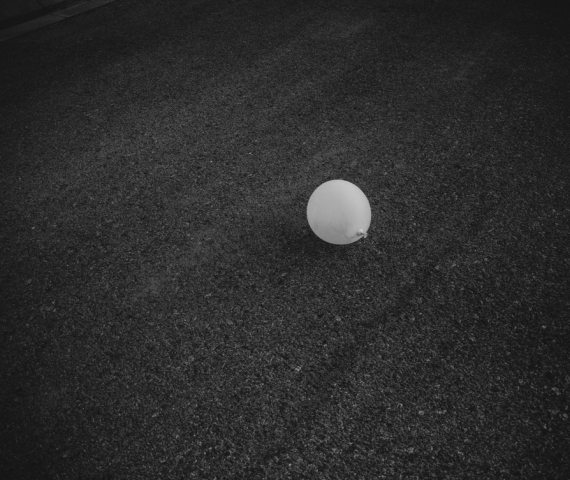
0000000 balloon

this is a death.

this the sound of a Boeing 747 knocking on your frontal cortex.

this is a purging of two-thousand and eighteen years of stop, of start over, let go, go home, be kind, deliver us from evil, love thy neighbor, tip your waiter, right side of the road, left side strong side.

this is a painter taking white #FFFFFF over everything except of course for

you.


this is my open palm telling you it’s okay.


you are okay.


you made a mess of yourself.

dirty laundry hanging from the dull blades of your ceiling fan.

dust lining the windows of your room.


start over.


press gently in reverse into the footprints you’ve left in the snow.


start over.


don’t give up.


give in.


suck in the sun, the sky, the dilapidated cars chugging down nowhere road so quick

and blow it out into a new balloon.


slipknot the string around your open facing wrist

and push off of the ground

into the sky which no one has actually been able yet

to measure.


cropped-ghost-january.jpg

Photo: Laurn Carrasco Morón

midwestern meditation – adrian s. potter

Stephen Radford

Having never been to heaven, I can’t conceive of hell. But when I consider it, I see yellow crops crowding a flat expanse and everything tinged with ochre – even our incendiary expectations. During our road trip, we solve the riddle of boredom by inventorying the silos, smokestacks, and silence that populates the prairie skyline. Everything we say sounds like an echo of something we said earlier. But in your eyes, I witness truth: brown of soil, green of grass, gold of grain, gray of tornadoes. Still, I dream of foreclosed fields and dying cowtowns, and yours the only living soul, a specter in reverse.

cropped-ghost-january.jpg

Adrian S. Potter writes poetry and short fiction. He is the author of the fiction chapbook Survival Notes (Červená Barva Press, 2008) and winner of the 2010 Southern Illinois Writers Guild Poetry Contest. Some publication credits include North American Review, Obsidian and Kansas City Voices. He blogs, sometimes, at http://adrianspotter.com/.

Photo: Stephen Radford

they are under my comforter of stars – promise clutter

redwoods
there will be an October surely,
my love,
suspended in fog
spiced with bark
& trapped beneath a canopy of mules
blocking the heavens from knowing
which way the wind blows
i do not catch in the chill
nothing here brings me to you
i see love in the gold glint on green
in the heat of the day
at night, the dogs hear
my mournful howls
i am not for you
as the redwoods are
i shed my leaves
before the first frost
i think you are the only one
to have ever seen the moon,
my love,
with candied cheek awe
trimming back eyelashes
exposing lakes of arcane calm
it is silent in comptche
we shuffle across dirt paths
i grab our elbows
to make us stargaze
they too are under
these lights
when you shine on them
won’t you send my love?
i grew accustomed to living without you,
my love,
here where the candlewax waves
crash against the stones
& the crow’s caw pierces my heart
my heart that aches for you
cropped-ghost-january.jpg