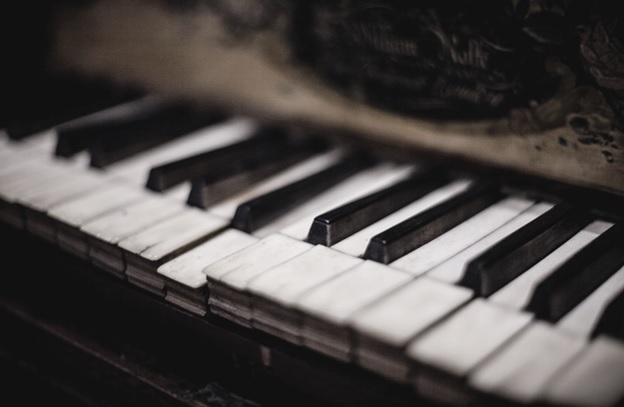
I was criticised by any number of people for what I did to the old piano. When my sculpture was exhibited at the gallery — all dismantled frames and twisted strings and bereft keys — I was criticised. Oh, yes. People at the Opening drew in shocked breaths and waggled their champagne glasses. The word desecration was used; also destructive and obscene. Obscene? I’ll tell you what’s obscene — having to put up with someone who is supposed to have moved on. My sculpture was large and it used most of the innards of the piano in a constructivist-style thing intended to reference a mound or hill. Like a burial mound. I even included an ironic plastic rose on the top, a dirty pink thing, to reference a wreath, but I don’t think the art lovers at the opening got that. They certainly mourned the piano, though.
“What did you have against that poor piano?” a tipsy art-type in an old-fashioned bow-tie asked me. He’d gone for whisky.
“How long have you got?” I replied, and sipped my champagne, leaving lipstick on the glass, blood red, which is ironic also, since the death of the piano was under discussion. In all truth, it wasn’t the piano itself that had earned my ire, but its former owner. I’ll tell you what happened and you can judge for yourself if I was justified in dismantling the thing.
When I moved in with Simon I kept my studio in the inner city. His place wasn’t far away but it was an upscale building, one of those new apartment blocks. They had CCTV cameras everywhere: didn’t want any undesirables, deplorables, muddying the terrazzo floors or shooting up in the shrubbery. You wouldn’t have thought that such a new build, where a year or so earlier there had been only a depthless mud-hole gouged into the land, could harbour any wraiths from the past. But my theory is — and I have reason to know — that the wraiths preserve their longevity by attaching their icy tendrils to objects, and objects can be moved around, as was this blighted piano. Simon told me that it had been a family piano for decades. In fact, it was an old wooden-framed thing, out of date and untuneable. Were you imagining an elegant baby grand with a rosewood cabinet? No, this was an old upright, scratched from many moves, barely playable. It had candle sconces screwed to its front. Candles! How long ago did people play the piano by candlelight? The dark ages?
I shouldn’t make flippant remarks about the dark. That piano and I were to share some sombre times. Simon and I had been together for about a year when I moved in with him. I was sure he was my soul-mate. I still am, and if he ever forgives me — or, as I prefer to think of it, understands me — I think we could be happy. If you notice an edge to my voice while I’m telling what happened, it’s because of Simon. When he found the piano gone, and I told him what I’d done with it, he went into a funk. He refused to come to the Opening at the gallery and so he hasn’t seen what a far, far better thing it has become. Those critics who could stomach the dismemberment have been raving about it. My agent is fielding offers. I have hopes that it’ll go to Abu Dhabi.
Simon goes away on business trips often, mostly to the US, for a week or two at a time. He packs a couple of his sharp suits into a folding suit bag and jets off to do whatever international-finance-types do. As for me, I’m a night owl and often come home late from my studio to the empty terrazzo-floored lobby of the apartment block. I rarely run across anyone from the other apartments. It’s an echoey lobby; there’s not much in it except a couple of Eames-replica chairs that I’ve never seen anyone sit on. There are security cameras with red cyclonic eyes staring down from the corners of the ceiling.
The old piano was an incongruous piece of furniture in Simon’s place, interior-decoration-wise, so naturally I asked him about it.
“It was Eliza’s,” he said, as if admitting something he’d rather I didn’t know.
Eliza was his ex. They hadn’t been married, exactly, unless you count that hybrid Buddhist-Hindu-hippy ceremony they went through in Kathmandu. Then Eliza was lost on the trail while they were hiking to Tengboche. Lost, as in never found. Almost certainly she went over the edge of a ravine into the Dudh Kosi and her body swept away downstream, though it was never recovered. Simon spent a long time hoping. That whole incident was years ago. He’d had two or three girlfriends between Eliza and me. But still he’d dragged the piano on at least two moves that I knew of. It sat against the wall of the living room, looking across at the Léger print on the opposite wall. It seemed to me to be constantly watching us as we lounged in front of the TV, or drank cocktails on the balcony, or slow-danced on the rug, listening to jazz. It appeared to me to disapprove of jazz.
Simon told me, when I pressed him, that the piano had first belonged to Eliza’s great-aunt, a spinster who’d lived in Melbourne and had gone to India as a missionary. Apparently she was revered in Eliza’s family. That was in the days when proselytizing was applauded. The great-aunt was musical. She played not only the piano but also the violin. That was all that Simon knew about this ephemeral person from the past, the musical missionary, Eliza’s relative. The piano was then bequeathed though Eliza’s relations — aunt, cousin, father — until, as each of them died, it eventually settled on her. She played, quite well. I’ve heard her. She favours eerie things, like Messiaen — at least that’s what I thought it was when I heard her. Yes, I’ve heard that piano play on many nights when I was alone in the apartment. Did I mention that we were on the thirty-fifth floor? An aerie. It was as if angels were malevolently plucking harp strings where they had no right.
All of this sounds fanciful, I know, and to start with I thought so too. The first time I heard the playing it was about 2 AM. I got up and marched out of the bedroom switching on all the lights. But the notes merely faded at my approach and so I assumed that I was imagining the whole thing. But the playing in the wee hours went on, only when Simon wasn’t there, of course. Obviously it was meant for me alone. I was targeted. I took to leaving all the lamps on in the living room but it made no difference. The music still woke me — and the lamps went out.
Naturally I told Simon what was going on. I tried to convince him to get rid of the piano, maybe pass it on to another of Eliza’s relatives. He actually said that he wanted to keep it in case Eliza came back! She has come back, I said grimly. Then he went all solicitous on me. He said I was just having some residual delusions. I wasn’t long out of rehab. When I met Simon I was doing far too much junk for my own good, and it was he, bless him, who’d got me into a program. Now I was clean, off the stuff, and my work was blossoming. I owe Simon so much. He’s the love of my life.
The night-time playing continued sporadically, always when I was alone in the apartment.
“Get rid of it, please!” I was begging him now.
“Sweetheart, it’s in your head. I can’t let it go. It’s my only reminder of Eliza.”
“Can’t you just keep her photo or something?” He laughed.
“Sure, but what if she comes back and I don’t have her piano? It was her most precious possession.”
That was the second time he’d said that about her coming back. If she came back, where would that leave me? This point didn’t seem to concern him as he stared across the room at the piano, and I saw in his gaze some past in which I had no part. My first impulse was to remind him that Eliza was pretty certainly dead, and so not coming back for her piano, but I stopped. Of course she was back, as I’d told him the first time we had this conversation. I couldn’t get through to him.
The playing went on. It was creeping me out. One night I changed tactics and tried spying unseen on the piano. I put my eye up to the gap in the bedroom door, which I’d left ajar. But when I looked the playing stopped abruptly. I thought I saw something slip out the front door. I definitely heard a click as the door closed. This wraith came in the front door? It didn’t happen like that in stories.
After the next night of ghostly playing, I went down to the security booth in the basement carpark. I knew the guys there; I often spoke to them when I parked my VW Beetle — they liked my car. I asked if we could take a look at the CCTV footage of the lobby from the night before. I told them I thought I’d heard noises around 2 AM, which was true. We had to go backwards and forwards a bit, but we found it. It was eerie to watch: a long stretch of silent emptiness, the cameras watching creepily, pointed at the lobby doors, the lift, the fire stairs. Twice, figures of other residents crossed the floor, silent footsteps, silent arrival of the lift, silent opening and closing of the lift doors. Then, finally, a figure emerged just as silently from the fire stairs door. The guys were amazed — “that thing’s alarmed,” they said. But no alarm sounded, there was just the CCTV silent soundtrack. The figure was frustratingly indistinct. I was sure it was female, but the security boys argued about that for a while.
“It’s wearing a cap.”
“That’s a skirt, for sure.”
“Or trousers — can’t tell. It’s not clear enough.”
The footage had been clear enough earlier to recognise the legitimate residents. We stopped and started it but we couldn’t get a better picture. The figure disappeared as silently as it had come. We didn’t see the lift arrive, but we could see the illuminated floor numbers marking its ascent from the lobby, then stopping at Level 35.
After that I dismantled the piano. I took out its guts and moved strings, hammers, felts surreptitiously to my car bit by bit. I prised off all its keys with pliers and took them away, keeping the lid on my work so Simon wouldn’t notice what was going on. It took a while, I can tell you. Of course the playing had to stop then. I thought about leaving the empty thing there, just a carcass with its ridiculous candle sconces. But two things changed my mind. The first was the imperative of the work — as I brought these infused and laden objects together in my studio I saw that they needed more bulk, the bulk of the piano cabinet, the wood, the structure. And more detail: the pedal, the hinges, and those sconces. The second thing that prompted me to completely dismantle the piano was the final occurrence of that eerie Messiaen, playing in the silence of 2 AM, despite the keys and strings being entwined in my studio two suburbs away.
At the Opening, an art agent came over and asked me about the piece. He was wearing a dishdasha and a keffiyeh. I smiled winningly.
“What is the piece entitled?” he asked.
“I call it ’Silence.’”
“And what is that strange smell it emits?”

Annette Freeman is a writer living in Sydney, Australia. She was born and raised in Tasmania, which she suspects is reflected in her writing in ways too mysterious to analyse. She has a Masters of Creative Writing from the University of Sydney, the support of a terrific writing group, and boundless respect for a fine sentence.



 south broadway press