

BOOK REVIEW:
SPIRIT IN THE DARK
BY GARY COPELAND LILLEY
A BOOK REVIEW BY SHELLI ROTTSCHAFER
Poet Gary Copeland Lilley has written several collections including Raven on Moaner’s Bench (Four Way Books, 2025), The Hog Killing (Blue Horse Press, 2018), The Bushman’s Medicine Show (Lost Horse Press, 2017) , Alpha Zulu (Ausable Press, 2008), Black Poem (Hollyridge Press, 2005), The Reprehensibles (Fractal Edge Press, 2004), and The Subsequent Blues (Four Way Books, 2004).
Spirit in the Dark: Poems is his forthcoming chapbook that weaves his blues guitar rhythms, his North Carolina rearing, and his Pacific Northwest home. Gary has had a storied life, once serving in the US Navy Submarine Force he now battles memories with his pen. As a poet, his language is melody which he hopes resonates through his readers’ ears, and transforms into body swaying, and feet tapping. He lives in Port Townsend, Washington with his partner and fellow poet, Tess Gallagher. He is the Artistic Director of the Port Townsend Writer’s Conference and teaches as Poetry Faculty through Western Colorado University’s low-residency MFA in Creative Writing.
Spirit in the Dark (2026) haunts it’s reader through a common arch, poems titled <<Spirit in the Dark #1-5>> which are in conversation with each other and dispersed throughout the collection.
“Spirit in the Dark #1” introduces Lilley’s reader to the lies told by the “mercy-spirit,” but the inescapable truth is that we all come to die (2). The only promise given by the “dark song” is that we all struggle to decipher what our walks in life will reveal. We all wish we had the ability to foretell, to sing and say the necessary things in the exact moment they would lend clarity. But, often those words only come in afterthought.
In “The Daze We Rolled Our Own Cigarettes” (3) Lilley speaks of the moments in life where there are glimpses of contented perfection. The vulnerability of a dog exposing her belly for scratches, the first cup of black coffee, and a good song rendered from a 12-string guitar. These are the things that ground us, these are the things that call us back from “the cross of two roads,” the one chosen, the one discarded.
“Spirit in the Dark #2” (7) narrates another tongue-tied moment when the poet recalls, “What I wish I’d said to everybody” but instead who’s words are elusive, just like the slipping away of a “low horizon.” What the poet knows is, “that marriage & / blood are stronger than death” where this eternal connection still lives on in “all of us / revolutionaries dead or alive, all us sinners, saints, siblings.” These ties bleed through Lilley’s creative community and transform into eulogized verse.
“Wolf Moon” is a stream-of-consciousness poem detailing a night-ride road trip (8). Sitting shot-gun is the devil, poking the poet with “argument-weary” thoughts in these “small hours of morning.” The darkness pulls the earth taunt as he drives toward, “the Great Dismal.” What saves him from this inner-dark-spiral is the gospel that blares from his radio and the “half-moon” light that catches his attention. Are these the “God-touched” moments we wait for in order to continue on that sweet desolate road? Or are we all due to end in the great swamp of our self-doubting minds?

“Spirit in the Dark #3” is a eulogy to Mama Daisy. This matriarch is remembered at every family gathering whether reunion, holiday, or wake – “there is an absence” without her presence. Memory “captures & re-captures” it is not the “remainders, the living” but rather the “missing part” that provides the “clear-eyed, sharper view” knowing we can do this life alone or together, but together is better (15).
Throughout this third section of Lilley’s collection he remembers particular folks in his life. His past selves reappear in ars poetica poems that peel back the layers of what he has learned (17). His brother-man, Daniel Anderson, who paratrooped into various unacknowledged wars in “anywhere-South-America” only to survive and not tell what had happened (18). And, “the old-man-janitor” who “doesn’t have any luck left” understands that sometimes, “what life offers you [is that] there’s nothing left but to swallow the spit” (19). These characters that re-visit Lilley through his poetry demonstrate the breadth of experiences and the spirits that has met.
“Spirit in the Dark #4” is the hope that exposes herself in jazz, gospel, and poetry. These revelations of clarity bend the poet, knee to sacred ground, in prayer with the understanding that, “in all [these] things [he is] saved.” Music and words are redemptive, and for these things, “in the end” he understands who he really is (26).
“Spirit in the Dark #5” recalls the underlayers of life for those who live upon the fine line of have-vs-have-not. We all have choices, some are fine, some are bad, some are worse. Lilley wonders upon the page as he observes “Mike,” who’s polemic choices have driven destructive decisions: Is it better to hustle so that a mother doesn’t have to sell her body for her children’s next meal? Is it better to bring a gun to a machete fight? Is it better to stand and take the swings, or run from the threats? Is it better to play nice or accept what comes your way, “when you ask for it” (29).
Gary Copeland Lilley’s final poem in the collection is “Miles, in a poem: Ars Poetica” (31). Lilley is a Miles Davis as opposed to a John Coltrane admirer. Like Miles he believes, “that notes you don’t play are just as important as the ones you” do play. Those silent pauses, the liminality, “resonates into that void.” Davis as to horn-note, Lilley as to word-poem; “the greater amount of open space… [the] more deliberate.”
Spirit in the Dark conjures the wisdom of his matriarchal family, the secrets of Carolina swamps, the knowledge learned over a lifetime. His verse-melodies hum these stories from strumming guitar, wheel-worn roads, and scratches of pen.

SPIRIT IN THE DARK
BY GARY COPELAND LILLEY
AVAILABLE THROUGH FINISHING LINE PRESS
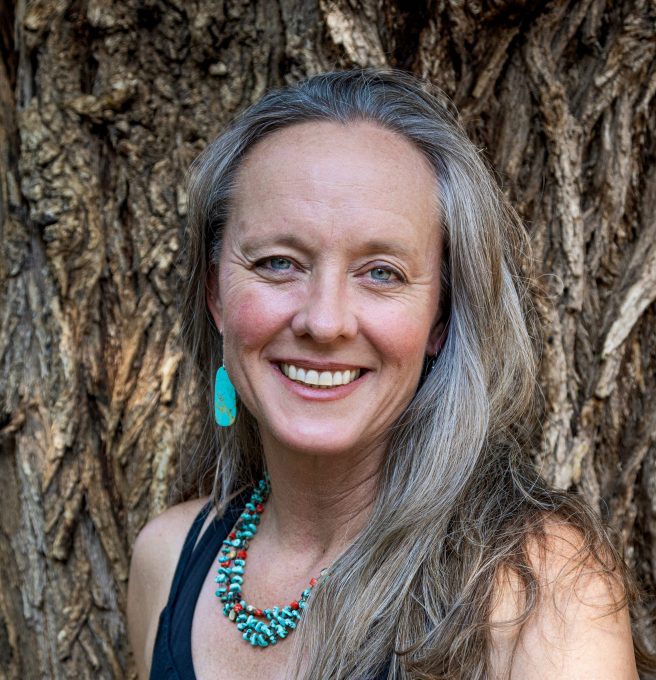
Shelli Rottschafer (she / her / ella) completed her doctorate from the University of New Mexico, Albuquerque (2005) in Latin American Contemporary Literature. From 2006 until 2023 Rottschafer taught at a small liberal arts college in Grand Rapids, Michigan as a Professor of Spanish. She also holds an MFA in Creative Writing with a concentration in Poetry and coursework in Nature Writing from Western Colorado University (2025).
Shelli’s home state is Michigan, yet her wanderlust turns her gaze toward her new querencia within the Mountain West where she lives, loves, and writes in Louisville, Colorado and El Prado, Nuevo México with her partner, photographer Daniel Combs and their Pyrenees-Border Collie Rescue.
Discover more of Shelli’s work at: www.shellirottschaferauthor.com

 south broadway press